Grease Creek was impaired for 16 years before Virginia finally had enough evidence to remove it from the list. The Buckingham County creek was first flagged in 2008 because of elevated E. coli readings. Its latest assessment tells a different story, with the 10.74-mile recreational segment meeting state water-quality criteria.That change did not come from one dramatic cleanup along the creek. It followed years of work across the surrounding watershed, where runoff and other pollution sources can reach streams. Virginia's Department of Environmental Quality now lists Grease Creek among its water-quality success stories for 2026.What put Grease Creek on Virginia's impaired list?Virginia first listed Grease Creek during its 2008 water-quality assessment cycle. DEQ records show an E. coli exceedance rate of two violations among nine samples collected at monitoring station 2-GRD001.62. The impairment covered recreation use along a 10.74-mile section of the creek.E. coli is commonly used as an indicator of fecal contamination in recreational waters. The bacteria themselves can come from humans and other warm-blooded animals. High readings can signal conditions where other disease-causing organisms may also be present, which explains the concern for people entering the water.The creek was also nested within the Slate River bacterial TMDL. EPA approved that Total Maximum Daily Load in September 2007, shortly before Grease Creek appeared on the impaired list. A TMDL essentially sets a pollution limit needed for a waterway to meet its water-quality standards.Why did the recovery take so long?The restoration story stretches beyond the creek itself. Much of the work focused on reducing nonpoint-source pollution, which can reach waterways through runoff from farms, residential areas and other land surfaces.Virginia's earlier nonpoint-source records describe agricultural and residential best management practices in the Slate River and Rock Island Creek watersheds. Those efforts included livestock exclusion fencing and other measures designed to reduce pollution reaching streams.One documented implementation effort began in 2011 through a partnership involving Virginia agencies, the Peter Francisco Soil and Water Conservation District and other stakeholders. Records show 31 systems were installed, including 79,457 linear feet of livestock exclusion fencing, while 47 acres of erodible cover crop were reforested.Those numbers help explain why the recovery cannot be pinned to one construction project. Watershed restoration is often a collection of smaller changes spread across private land and stream corridors. Their combined effect can take years to appear clearly in water-quality monitoring.What did the latest monitoring show?Grease Creek did not improve in a perfectly straight line. During the 2020 assessment cycle, DEQ still recorded two exceedances among 12 samples at the monitoring station. That meant the creek remained impaired despite years of restoration work.The 2024 assessment produced the evidence regulators needed for a different decision. DEQ found that Grease Creek met both applicable E. coli criteria for its recreational use. The agency therefore delisted the 10.74-mile segment for that impairment.That distinction matters because the decision was based on monitoring data rather than appearance. A creek can look clear while still carrying bacterial contamination. Water-quality assessments provide the measurements needed to determine whether a designated use is actually being protected.What does delisting mean for people?The simplest answer is that the creek no longer meets the regulatory definition of impaired for that particular recreational E. coli problem. It does not mean every possible environmental concern has disappeared from the watershed.DEQ describes water-quality assessment as an ongoing process. Future monitoring can identify new problems or show that conditions have changed, especially because rainfall, land use and runoff can affect bacterial levels.For residents, that makes the Grease Creek story more useful than a simple restoration headline. It shows why water-quality decisions depend on repeated measurements over time. One good sample cannot erase years of contamination, just as one bad sample cannot necessarily define an entire watershed.Grease Creek is a small Virginia stream, but the problem it faced is familiar across the United States. Thousands of creeks and tributaries carry runoff toward larger rivers, reservoirs and coastal waters. Their condition can influence recreation, wildlife and the quality of downstream water.The restoration also illustrates why local conservation programs matter. Large environmental projects often receive attention because they are visible and expensive. Smaller watershed measures can be less noticeable, even when they address pollution much closer to its source.Virginia DEQ says its documented success stories depend on cooperation among agencies, permitted entities and other stakeholders. The agency also notes that each watershed requires an approach suited to its own conditions.What happens to Grease Creek now?The most important task is maintaining the improvement that produced the 2024 result. Delisting removes the documented impairment, but it does not make the watershed permanently immune to pollution.Continued monitoring will remain important as conditions change across Buckingham County. The goal is not simply to remove a creek from a regulatory list, but to keep the water quality strong enough that it does not return.Grease Creek's 16-year record offers a quiet lesson about environmental recovery. Sometimes restoration is not a dramatic transformation that people notice immediately. It is years of practical work followed by a set of measurements showing that the water finally changed.
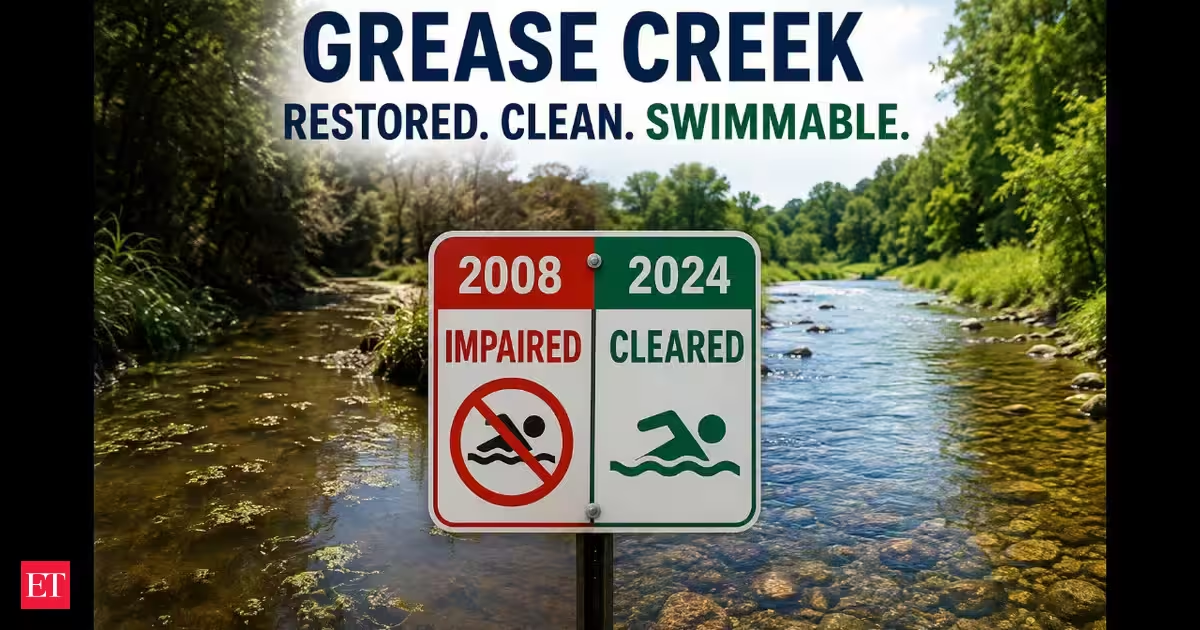
In 2008, Virginia listed Grease Creek as impaired for swimming. 16 years later, DEQ cleared it from the impaired list after watershed BMPs restored water quality in 2024
Grease Creek in Virginia has finally escaped a problem that followed it for 16 years. The creek was listed as impaired for swimming in 2008 after tests found elevated E. coli levels. Now, Virginias latest water-quality assessment shows a different picture. Watershed best management practices helped reduce pollution, allowing the 10.74-mile creek to meet recreational water standards and leave the impaired-waters list.
840 words~4 min read