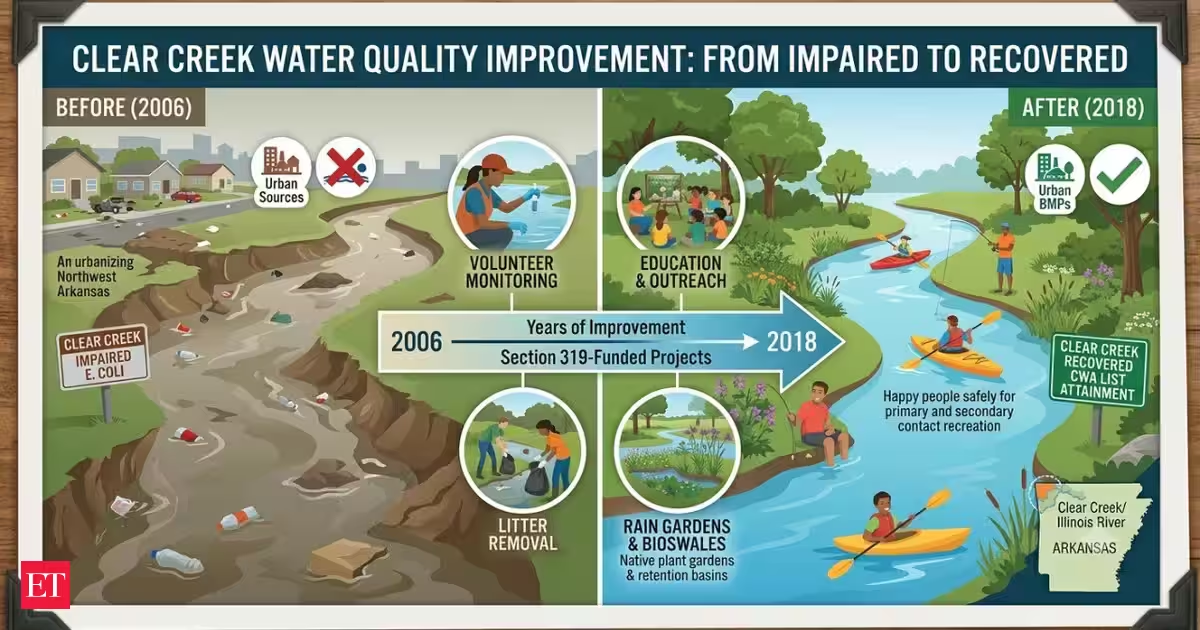
In 2006, the Arkansas Department of Energy and Environment's Division of Environmental Quality listed 13.5 miles of Clear Creek as impaired after E. coli levels exceeded the state's criterion for primary and secondary contact recreation. Twelve years later, Clear Creek showed attainment of the E. coli criterion and supported primary and secondary contact beneficial uses for the first time since the impairment listing, according to Arkansas' EPA-approved 2018 Clean Water Act Section 303(d) list.The improvement followed years of water quality monitoring, education and outreach, along with green stormwater infrastructure and other urban best management practices across the watershed.An urban watershed facing pollution challengesClear Creek begins in the urbanized area of southeast Springdale and northeast Fayetteville, flows through Lake Fayetteville and continues nearly 12 miles west to the Illinois River.The watershed includes residential neighborhoods, commercial developments, rural areas and agricultural lands. E. coli was the main reason for the 2006 impairment listing, with urban sources identified as the cause.Nutrients, sediment, trash and eroding streambanks were also affecting the waterbody.You Might Also Like:In 2008, volunteers working with the Illinois River Watershed Partnership found a positive correlation between increased urban area and higher nitrogen, phosphorus and sediment levels in Clear Creek.Projects targeted urban pollutionSection 319-funded projects began shifting attention toward urban sources of pollution in 2008.From 2008 to 2009, the Illinois River Watershed Partnership oversaw volunteer water quality monitoring at 37 sites. Samples were analysed for nitrogen, phosphorus, total suspended solids and other water quality measurements.In 2009, the University of Arkansas Cooperative Extension Service began an educational project that included 61 outreach events, 17 creek clean-ups, 15 riparian buffer demonstration sites, rain barrel workshops and presentations on nonpoint source pollution.You Might Also Like:Between 2011 and 2014, the Illinois River Watershed Partnership installed 31 rain gardens with the help of volunteers and local partners. The gardens included 7,426 native plants and were designed to slow stormwater in urban areas while also serving as outdoor classrooms.Additional work included bioswales, community events and litter clean-ups.Stormwater retention improvedBy 2014, after many rain gardens and bioswales had been implemented, the Illinois River Watershed Partnership and Beaver Water District found a 99% retention rate, compared with an initial projection of 82%.The reduced stormwater volume correlated with reduced nonpoint source pollutants, including bacteria, nitrogen and sediment, in the Clear Creek watershed.Beginning in 2015, the Illinois River Watershed Partnership and local partners installed eight rain gardens and four bioswales and created mitigation for more than seven acres of impervious area across the watershed.The work also included litter events that removed an estimated three tons of litter and rain barrel workshops attended by 78 stakeholders.E. coli levels improvedThe Arkansas Water Resources Center sampled five sites along Clear Creek between 2012 and 2014.In 2012, two sites had primary-contact E. coli exceedances in 12.5% of their samples. By 2013 and 2014, both sites had dropped to 0% exceedance.Clear Creek later showed attainment of the E. coli criterion in Arkansas' 2018 Clean Water Act Section 303(d) list and supported primary and secondary contact beneficial uses for the first time since being listed as impaired in 2006.Since 2008, more than 4,000 volunteers from Northwest Arkansas have helped install rain gardens and bioswales and participated in clean-up events and other activities.The urban best management practices have decreased the amount of sediment, phosphorus, nitrogen and other nonpoint source pollution entering the watershed, while education events continue to promote stewardship of Clear Creek.
In 2006, Arkansas DEQ listed Clear Creek for E. coli. 12 years later, the creek attained the recreation standard in 2018, restoring contact recreation after BMP projects
Clear Creek Arkansas water quality improvement: Learn how Clear Creek in Arkansas overcame E. coli contamination through dedicated community efforts, green infrastructure, and successful water quality management, leading to improved recreational standards by 2018.
564 words~3 min read