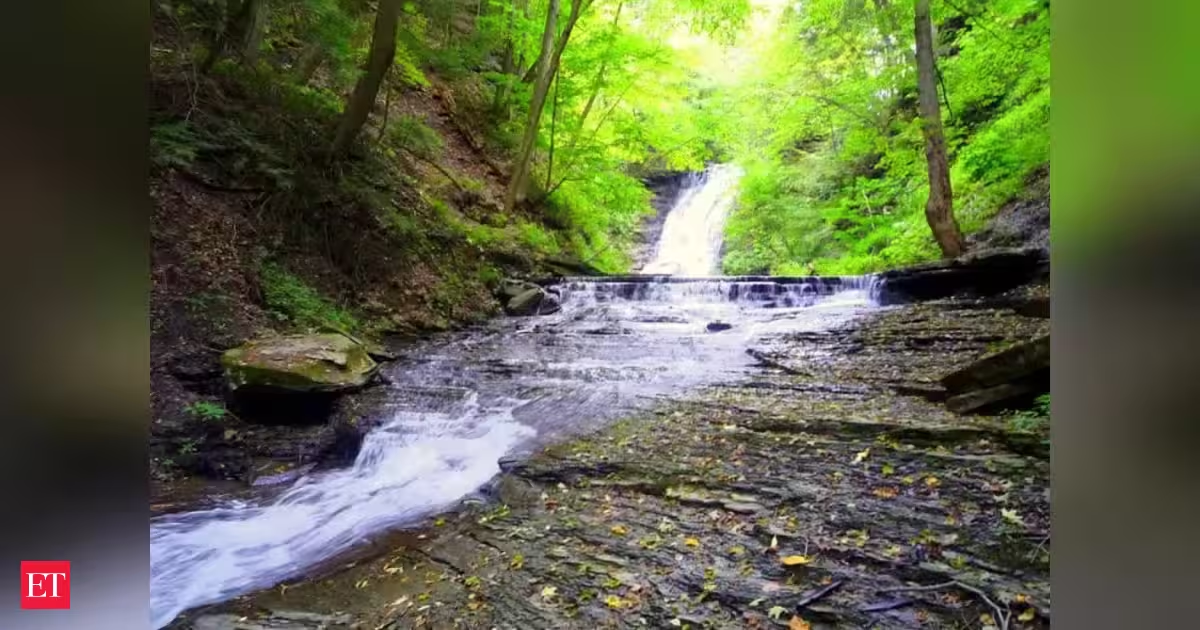
In 1996, New York identified the upper portion of Tonawanda Creek as a priority waterbody because nutrients and sediment from agricultural activities and other nonpoint sources were affecting its use as a water supply.The New York State Department of Environmental Conservation added the affected section to the state's Priority Waterbodies List that year and later placed it on the Clean Water Act Section 303(d) list of impaired waters in 2004 because of silt and sediment.In 2012, NYSDEC removed the Upper Tonawanda Creek and Minor Tributaries assessment unit from the impaired waters list based on water-quality and biomonitoring data collected in the watershed.A major watershed in western New YorkTonawanda Creek is a 101-mile-long tributary of the Niagara River and drains approximately 631.9 square miles, making its watershed one of the largest in western New York.The watershed covers portions of Wyoming, Genesee, Niagara and Erie counties, as well as the Tonawanda native reservation area.You Might Also Like:Agriculture is the largest land use in the watershed, accounting for 45%, followed by forest at 27%, urban and residential areas at 17%, and wetlands at 11%, as per an EPA report.The creek flows through the former lake bed of prehistoric Glacial Lake Tonawanda, and many of the wetlands in the watershed are remnants of that earlier time.Sediment levels exceeded state standardsThe Upper Tonawanda Creek and Minor Tributaries assessment unit includes approximately 255 stream miles upstream of the city of Batavia.The section was added to the impaired waters list for failing to support its water-supply use because of elevated levels of silt and sediment.You Might Also Like:New York's water-quality standards require total dissolved solids levels to remain below 500 milligrams per litre. Total dissolved solids were used as a surrogate for silt and sediment.Monitoring data collected in 1993 and 1994 showed that TDS levels in the upper portion of Tonawanda Creek regularly exceeded the state standard, reaching maximum values of approximately 800 milligrams per litre. Agriculture and streambank erosion were identified as the major sources of the silt and sediment.Farmers worked to reduce nutrient and sediment lossesWyoming and Genesee counties identified the Tonawanda Creek watershed as a high priority through their County Water Quality Strategies.The counties later developed Agricultural Environmental Management Strategic Plans that identified agricultural nonpoint-source concerns and prioritised the best management practices needed to address them.You Might Also Like:In 2001, the Tonawanda Creek Watershed Agricultural BMP Implementation Project was launched. During the first phase, detailed assessments were completed on 68 farms to inventory farming activities and potential environmental concerns, assess and prioritise areas of concern, and develop conservation plans.Project partners then began implementing agricultural best management practices across the watershed.Since 2006, New York Environmental Protection Fund grants have supported conservation practices on 12 farms in the upper portion of the watershed. These practices included conservation tillage, cover cropping, pasture and grazing management, fencing, livestock water supplies, filter strips, barnyard management systems, silage leachate management systems, and waste storage and transfer systems.Water quality improvedThe work by the Wyoming County and Genesee County Soil and Water Conservation Districts helped reduce soil erosion, sedimentation and nutrient losses from farms.Water-quality sampling conducted in 2006 showed average TDS values of approximately 270 milligrams per litre, with a maximum value of 302 milligrams per litre. Both measurements were below the state's 500-milligrams-per-litre standard.Additional biomonitoring continued in 2010 to track water-quality improvements in the watershed.Efforts to protect the creek continuedThe Tonawanda Creek watershed remained a high priority in updated water-quality strategies and Agricultural Environmental Management Strategic Plans and could be considered for future funding through the Environmental Protection Fund and other New York State grant programmes.The two phases of the Tonawanda Creek Watershed Agricultural BMP Implementation Project received $943,029 in Agricultural Nonpoint Source Implementation Program funding through the New York Environmental Protection Fund. Landowners and sponsors contributed an additional $704,295 toward agricultural projects in the watershed.In 2010, the Tonawanda Creek Watershed Committee was formed to continue efforts to protect, conserve and restore the creek and its watershed.The committee is a multi-county alliance involving Wyoming, Genesee, Erie and Niagara counties, along with state, local and tribal officials and interested citizens.
In 1996, New York flagged Upper Tonawanda Creek as a water-supply concern. 16 years later, NYSDEC removed it from the impaired list after farm BMPs improved water quality
Explore how the implementation of best management practices (BMPs) by farmers led to the improvement of water quality in Upper Tonawanda Creek, which was flagged as a water-supply concern in 1996 and removed from the impaired list in 2012.
678 words~3 min read