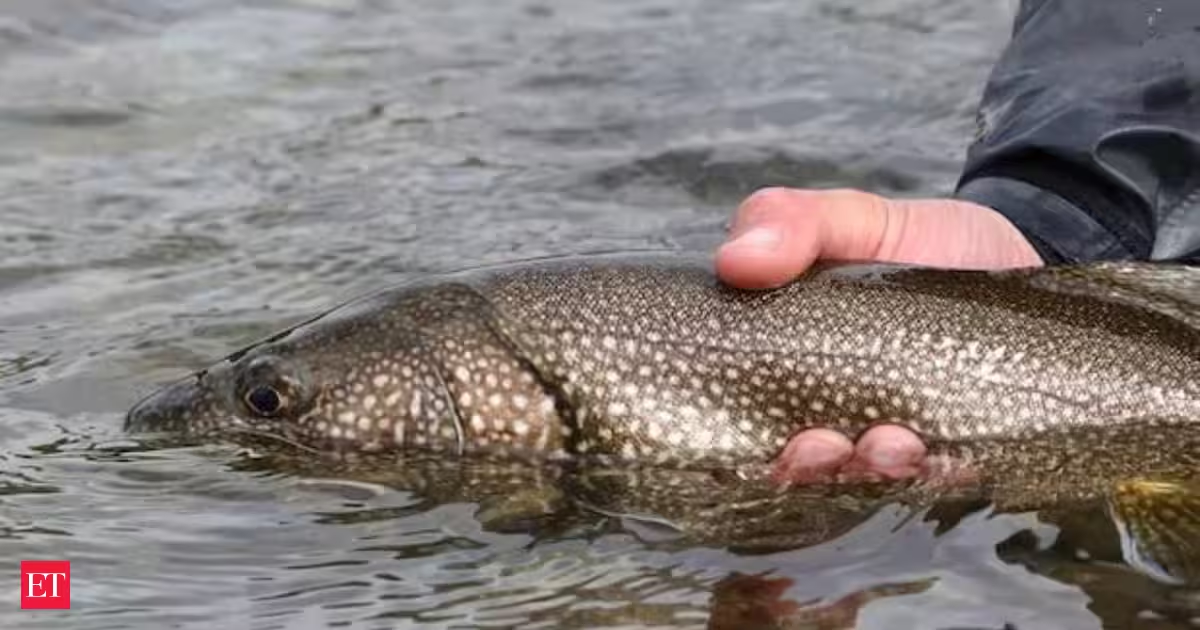
A pesticide banned more than 50 years ago once made eating fish from Keuka Lake a health concern. DDT had largely disappeared from farm use, but its residues remained in soil around the watershed. Heavy rain could move that soil toward streams and eventually into the lake. That made erosion an important part of a pollution problem that seemed to belong to another era.Keuka Lake sits in New York’s Finger Lakes region and supports fishing, tourism and drinking water needs. The lake covers about 11,800 acres and reaches roughly 185 feet at its deepest point. Its surrounding watershed spans about 100,000 acres, including forests, farms and vineyards. For people living and working around the lake, water quality is tied closely to what happens on the land.The lake was placed on New York’s Clean Water Act Section 303(d) list in 1998. The listing reflected an impairment of fish consumption linked to DDT contamination. New York had already issued a restrictive fish consumption advisory in 1983. The eventual improvement came from years of controlling how old contamination moved through the watershed.Why did DDT remain a problem after the ban?DDT was widely used to control agricultural pests before New York banned it in 1972. The chemical is persistent, meaning it can remain in environmental systems long after its original use ends. It also binds strongly to soil particles, giving erosion a direct role in transporting residues. That connection helped shape the restoration strategy at Keuka Lake.The issue was not simply that DDT existed somewhere in the watershed. The concern was whether contaminated material could continue reaching the lake. Once in aquatic ecosystems, DDT can accumulate through the food web and eventually appear in fish tissue. That helps explain why an old pesticide could remain relevant to anglers decades after its use ended.How did farmers help change the pollution pathway?From 2003 through 2014, conservation practices were implemented on more than 60 farms and 20 vineyards around Keuka Lake. The work focused on two major pathways for DDT and other pesticides. One was sediment movement, while the other involved pesticide use and off-site drift.Vineyards received diversion ditches, hay mulch and cover crops between rows. More than 220 acres received cover crops, while more than 600 acres received critical planting to stabilize erosion-prone areas. Other projects included grassed waterways, sediment-control basins and vegetated streamside buffers. These measures helped keep soil in place instead of allowing runoff to carry it toward the lake.The programs also changed how pesticides were applied. Integrated pest management practices covered roughly 300 acres between 2007 and 2014. New spraying equipment was purchased for use on more than 40 farms. Better spray placement helped farmers target crops more precisely while reducing unnecessary pesticide movement.What happened to the fish?New York health officials reassessed the fish consumption advisory in 2013. They examined lake trout tissue collected in 2000, 2003, 2007 and 2011. Testing from brown trout, largemouth bass, smallmouth bass and yellow perch also contributed to the assessment. The lake trout results showed much lower total DDT concentrations than those recorded in 1983.That decline changed what people could do with their catch. New York relaxed the restrictive advisory, allowing all population groups to eat up to four meals per month of Keuka Lake fish. NYSDEC then determined that fish consumption was no longer an impaired use. The lake was removed from the federal Section 303(d) list in 2014.That decision did not mean contamination concerns disappeared forever. Fish advisories can change as monitoring produces new information about contaminants and species. New York continues to publish fish consumption guidance for Keuka Lake and other waters across the state.Why does the Keuka Lake cleanup matter beyond New York?The restoration offers a useful lesson for other American watersheds with agricultural land and legacy chemicals. Pollution does not always move directly from a visible discharge into a river or lake. Sometimes it travels attached to ordinary soil, carried by rain from fields and slopes. Controlling erosion can therefore address both sediment pollution and the contaminants riding with it.The project also shows why environmental restoration can take years to become visible. DDT use ended in New York in 1972, yet fish consumption remained restricted for decades afterward. Conservation work beginning in the early 2000s added another layer to that long recovery. Approximately $800,000 from New York’s Environmental Protection Fund supported nonpoint-source pollution control projects in the Keuka Lake watershed.The work involved Cornell University’s Geneva Experiment Station, the Finger Lakes Grape Program and local soil and water conservation districts. Their efforts connected farming practices with a problem that was ultimately measured in fish. That is perhaps the most revealing part of the Keuka Lake story. A healthier fishery did not come from one dramatic cleanup, but from changing how water and soil moved across the landscape.Old pollutants can remain buried in places where nobody is actively using them anymore. If rainfall keeps moving contaminated soil, those chemicals can still find their way into waterways. Keuka Lake shows how stopping that movement can become a practical path toward restoring a lake and giving anglers more freedom at the dinner table.
In 1998, New York listed Keuka Lake as impaired after DDT contamination. 16 years later, fish-tissue data led officials to remove the lake from the impaired waters list
Keuka Lake DDT cleanup shows how a pesticide banned decades ago kept affecting fish through contaminated soil and runoff. The problem began long before todays conservation efforts. DDT settled into farmland and could travel with eroding soil toward the lake. New York farmers later adopted erosion controls, cover crops and better pesticide practices. Fish testing eventually showed much lower DDT levels. That helped restore safer fish consumption at Keuka Lake.
847 words~4 min read