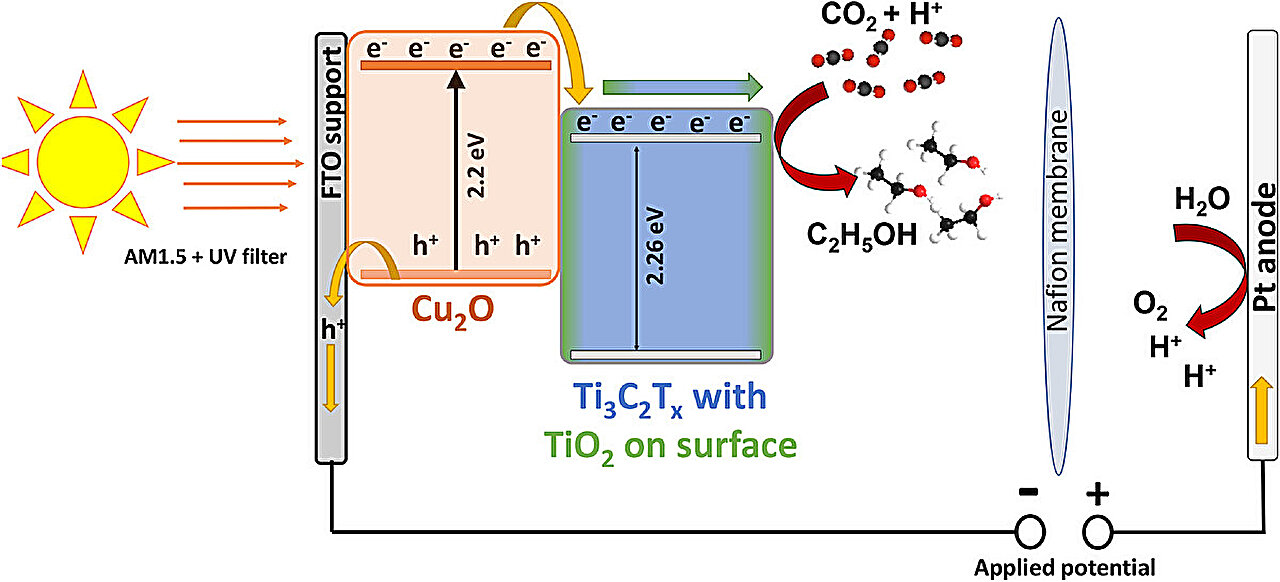
Schematic illustration of the proposed band alignment and charge-transfer pathways in the FTO/Cu2O/TiO2-MXene photocathode for PEC CO2-to-ethanol conversion. Credit: Advanced Energy Materials (2026). DOI: 10.1002/aenm.71469
Czech researchers at Charles University in Prague, led by Pavla Eliášová, have developed an advanced photocathode that helps convert the greenhouse gas carbon dioxide into pure ethanol using sunlight. The new technology solves a long-standing problem of material degradation in water, achieves record conversion efficiency and opens the way toward sustainable production of green fuels. The paper is published in the journal Advanced Energy Materials.
Converting carbon dioxide (CO2) into useful fuels using solar energy represents the holy grail of modern green chemistry. The device enabling this conversion is called a solar reactor. Its key element is a photocathode: a material that absorbs light and enables the chemical reaction. Cuprous oxide has long appeared to be an ideal material because it is inexpensive, readily available and excels at capturing sunlight. In practice, however, it faced a fundamental obstacle: In an aqueous environment under light, it transforms and degrades extremely rapidly—much like iron undergoing swift corrosion—and loses its functionality within tens of minutes.