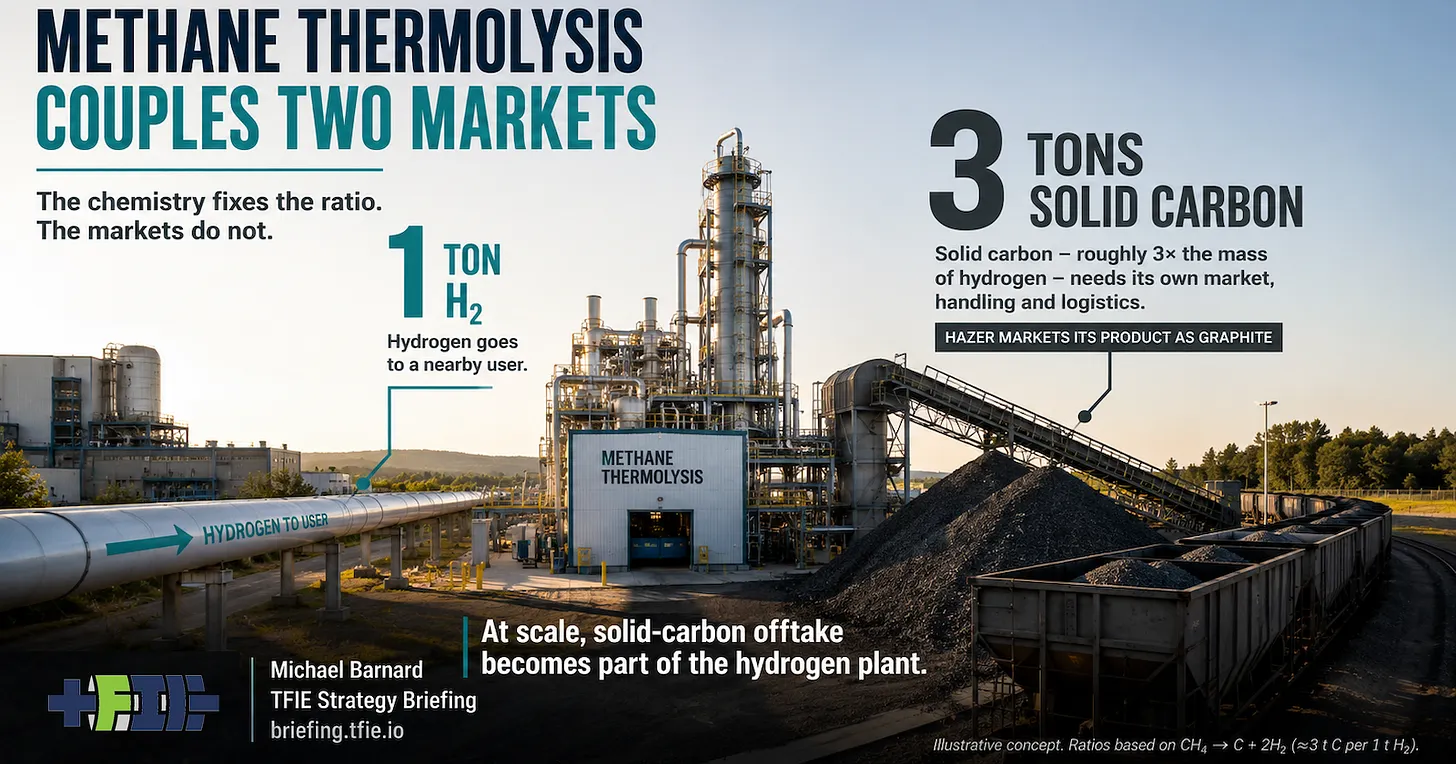
Even the strongest apparent dual-product customer cannot absorb the mass balance: a large hydrogen-DRI steelworks could still leave roughly 80–90% of thermolysis graphite needing other markets.
Methane thermolysis has one of the cleaner propositions in the hydrogen space. The process is also commonly called methane pyrolysis, but I prefer thermolysis. An engineer and founder working in the field pointed out to me that the useful distinction is straightforward: it is heat, not flames, doing the work. Methane is being thermally split rather than combusted. The result is hydrogen and solid carbon instead of hydrogen plus a concentrated process stream of CO₂.
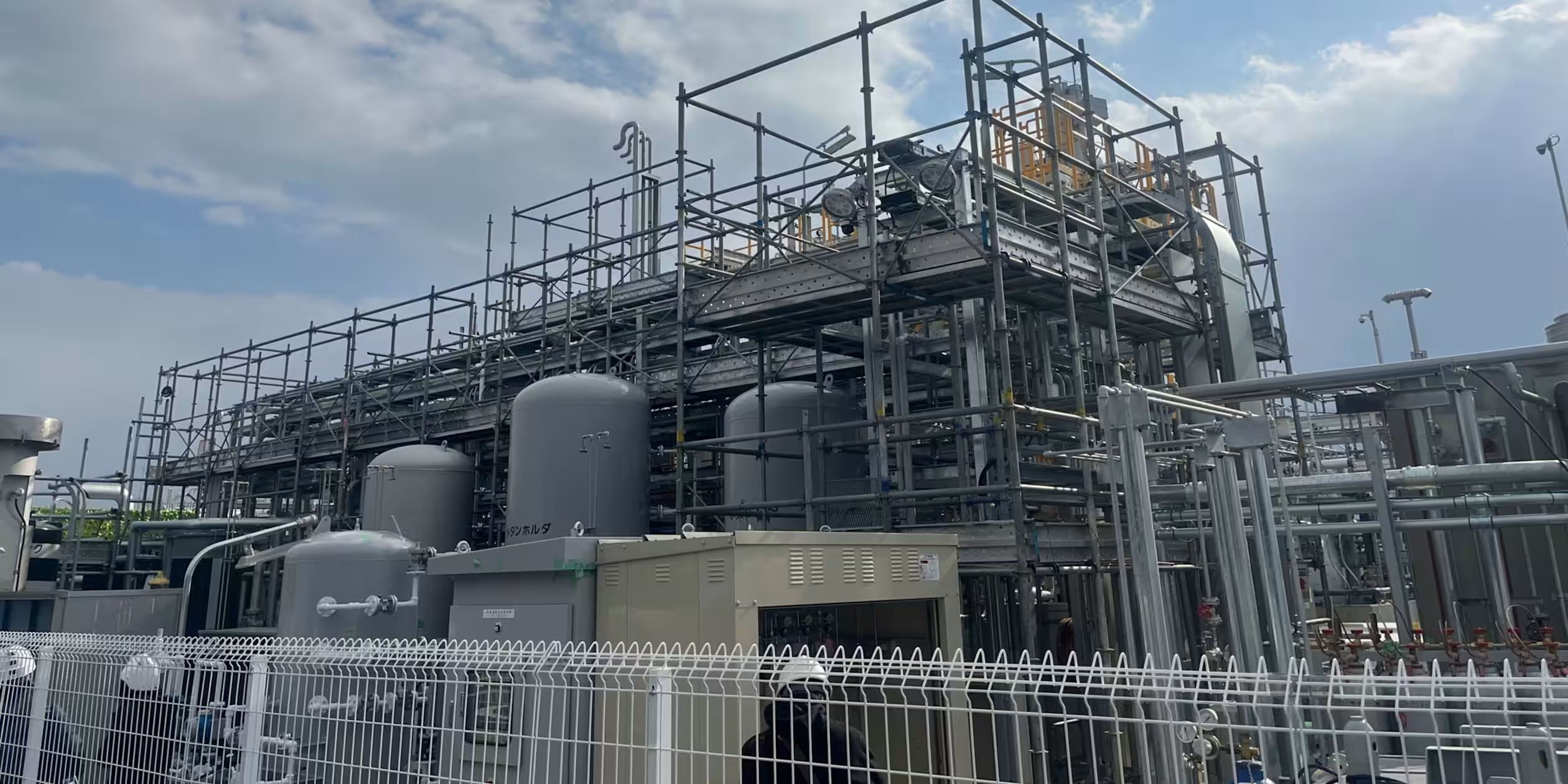
That is useful, in theory. Avoiding process CO₂ means avoiding the capture, compression, transportation and geological-storage chain that accompanies blue-hydrogen proposals. Hazer Group has also moved its catalytic implementation beyond laboratory chemistry into an operating demonstration plant and commercial-scale engineering work with KBR. The interesting question is no longer whether methane can be split this way. It is what happens when the chemistry is scaled into an industrial business.
The catch appears in the mass balance. Every tonne of hydrogen brings roughly three tonnes of solid carbon with it. My full TFIE Strategy Briefing analysis follows that ratio through an industrial-scale plant, tests the strongest apparent customer for both products, and finds that even there most of the carbon still needs another market.