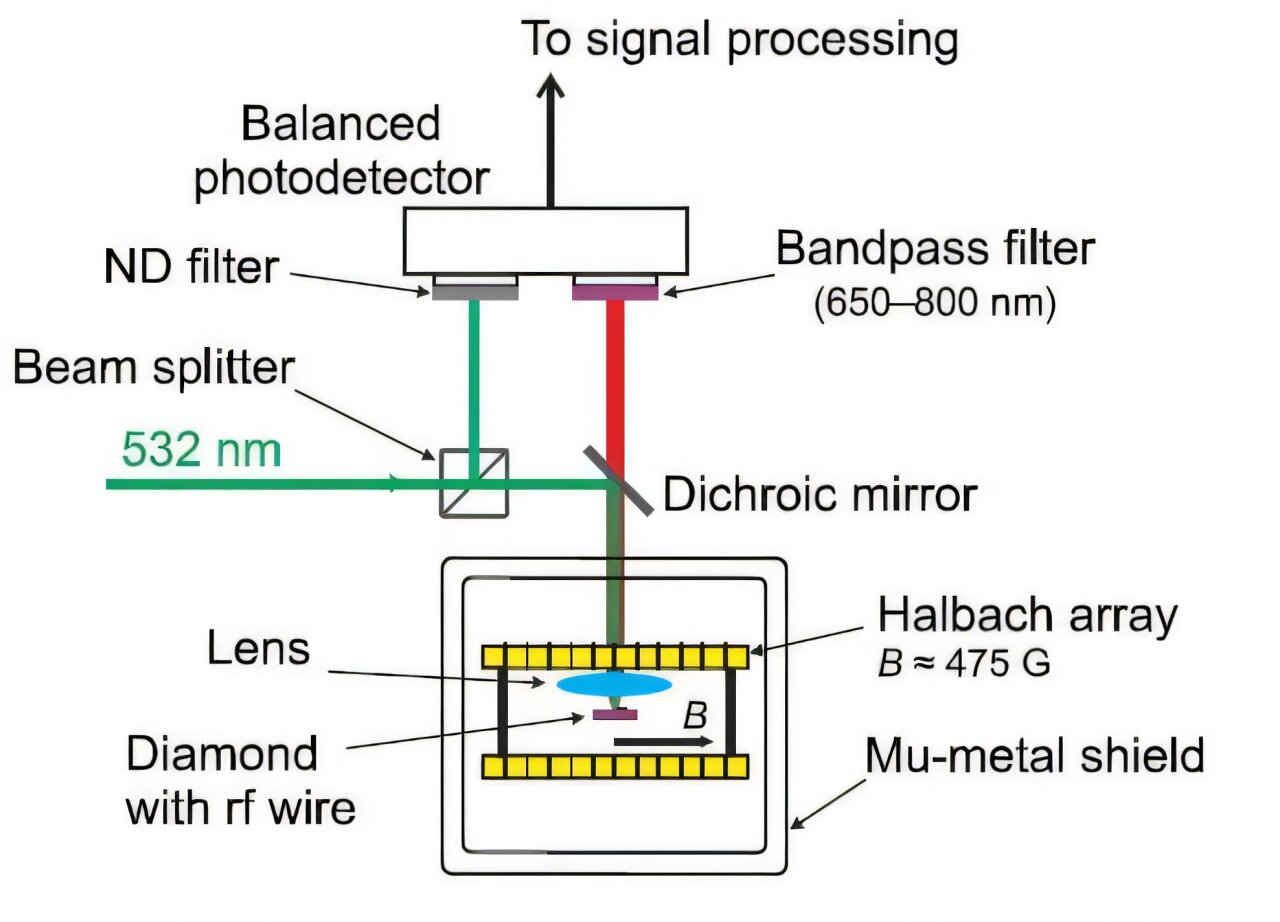
A schematic of the experimental setup. The Halbach array provides the magnetic field. It is aligned to one of the NV orientations and orthogonal to the incident light. A copper wire with a diameter of 160 microns delivers the radio frequency and microwave signals to the ensemble, near the optical focus of the lens. Credit: Physical Review Applied, American Physical Society
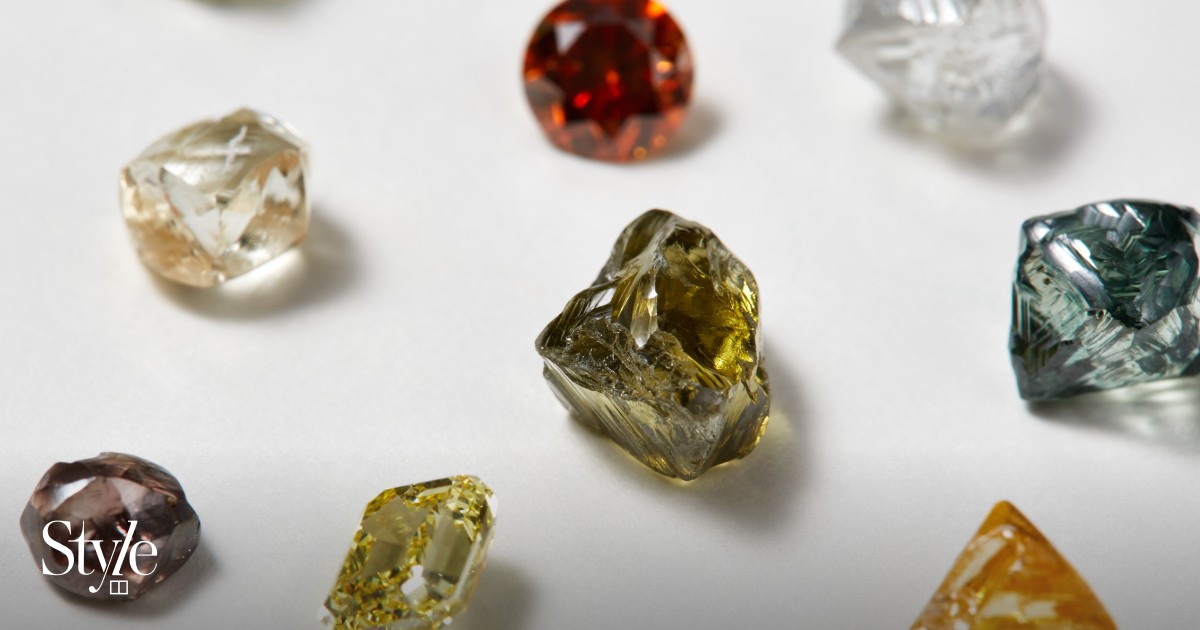
Despite all the advertisements for engagement rings and necklace gifts, natural diamonds are imperfect. Their carbon atoms are arranged in a cubic lattice, but they nonetheless contain several types of crystallographic defects due to impurities that occasionally replace a carbon atom. The most common types of impurities are nitrogen and boron; "Type I" diamonds contain nitrogen impurities, which can be isolated or clustered, at concentrations of up to 1%, and make up about 95% of all natural diamonds.
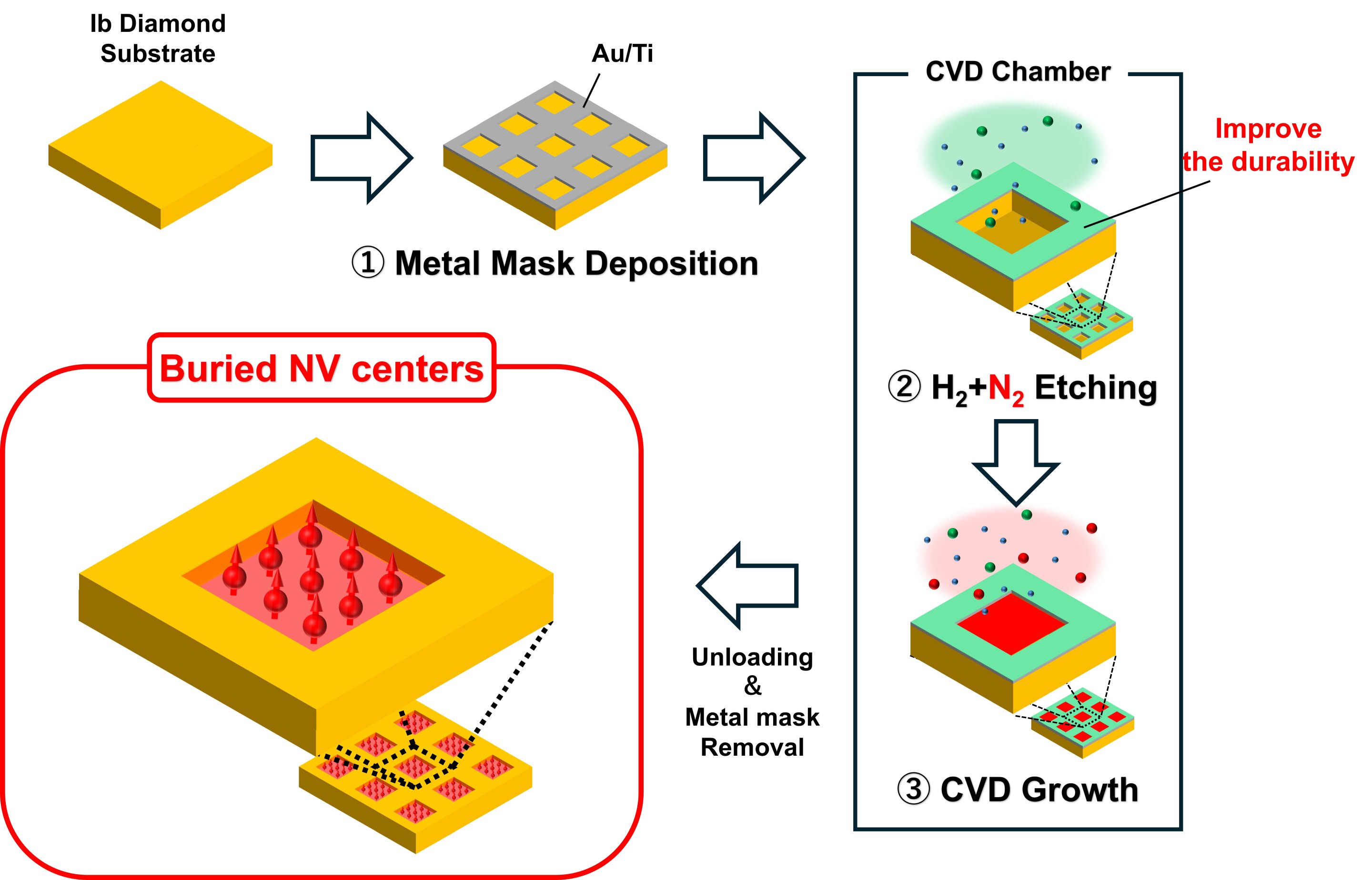
More specifically, some diamonds have a nitrogen-vacancy (NV) impurity. A nitrogen atom replaces one carbon atom, and adjacent to it is an empty lattice spot. One type of solid-state clock, a diamond clock, uses this feature to measure time, as the defect has optical and nuclear spin states that can be manipulated with microwaves and other light. But the NV energy levels are strongly modified by temperature.