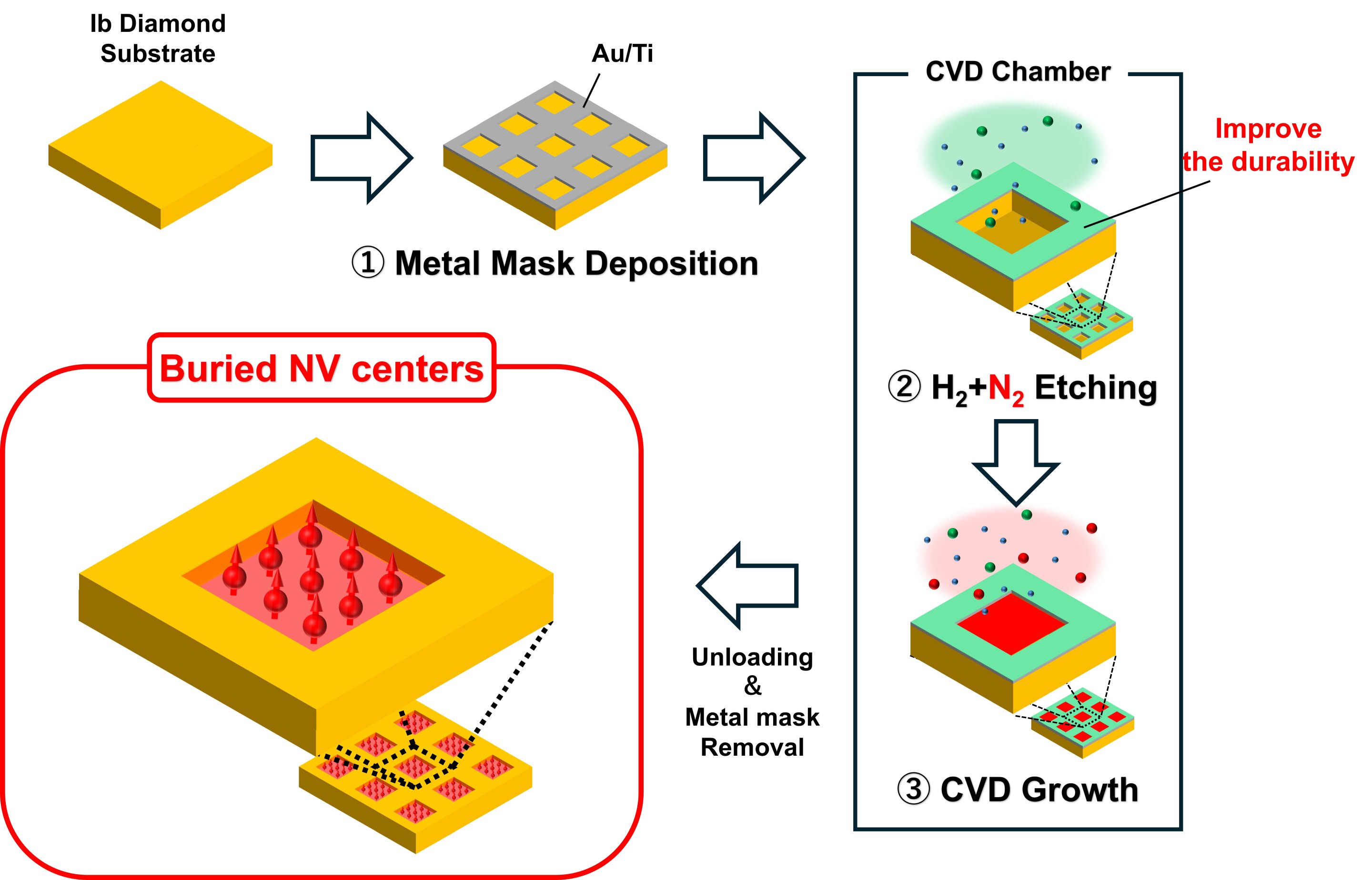
Schematic illustration of the newly developed buried-growth process for highly aligned NV centers in diamond. Credit: Kanazawa University
Researchers at Kanazawa University, in collaboration with Diamond and Carbon Applications (Germany), have developed a buried-growth process for nitrogen–vacancy (NV) centers in diamond using microwave plasma chemical vapor deposition (MPCVD). By employing nitrogen-radical selective etching, which simultaneously enhances metal-mask durability through nitridation, the team enabled a continuous etching–growth sequence within a single MPCVD process.
The work is published in the journal Carbon.
Optical measurements confirmed highly aligned NV centers selectively buried in predefined regions. This integrated approach provides a stable and scalable platform for orientation-controlled diamond qubits and future room-temperature quantum technologies.
Nitrogen–vacancy (NV) centers are atomic-scale defects in diamond that act as quantum bits. Unlike many quantum systems, they remain stable at room temperature. Their quantum states can be controlled and read using light, allowing information to be stored and processed with high precision. These properties make NV centers promising components for scalable quantum technologies.