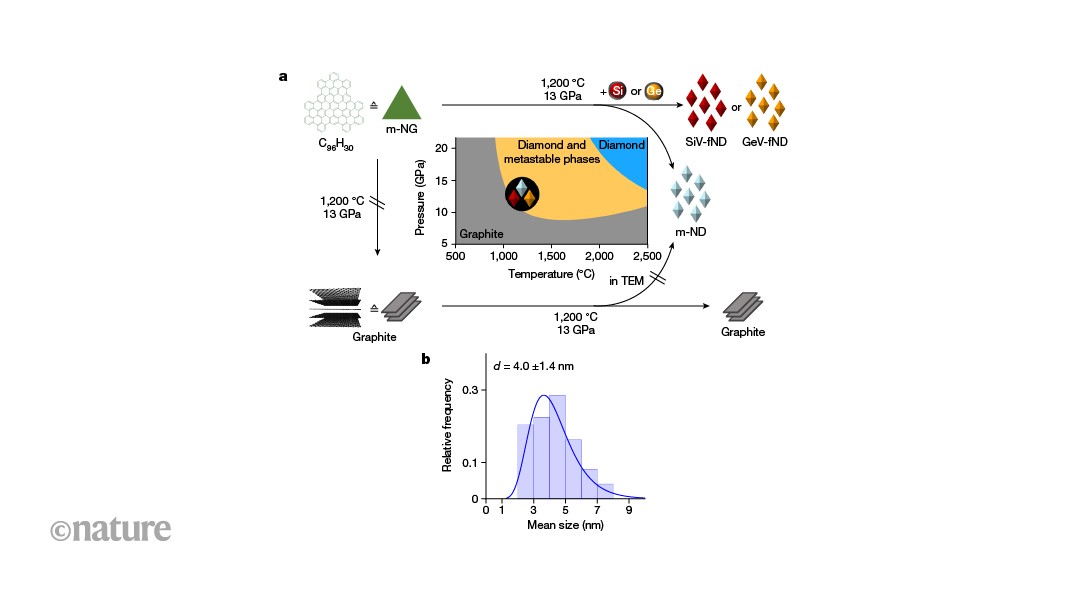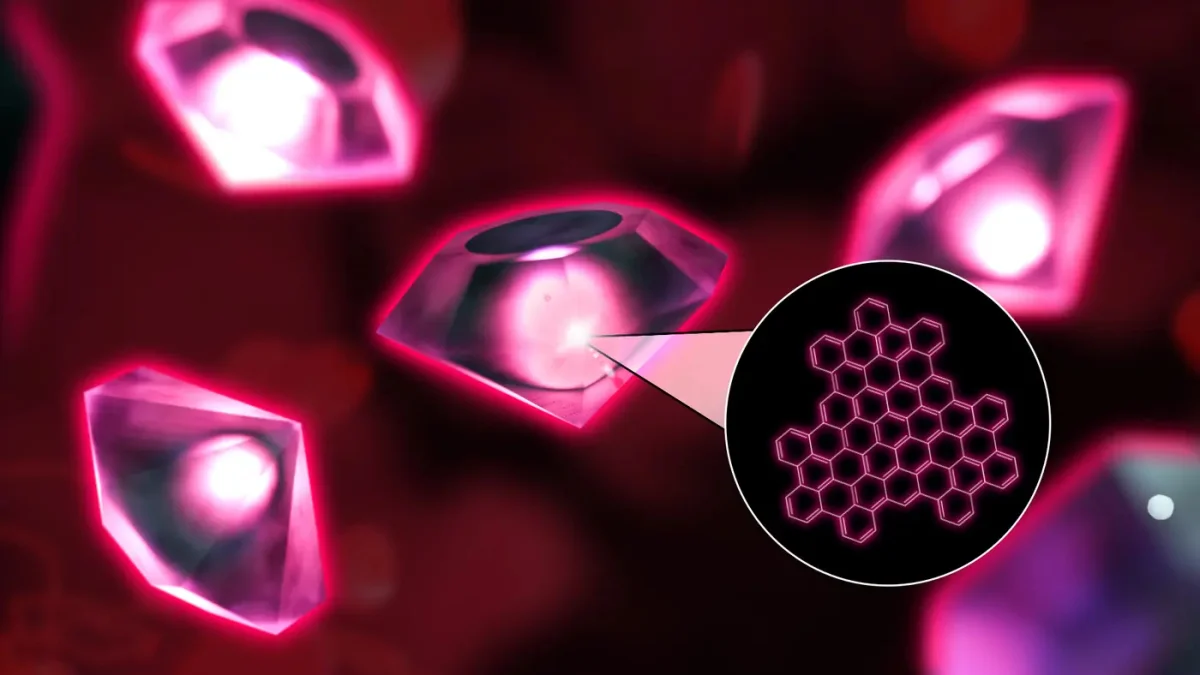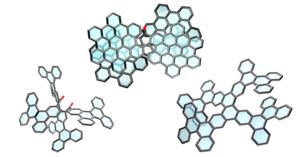
AbstractNanodiamonds hosting colour centres are promising building blocks for quantum technologies, enabling advances in quantum computation1,2, nanoscale NMR spectroscopy3–6, single-spin magnetometry7,8, wide-field quantum imaging9 and single-photon sources10,11. However, the controlled bottom-up synthesis of ultrasmall and structurally uniform nanodiamonds has remained a major challenge, with existing methods producing heterogeneous materials that vary in size, morphology, impurity content and defect quality. Here we show that well-defined, hydrogen-terminated molecular nanographenes serve as chemically confined precursors for high-pressure, high-temperature synthesis of ultrasmall (3–4 nm), monodisperse and highly crystalline molecular nanodiamonds (m-NDs) with only a single sp² surface reconstruction and produced on a milligram scale. The same bottom-up platform also enables a two-component strategy for incorporating silicon- and germanium-based colour centres during synthesis, yielding SiV⁻ and GeV⁻ emitters without ion implantation, irradiation or post-treatment. Because the nanographene precursor defines both the confined carbon framework and the hydrogen content, this approach provides intrinsic, precursor-level control over nanodiamond size and composition, particularly in the low-nanometre regime relevant for biological and quantum sensing. Molecular nanographenes, ultralarge polycyclic aromatic hydrocarbons, therefore establish a scalable and modular route to high-quality molecular and fluorescent nanodiamonds and offer a general design principle for tailored quantum materials and nanoscale devices.
Bottom-Up Synthesis of Molecular Nanodiamond from Nanographene - Nature
Nature - Bottom-Up Synthesis of Molecular Nanodiamond from Nanographene
706 words~3 min read