For decades, heat has been the workhorse of materials manufacturing, providing the energy needed to drive the chemical reactions that create everything from semiconductors to advanced electronic materials. But what if, instead of heating an entire device, scientists could use mechanical force to trigger those same reactions only where they were needed?
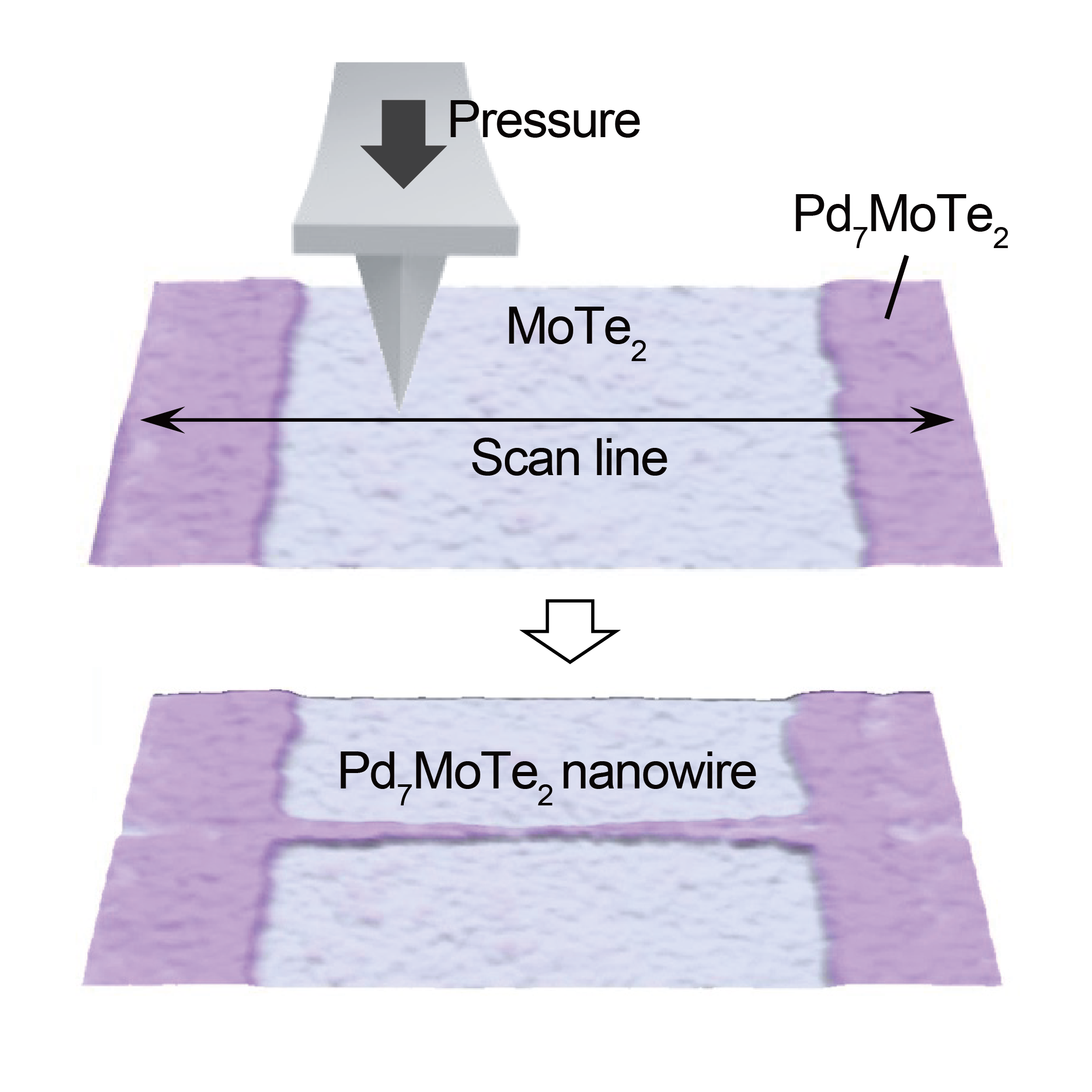
A close collaboration between Penn, led by Robert Carpick, John Henry Towne Professor in Mechanical Engineering and Applied Mechanics, and Princeton University, led by Sanfeng Wu, Associate Professor of Physics, has demonstrated exactly that. Together, the team has developed a technique that uses the tip of an atomic force microscope (AFM) to “write” an atomically thin quantum material with nanometer precision. Published in Physical Review X, the study introduces a new manufacturing approach that could enable more energy-efficient fabrication of next-generation electronic and quantum devices.
“Our work shows that mechanical force can complement and sometimes even replace heat as a catalyst for creating new materials through mechanochemistry,” says Carpick. “Using the AFM, we’ve developed an energy-efficient tool for making entirely new materials exactly where we want them.”