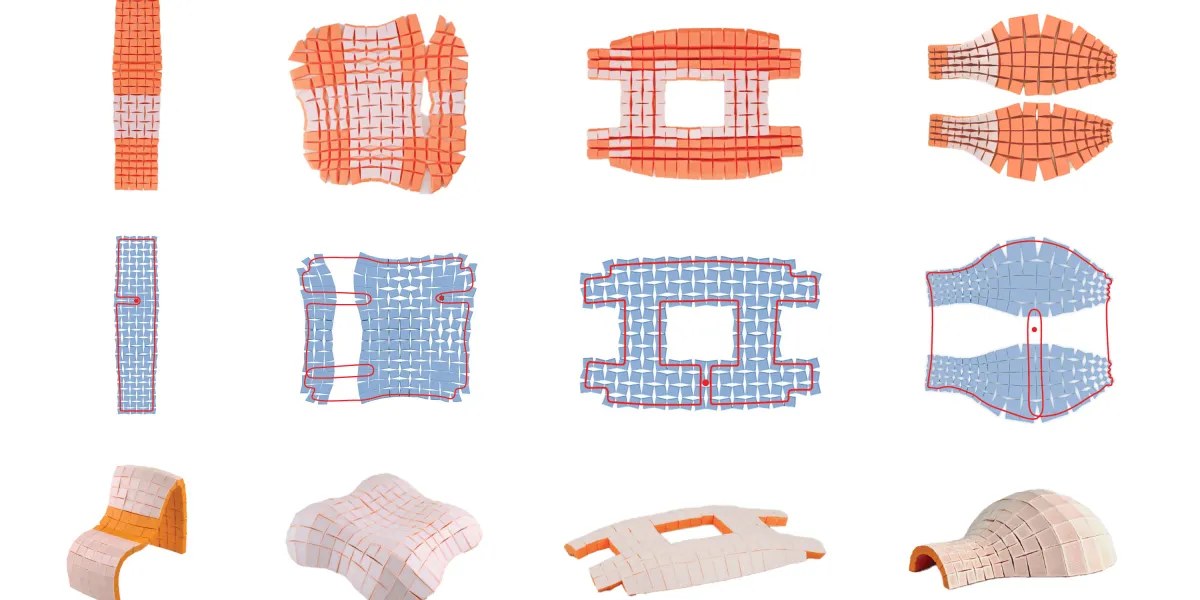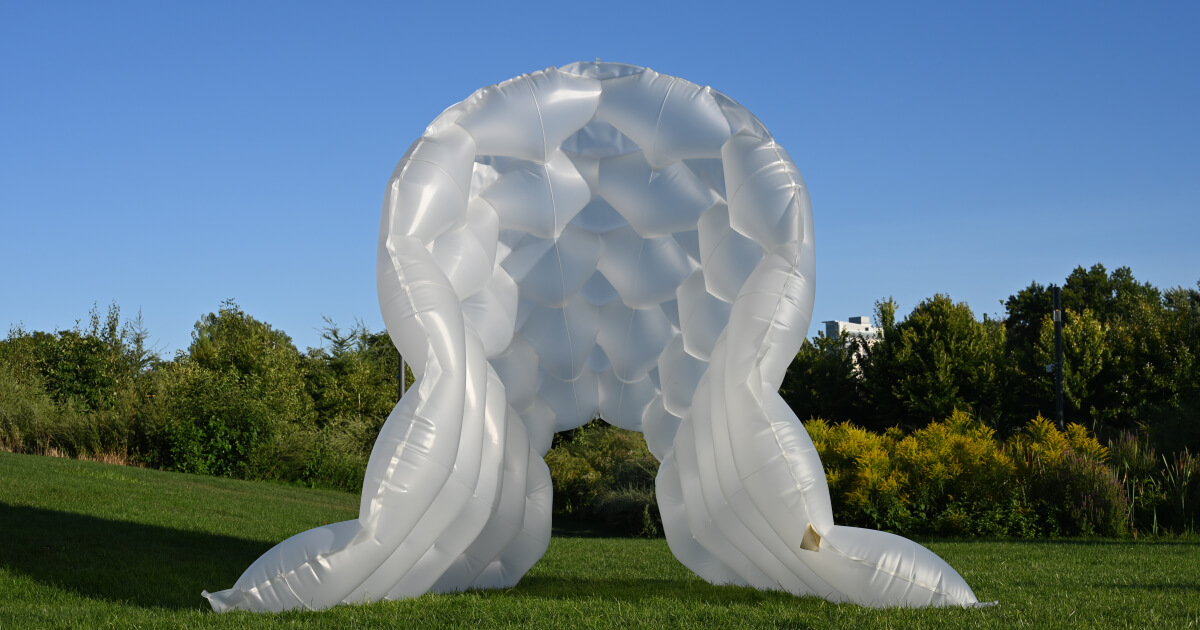
Inflatable structures are all around us, from pool floaties and archways at the Tour de France, to life-saving emergency resuscitators and vehicle airbags. As useful as these structures are, they are limited by only having two stable states — inflated and deflated. Maybe not for long. A Harvard team comprising engineers and architectural designers have developed a mechanics-based framework for precisely controlling how and where crumples form on inflatable membranes. They used these controlled crumples to create lightweight inflatable objects that change shape after inflation, and that exhibit what physicists call multistability – the ability to lock into not just one, but multiple stable shapes. The research, which was supported by a Department of Defense Multidisciplinary University Research Initiative (MURI) award, lays the groundwork for exploring new kinds of complex, inflatable devices.
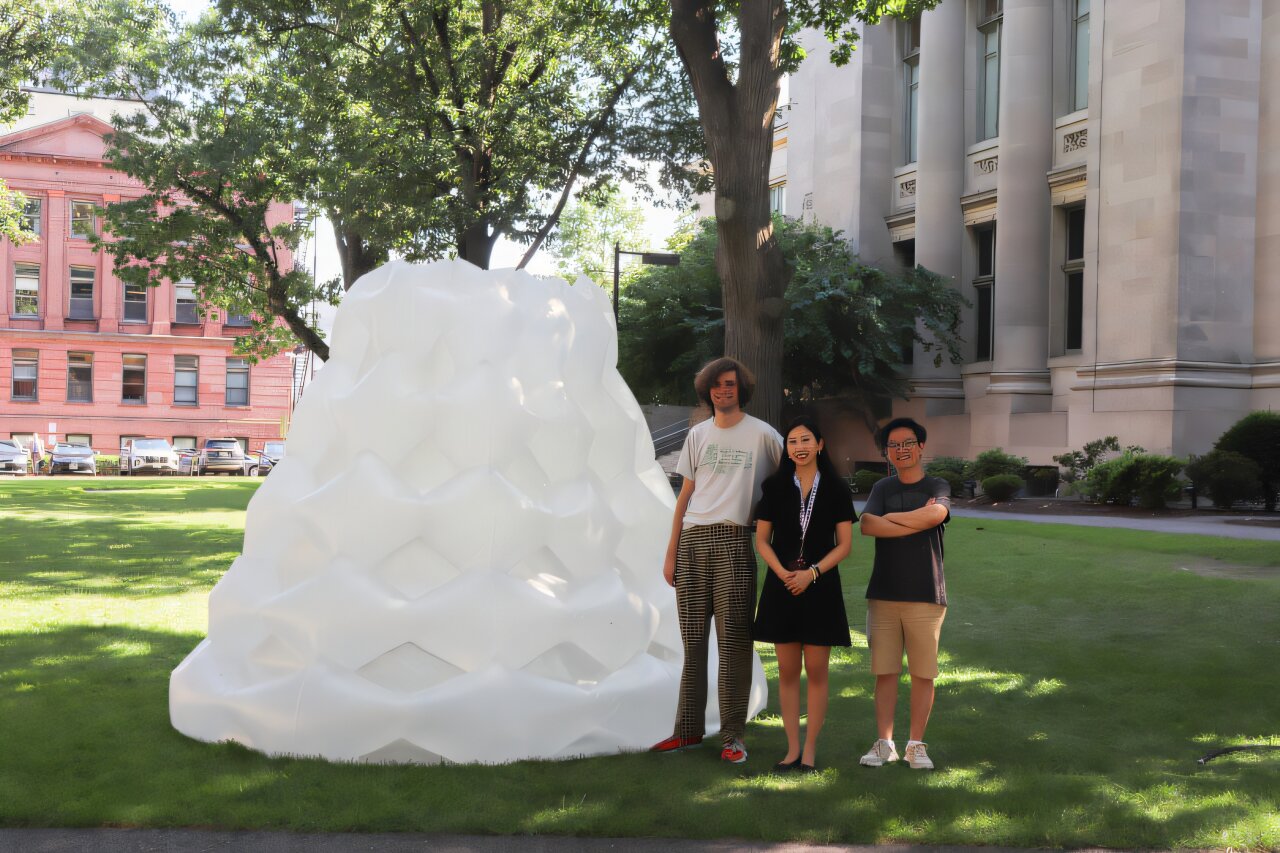
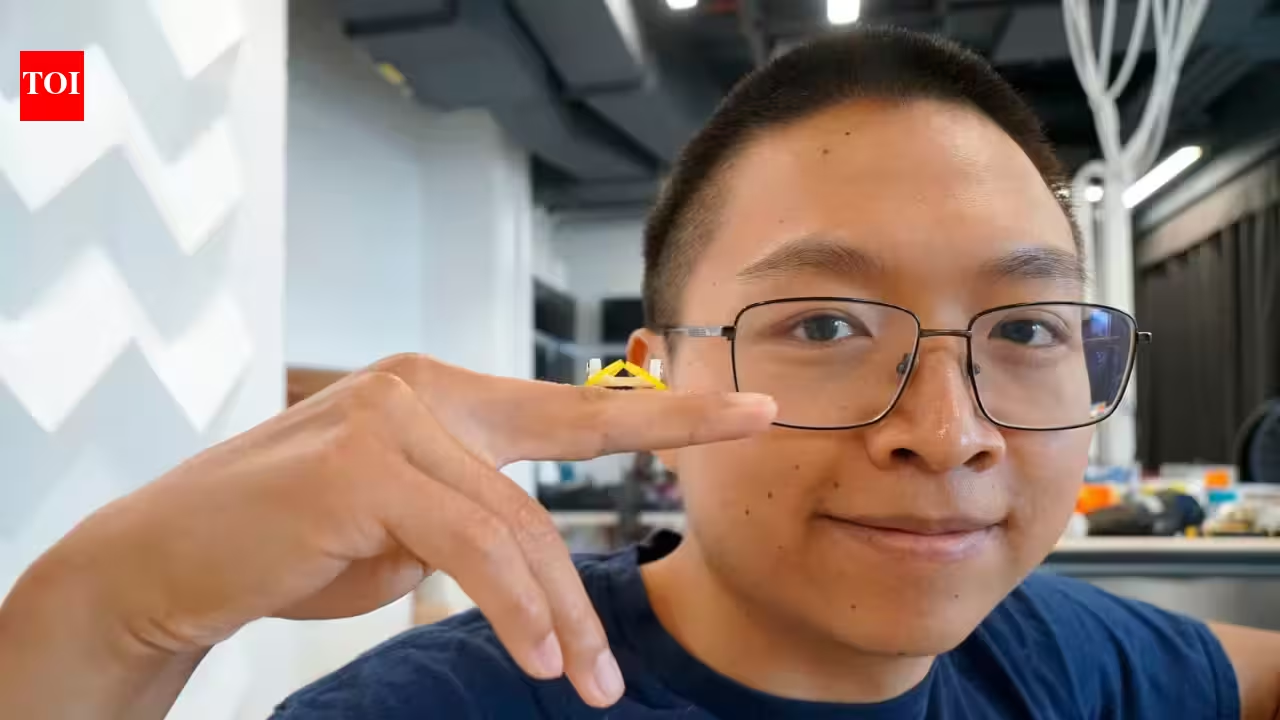
Lead researchers Leon Kamp, Hye Jun Youn and Yi Yang with a meter-scale multistable inflatable object.
The research is published in Advanced Science and led by Katia Bertoldi, the William and Ami Kuan Danoff Family Professor of Applied Mechanics in the John A. Paulson School of Engineering and Applied Sciences (SEAS), and Martin Bechthold, the Kumagai Professor of Architectural Technology in the Harvard Graduate School of Design. The journal featured the research on its inside back cover. “This project not only explores the use of multistability in new and perhaps unexpected ways, but it also shows the exciting potential of collaborations between designers and engineers,” Bertoldi said. Multistability as both a design and engineering challengeThe project began several years ago when co-first author Hye Jun Youn, then a master’s student in the Harvard Graduate School of Design, started experimenting with thermoplastic polyurethane film – the same material used in most pool toys. She had designed modular inflatable shapes called “PneuBots” that would curiously curl and bend into stable shapes when inflated, piquing her interest in the physical mechanisms behind this behavior.“I needed scientific data to prove this shape-changing behavior – something I couldn’t prove myself,” said Youn, now a Ph.D. student at the MIT Media Lab.At Harvard, her search for collaborators led her to structural design professor Bechthold, who became her advisor on the project. She connected with Bertoldi’s group at SEAS through both Bechthold and classmate Leon Kamp, a graduate student in the Bertoldi lab, which was already known for extensive exploration of multistable and shape-morphing structures inspired by both nature and art.When Youn first brought her hand-held prototypes to a Bertoldi group meeting, then-postdoctoral researcher and co-first author Yi Yang was struck.“I saw that the inflatable was just a very small pouch or pillow, and I thought, ‘Oh this pouch is actually bistable,’” recalled Yang, now an assistant professor of engineering at Gordon College. “Our lab is very interested to understand how structures change shape, so this triggered my motivation to understand the physics or science behind this bistable structure.” Most inflatable membranes are soft and flexible, but when pressurized, they prefer to bend rather than stretch, which naturally produces wrinkles or crumples, like those along the perimeters of Mylar balloons. Crumples are generally considered something to avoid when making inflatables. The Harvard team instead wondered whether those features could be useful. Building bistable structuresThey started with a flat rectangular pouch and placed notches along its edges. Upon inflation, the notches cause crumples to span the surface, becoming like a mechanical hinge.