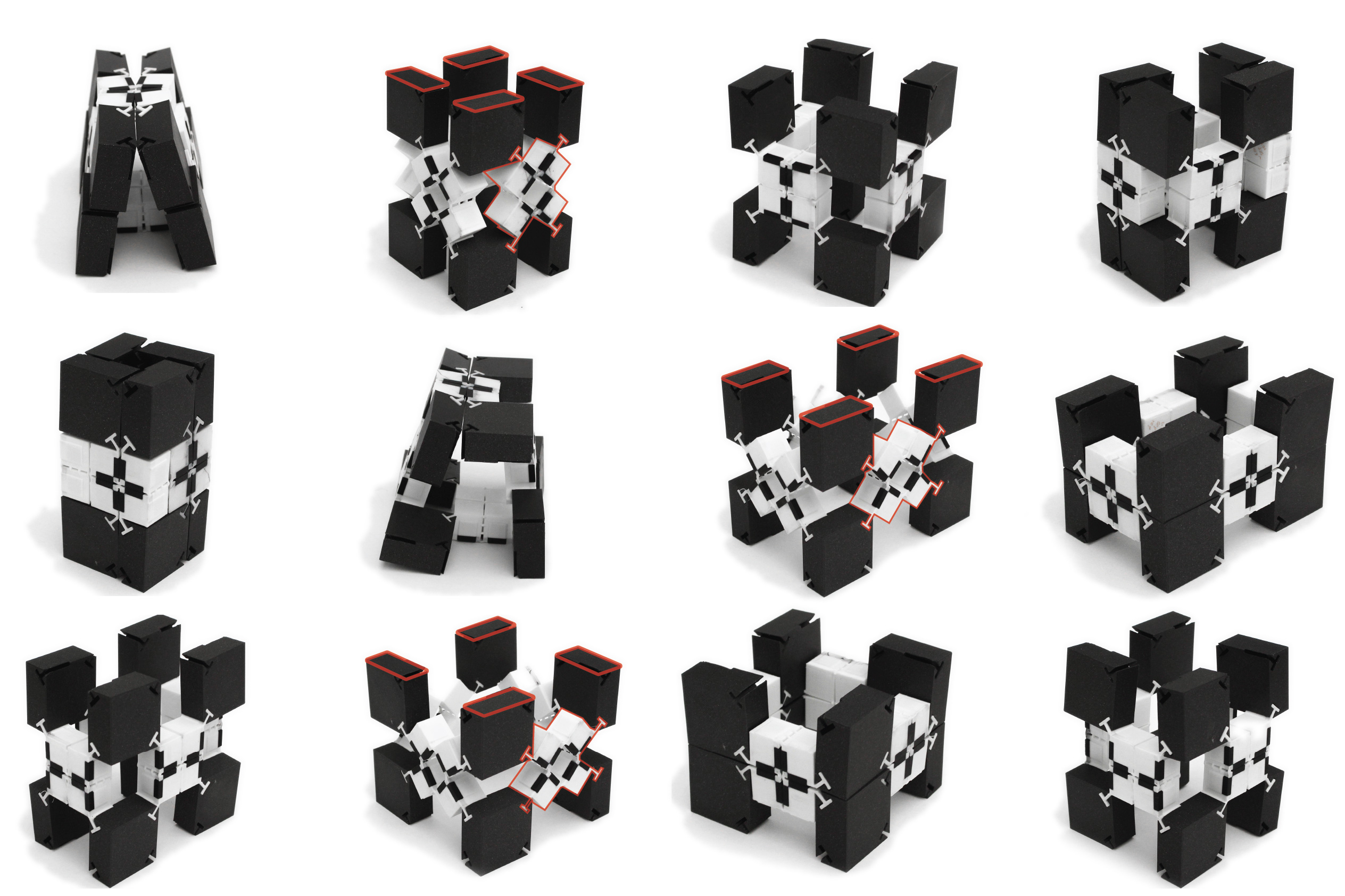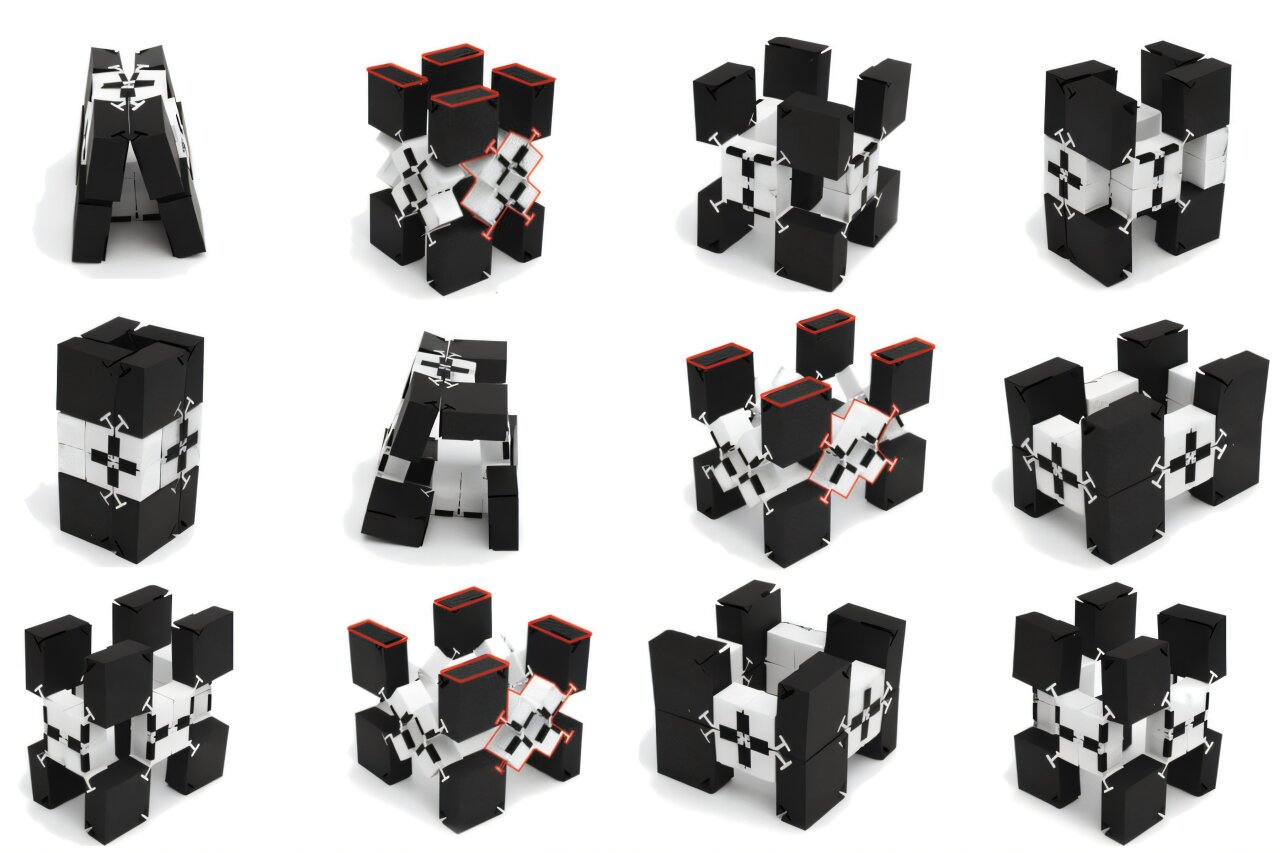
These rows show just a portion of the wide variety of configurations the Bifur-circuits can make. Credit: Massachusetts Institute of Technology
A new set of modular components allows users to create reconfigurable smart devices with electrical connections that keep working no matter what shape the structure forms.
This electrical modularity can enable engineers to design interactive devices that can sense which shape they have taken, without the need for external wires. For instance, the modular components, which the researchers call "bifur-circuits," could be used to rapidly design and prototype adaptable smart devices, like assistive furniture that helps individuals change body positions while recovering from injuries or reconfigurable robotic grippers that remain electrically connected when they change shapes for different applications.
Developed by MIT researchers, these 3D-printed building blocks, which are a type of structure known as a mechanical metamaterial, can be combined to form many more configurations than traditional metamaterial structures.
In a study presenting the new system, the researchers demonstrated several interactive objects, including a chair that converts to a table with storage and can also flatten for stowing. The structure senses its configuration and sends corresponding messages to an electronic display.