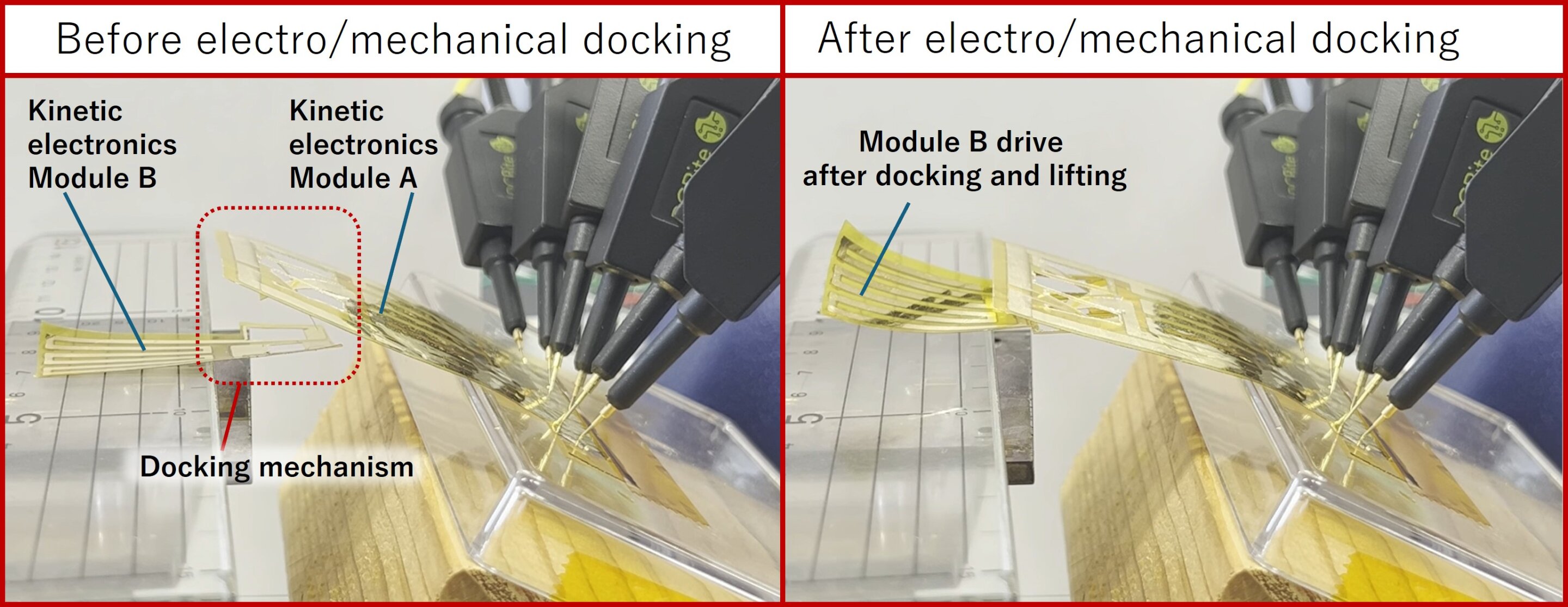
Kinetic electronics module A, which integrates an electrical circuit and an actuator, deforms in response to an electrical input and connects mechanically and electrically to thin-film circuit module B via the docking mechanism. Before connection (left image), the two modules are separate; after connection (right image), Module A holds and lifts Module B, and by supplying power through the connection point, it can independently drive Module B to deform. Credit: Fumihiro Sassa/Kyushu University
Publishing in the journal npj Flexible Electronics, researchers from Kyushu University have developed prototype thin-film electronic modules that can automatically connect and disconnect with one another.
Flexible electronics is a growing field of research because of its potential applications in wearable sensors, soft robotics and medical devices.
"Today, most of these devices are made as fixed, one-piece systems. For some time now, our group has been developing kinetic electronics, thin-film devices with actuators and circuits so they can move, attach and function together," explains Associate Professor Fumihiro Sassa of Kyushu University's Faculty of Information Science and Electrical Engineering, who led the study.