view more
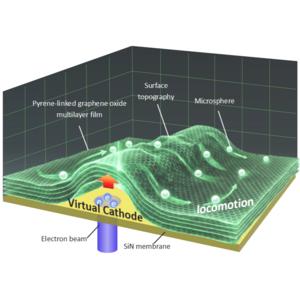
Researchers at Nagoya University in Japan have developed a method to form dome-shaped bumps on nanofilms in water using a computer-guided electron beam. The bumps form within 10 seconds and can be flattened, reshaped, or repositioned as needed.
This method may enable computer-guided manipulation of nanomachines for uses such as microscale touch sensing, guiding cellular growth, and direct assembly of colloidal particles. The findings were published in the journal ACS Applied Materials & Interfaces.
Existing approaches each have drawbacks: light-based techniques typically take 60 seconds or more per shape change, while electrical methods rely on fixed electrodes that restrict where reshaping can occur and limit the size of the change.
To overcome these limits, the first author, Ken Sasaki, and Associate Professor Hisataka Maruyama, along with Professor Takayuki Hoshino of Nagoya University's Graduate School of Engineering, combined two innovative technologies. The first is a "virtual cathode" display, in which an electron beam is scanned across a silicon nitride (SiN) membrane along a computer-defined path, generating a localized electric field with nanoscale precision. Because the pattern is set by the scan path rather than a physical electrode, its shape and position can change instantly.