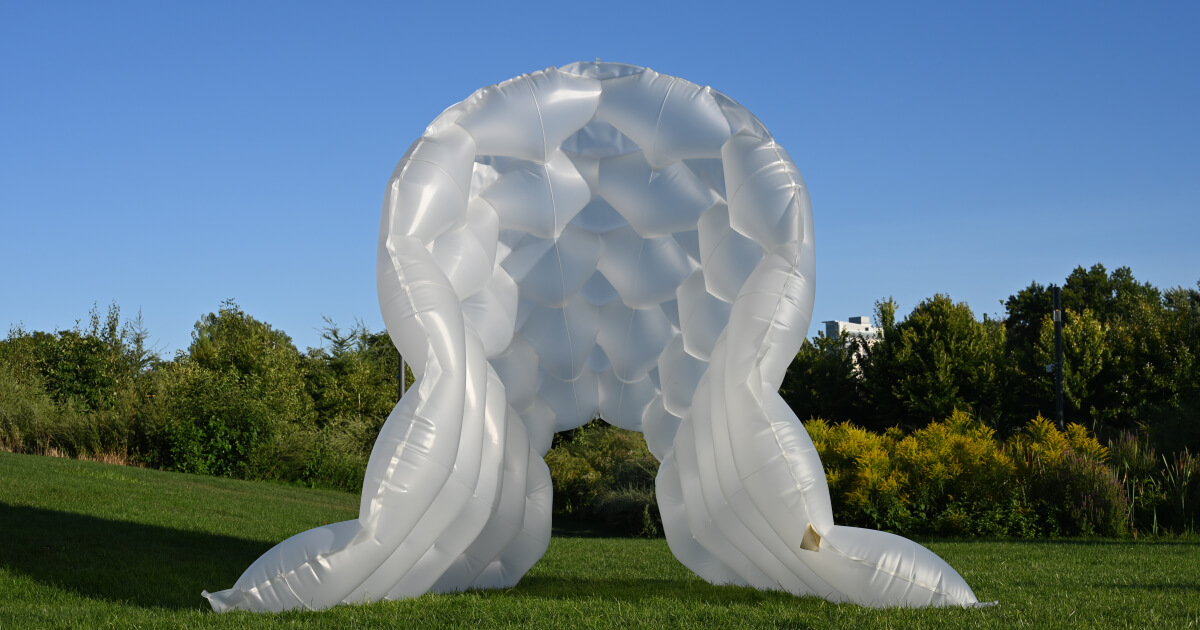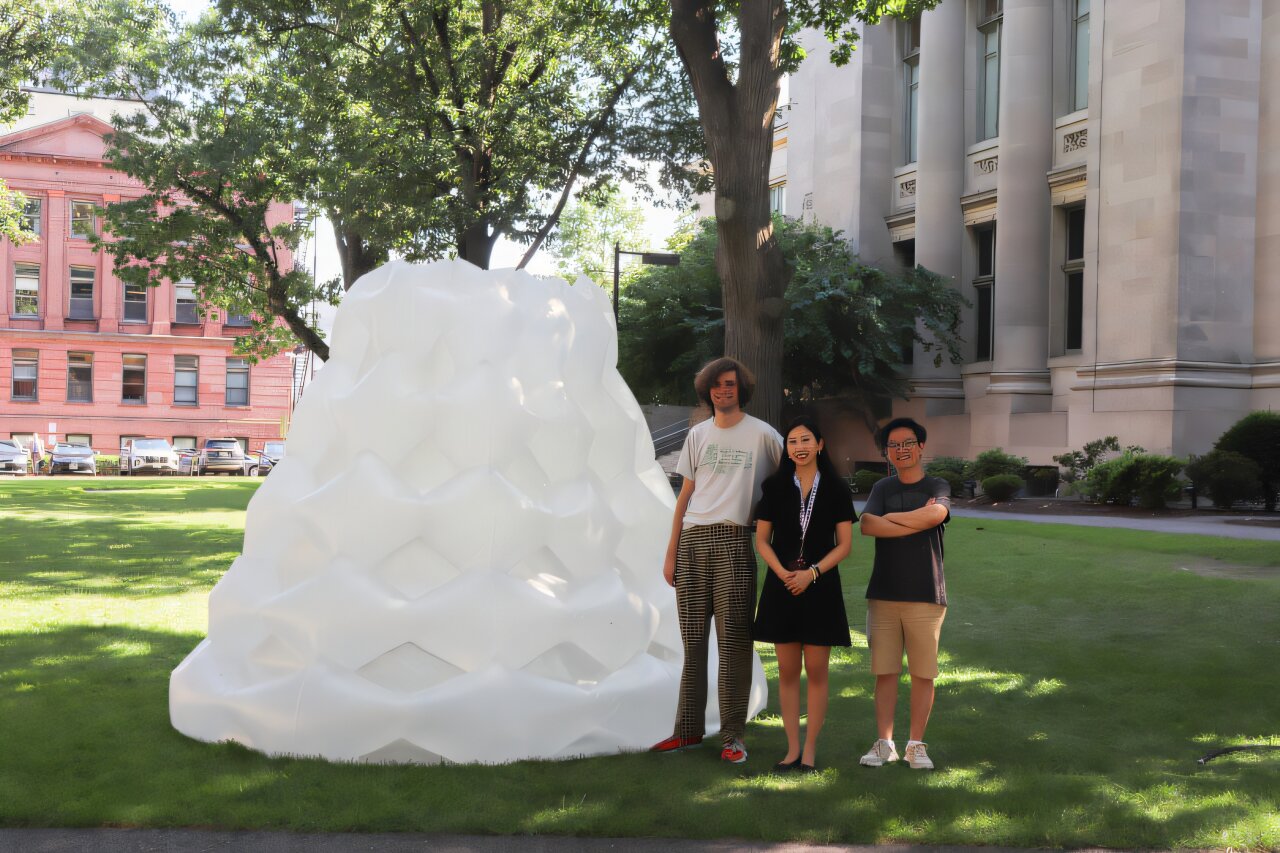
Lead researchers Leon Kamp, Hye Jun Youn and Yi Yang with a meter-scale multistable inflatable object. Credit: Harvard University
Inflatable structures are all around us, from pool floaties and archways at the Tour de France to life-saving emergency resuscitators and vehicle airbags. As useful as these structures are, they are limited to only two stable states—inflated and deflated.
Maybe not for long. A Harvard team comprising engineers and architectural designers has developed a mechanics-based framework for precisely controlling how and where crumples form on inflatable membranes. They used these controlled crumples to create lightweight inflatable objects that change shape after inflation and exhibit what physicists call multistability—the ability to lock into not just one but multiple stable shapes.
The research, published in Advanced Science, lays the groundwork for exploring new kinds of complex inflatable devices.
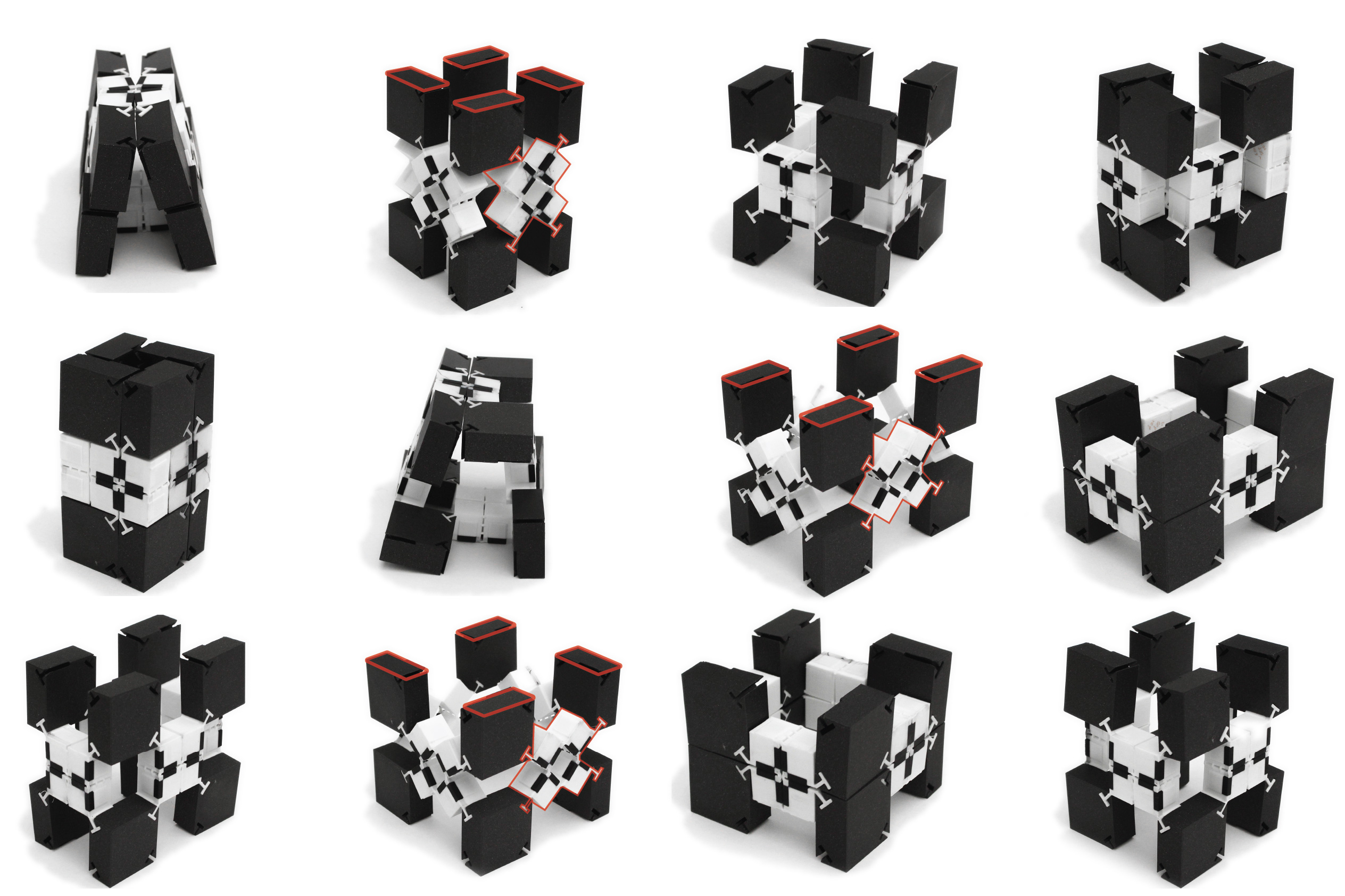
Reconfigurable Inflatables: Centimeter-Scale Tessellations. Credit: Harvard John A. Paulson School of Engineering and Applied Sciences