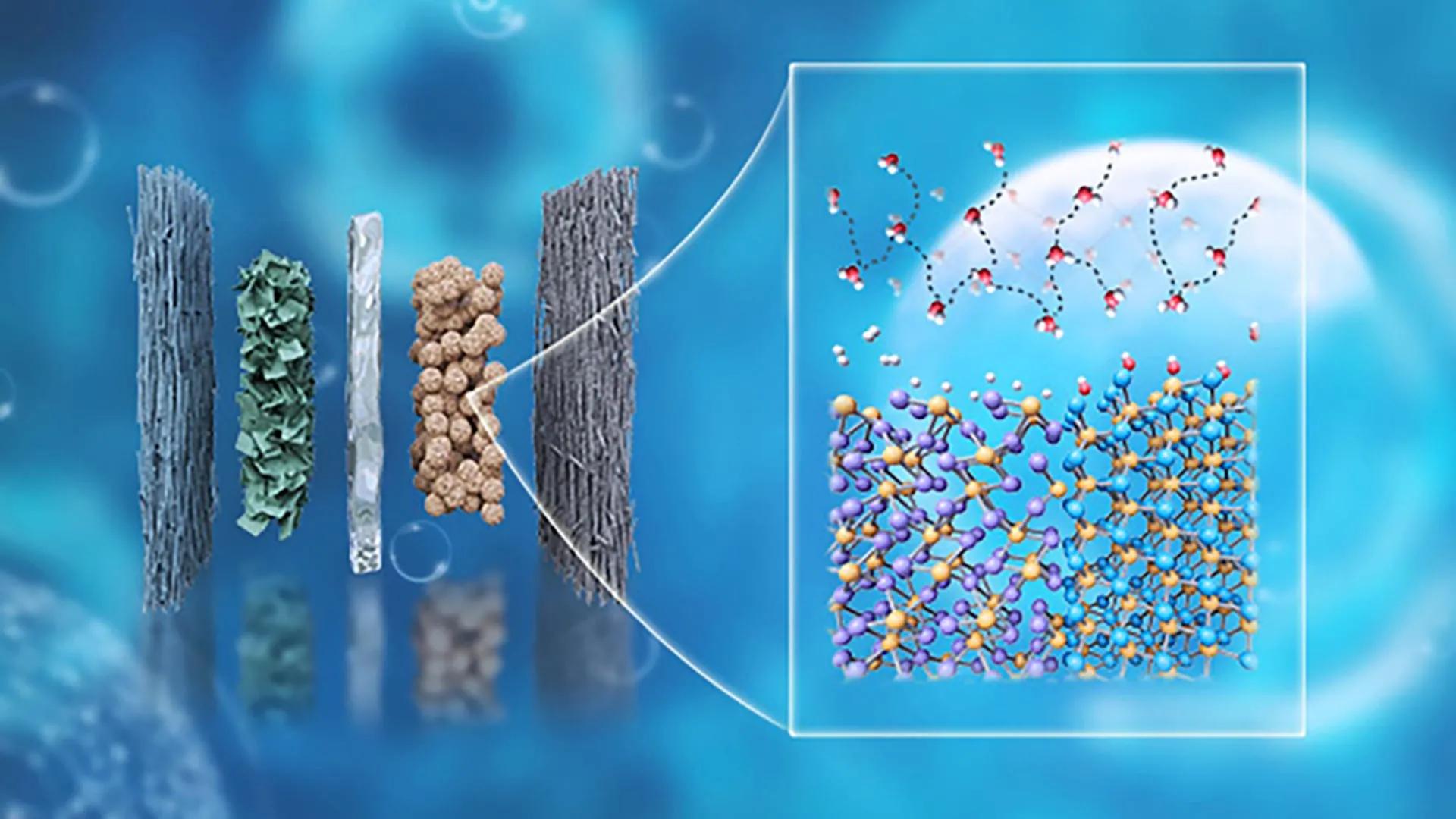
Researchers use quenching, an approach borrowed from metallurgy, to rapidly cool materials and lock in atomic structures that can vastly upgrade the power and durability of fuel cells. Credit: University of Texas at San Antonio
As the global push for cleaner energy intensifies, solid oxide fuel cells have emerged as a promising option. They turn hydrogen or other renewable fuels directly into electricity and heat without combustion, eliminating virtually all pollution and boosting efficiency to more than 60%. But a major downside has kept them out of everyday commercial use: They require extremely high temperatures to operate.
A team of researchers at UT San Antonio and partner institutions has found a way around that barrier. Instead of relying on perfectly ordered materials, the researchers applied a thermal shock technique to create tiny clusters of disordered atoms that move oxygen ions much more easily at lower temperatures. The result could help make fuel cells cheaper, more durable and easier to use outside the lab.
"The golden rule has been that you need a perfect crystal lattice for fast ion movement," said Chonglin Chen, Ph.D., a professor in the Department of Physics and Astronomy in the College of Sciences. "What we have done here challenges that assumption."