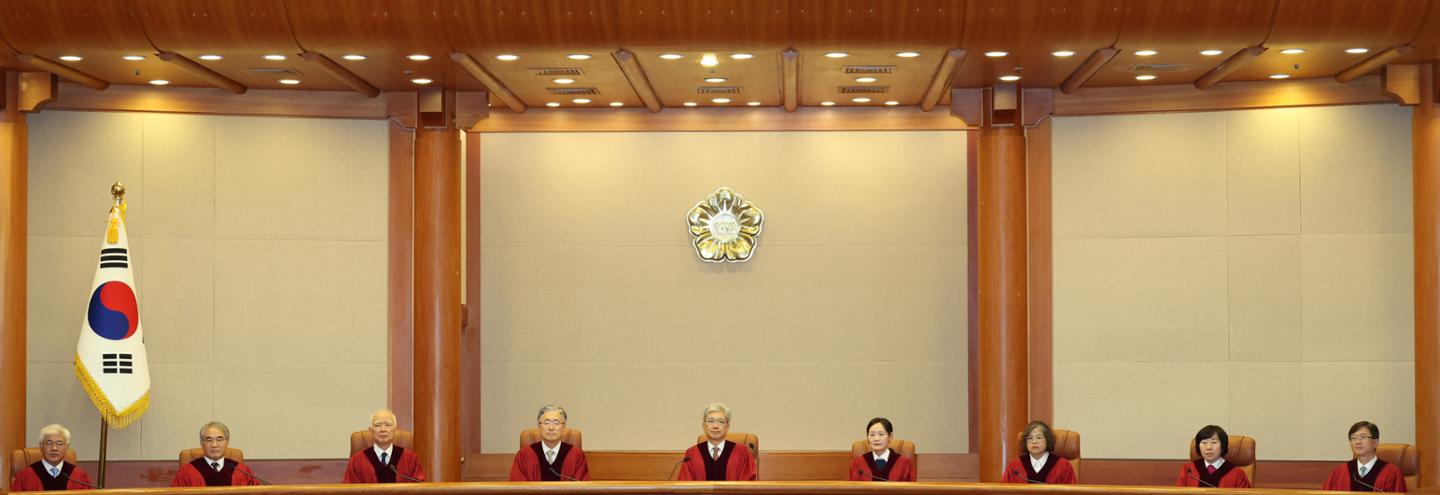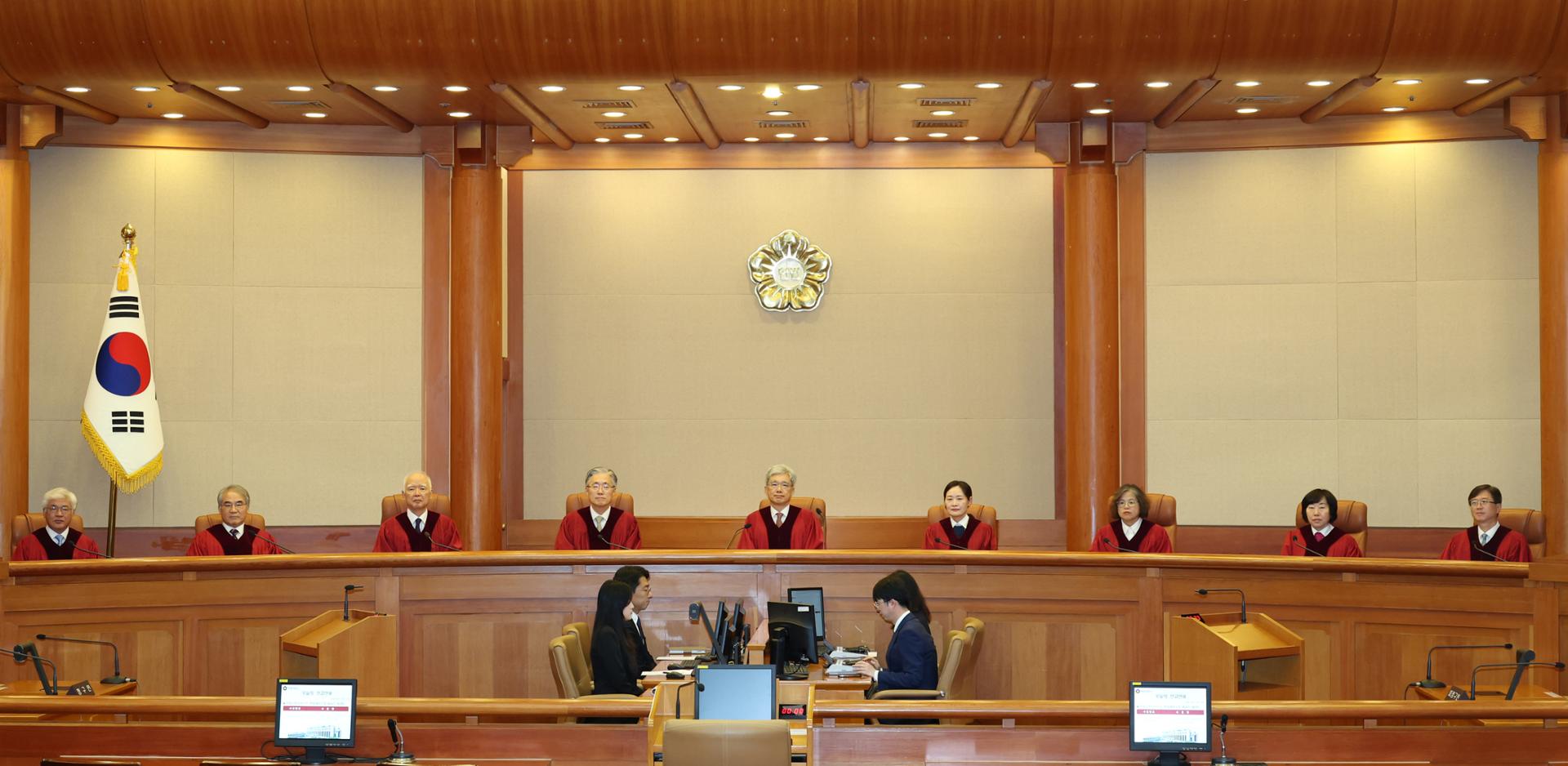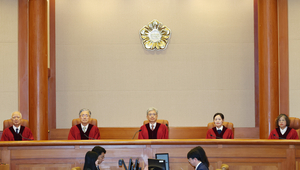
Constitutional Court justices are pictured on Thursday at South Korea's Constitutional Court in Jongno-gu, Seoul. (Yonhap) South Korea’s Constitutional Court ruled Wednesday that children born in the country must have access to birth registration regardless of nationality or immigration status, finding lawmakers’ failure to create such a system unconstitutional.“The legislative omission of provisions allowing foreign nationals born in Korea to register their births under Korean law is unconstitutional,” the court said in a unanimous decision.The case was brought by a Vietnamese man and his daughter, who challenged the absence of a birth registration system for non-Korean children born in South Korea.The father entered Korea in 2008 on a nonprofessional employment visa and married a Vietnamese woman in 2016. The couple later overstayed their visas.Their daughter was born at a clinic in Seoul in April 2019, but her parents were unable to register her birth under Korean law.Under the current Act on Registration of Family Relations, Korea’s birth registration system applies only to Korean nationals, leaving children of foreign nationals outside the system.The father and daughter filed a constitutional complaint in 2022, arguing that the lack of a domestic birth record could prevent the child from fully accessing healthcare, childcare and education.The girl, who has Vietnamese citizenship, turned 7 this year and reached school age. Although foreign children can attend Korean schools under existing rules, enrollment can require documents showing their immigration or foreigner registration status.Children born in Korea to undocumented foreign parents are sometimes referred to as “shadow children” because their births are not recorded through Korea’s family registration system.The court said the lack of an official birth record could leave such children vulnerable to exclusion from healthcare, education and other public services and make it harder for authorities to detect illegal adoptions and other crimes.International organizations have also repeatedly urged Korea to close the gap, citing the UN Convention on the Rights of the Child, which recognizes every child’s right to be registered immediately after birth.The Constitutional Court accepted the daughter’s claim, saying people have a right to have the fact of their birth officially recorded by the state with jurisdiction over where they were born.“Under the Constitution, foreign nationals born in Korea also have the right to have their births registered immediately after birth,” the court said.“The state has a legislative duty to establish a system allowing children born in Korea to register their births under Korean law regardless of their nationality, immigration status or whether their births have been registered in their parents’ country of nationality,” it added.The court, however, unanimously rejected challenges to provisions limiting compulsory education under the Framework Act on Education to Korean nationals and to rules requiring confirmation of foreigner registration when a foreign national applies to enter elementary school.Wednesday’s ruling marked only the second time since the Constitutional Court was established that it upheld a constitutional complaint based on a “genuine legislative omission,” referring to a case in which lawmakers fail to enact legislation despite a constitutional duty to do so.
Foreign children born in Korea must be allowed birth registration, court rules
South Korea’s Constitutional Court ruled Wednesday that children born in the country must have access to birth registration regardless of nationality or immigra
500 words~2 min read