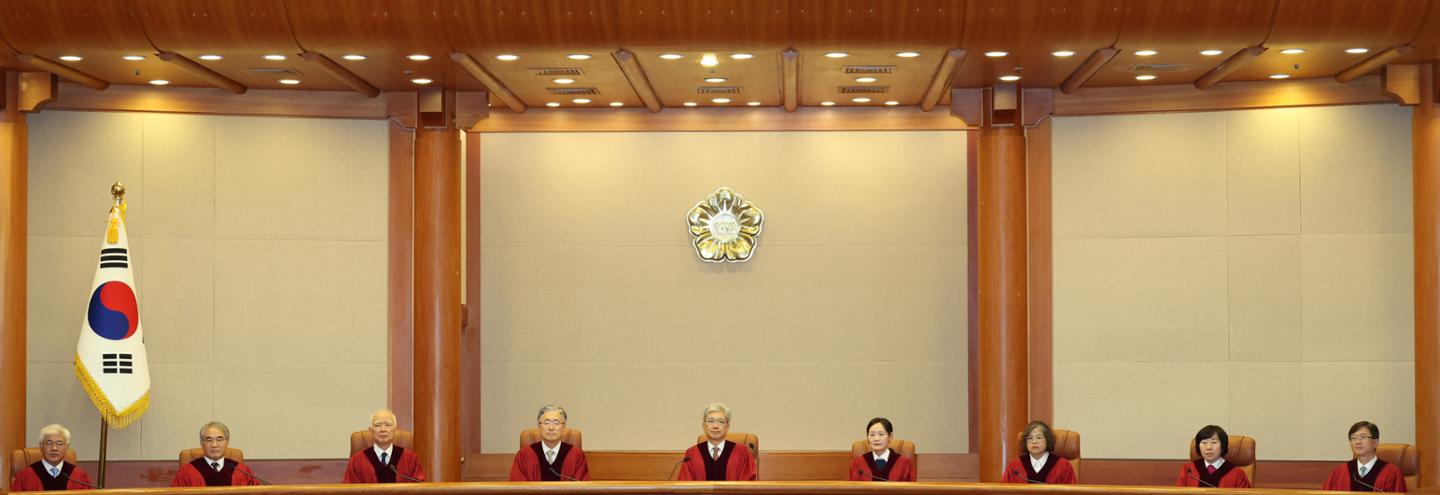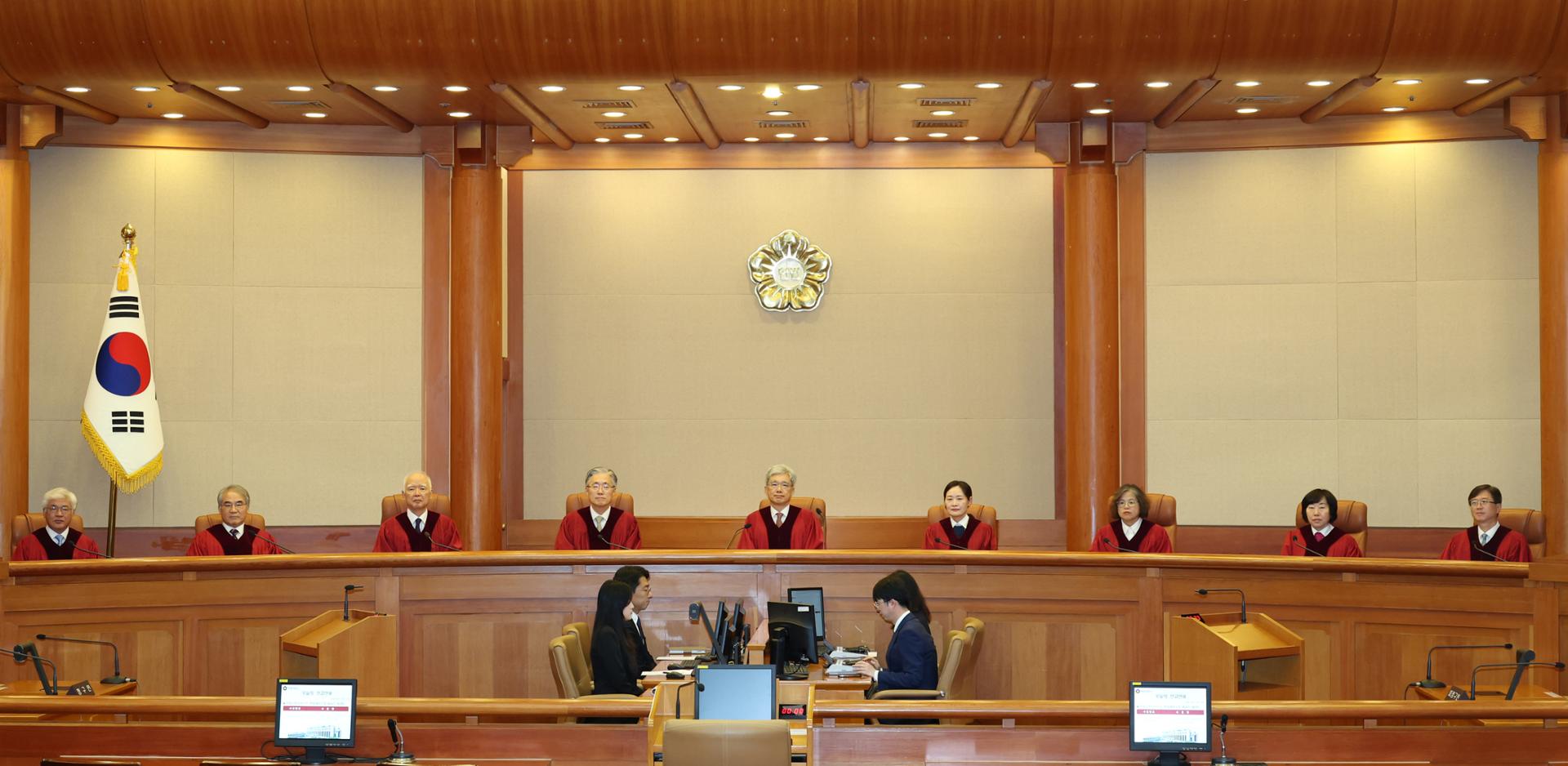
The flag of the Constitutional Court of Korea flies outside the court in Seoul’s Jongno District. (Kim Young-won/Hankyoreh)
The Korean Constitutional Court ruled Thursday that the lack of a legal guarantee for registering foreigners born in Korea was unconstitutional, emphasizing the unconditional right to birth registration. The court asserted the constitutional requirement for a state-managed universal registry for all children born in the country regardless of their parents’ nationality or immigration status.The Constitutional Court reached a unanimous decision Thursday in a constitutional petition filed by a Vietnamese national and his daughter about the lack of legislation making it mandatory to register the birth of foreign children.The Vietnamese man entered Korea in 2008 on a migrant work visa and remained in the country as an undocumented migrant after his immigration status expired. He and his Vietnamese wife welcomed their daughter into the world in 2019, but her birth could not be registered in Korea. Later, she received Vietnamese nationality.The man and his daughter petitioned the Constitutional Court to address what they argued was an infringement of the rights to have one’s birth registered and to receive an education.Korea’s current system of birth registration does not guarantee the right of immediate registration for foreigners born in the country. The birth of a child is confirmed and recorded on Korea’s Family Relations Register, but only Korean nationals are able to do that.Before the birth of a foreigner in Korea can be registered, the foreign parents must first register the birth in their home country, making immediate registration basically impossible.In its ruling, the Constitutional Court recognized a distinct fundamental right to have one’s birth registered immediately.“Considering that children are unable to select their nation, parents or location of birth, having the state with jurisdiction at the place of birth officially record their existence as soon as they are born is the minimum protection to which they are entitled as human beings,” the court said.The court also mentioned that the UN Committee on the Rights of the Child has recommended that Korea adopt universal birth registration.“The state has a legislative obligation to explicitly codify this right so that foreign nationals born in Korea can register their births under Korean law, regardless of their nationality or immigration status, and regardless of whether their births have been registered in their countries of origin,” the court said in its ruling.Universal birth registration is a system under which all children born in a country are registered with the state, enabling them to demonstrate their legal status.The Constitutional Court took pains to assuage fears that universal birth registration would imply condoning undocumented migrants who have overstayed their period of sojourn.“The system is merely the first step toward providing foreign children born in Korea with basic minimum protection and support during their stay; it does not in itself grant them Korean nationality or the right to stay in Korea,” the court explained.The Constitutional Court’s ruling about legislative omission places a legal and political obligation on the National Assembly to quickly pass a law to resolve this issue, though the court did not impose a deadline.“This ruling of legislative omission creates an obligation for the National Assembly to enact legislation. While the court does not set a specific deadline, its ruling amounts to an order for the National Assembly to take swift action,” a court official said.By Lee Na-young, staff reporterPlease direct questions or comments to [english@hani.co.kr]