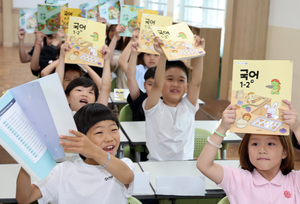
Students at Modong Elementary School in Sasang-gu, Busan, hold up their new textbooks for the fall semester during a school reopening ceremony on Aug. 11, 2025. (Newsis) For foreign national parents living in South Korea, choosing a school for their children can involve unfamiliar rules, documents and terminology.Children can enter Korea’s public school system regardless of their nationality, immigration status or Korean-language ability. Unlike Korean families, however, foreign national parents generally have to initiate the enrollment process themselves.Elementary and middle school education is compulsory in Korea, and public schools do not charge tuition. Families may also consider international schools, although admission requirements and fees vary widely.Admission and tuitionKorean children approaching elementary school age normally receive an enrollment notice from their local government. Foreign families, by contrast, may need to contact a school or the education office serving their place of residence.A parent or guardian may apply for a child’s admission or transfer to a school in the district where the family lives.Schools may verify the child’s entry and departure records, foreign resident registration or other information showing that the family resides in the district. Parents may be asked to consent to the school checking the records through government authorities.If official immigration or registration records are unavailable, families may submit other documents showing their place of residence, such as a lease agreement.Children who have previously attended school abroad may also be asked to provide enrollment records, transcripts or other documents showing the education they have completed. The school will then determine the appropriate grade based on the child’s age and educational background.A lack of legal immigration status alone should not prevent a child from attending school.Public elementary and middle schools do not charge tuition, although families may still have to pay for meals, after-school programs, school trips or other activities.Most high school students are covered by Korea’s tuition-free education program, which covers admission fees, tuition, school operation fees and textbook costs. Some private schools permitted to set their own tuition are excluded.International schools generally charge substantially higher fees. According to Education Ministry data released in 2025, annual tuition for high school programs at international schools averaged about 26.4 million won ($18,400) as of October 2024, excluding admission fees.International schoolsSchools commonly described in English as international schools do not all have the same legal status in Korea. One legally recognized category is “foreign school,” established primarily to educate the children of foreign nationals. Such schools generally teach in a language other than Korean and follow curricula that differ from those of regular Korean schools. Most use English, although some operate in Chinese, Japanese or other languages.A student is generally eligible to apply if at least one parent is a foreign national, regardless of the student’s own nationality.Korean nationals may also apply if they have lived abroad for at least three years. The law does not separately require them to have attended school overseas throughout the entire period.Parents should check with individual schools and the relevant education office about how overseas residence is calculated and what documents are required.Korean nationals who meet the eligibility requirements may generally account for no more than 30 percent of a foreign school’s authorized enrollment. A regional education superintendent may raise the ceiling by up to 20 percentage points, allowing a maximum of 50 percent.The linguistic and cultural makeup of the student body can differ significantly from one school to another. Parents may therefore want to ask which languages students commonly use, what nationalities are represented, and what support is available for children who are new to Korea.Check the school’s legal statusParents should also distinguish legally authorized foreign schools from private institutions that use terms such as “international school” in their names or promotional materials.An unauthorized institution may offer classes and curricula similar to those of a recognized foreign school but is not legally classified as a school in Korea.Elementary, middle or high school education and qualifications from such institutions may not be recognized under the Korean education system.Students who do not otherwise hold a recognized Korean or foreign qualification may need to take a school equivalency examination before entering their next school or university.The outcome may differ if the student has completed an accredited foreign curriculum or obtained another qualification recognized in Korea.Before enrolling a child, parents should check whether the relevant education office has authorised the institution, and confirm whether academic records or diplomas received there will be accepted.Foreign families who need help with enrollment, Korean-language education or school placement can contact their local education office or regional multicultural education center.
Moving to Korea with children? Here is how the school system works
For foreign national parents living in South Korea, choosing a school for their children can involve unfamiliar rules, documents and terminology. Children can e
755 words~3 min read