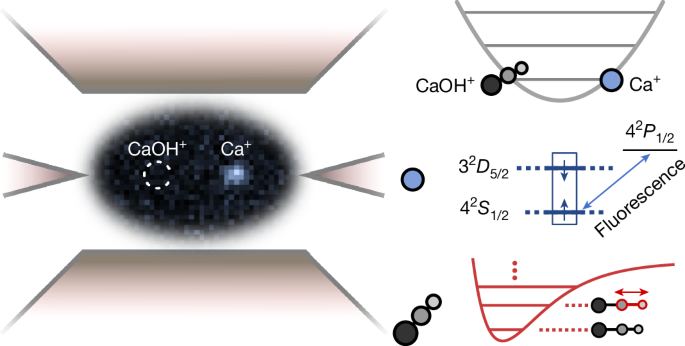
MainAbsorption spectroscopy is one of the most fundamental methods to investigate light–matter interaction and has long been accepted as a standard method1. Usually, the fraction of the transmitted light is measured, which reveals quantities such as the absolute absorption cross section5,6. Measuring the fraction of absorbed light becomes difficult when investigating a single atom or molecule, as fluctuations and the inherent quantum noise of light often dominate the signal2,3. Nevertheless, there have been several demonstrations of detecting the absorption of light in a single atom or molecule with visible light7,8,9. These experiments are performed with a large number of photons being absorbed by the atom or molecule to produce a sufficient absorption signal and require efficient and low-noise photon detectors that are not available for a large part of the electromagnetic spectrum.For molecular ions that repel each other, it is difficult to obtain a dense sample for performing efficient absorption spectroscopy and often requires techniques that are applicable to single molecules. Thus, it is common to investigate molecular ions through the secondary actions that occur when the molecule absorbs light, such as photodissociation10,11,12, charge transfer13, fragmentation14 and inelastic collisions15,16. In contrast to these methods, which often perturb the molecular state or even destroy the molecular ions, recent efforts have been made to use quantum logic spectroscopy for detecting the state of the molecular ion by a co-trapped atomic ion in a non-destructive fashion17,18,19,20. Quantum logic spectroscopy enables spectroscopy on intramolecular transitions by monitoring the state of the system and its changes due to interaction with light18,21. So far, these experiments are limited to molecular species with relatively simple internal structure and are predominantly applied to diatomic molecules.We use the same principle of quantum logic spectroscopy, probing the light–molecule interaction by a co-trapped atom, but we choose to detect photon absorption events directly using the recoil that a single absorbed photon exerts on the molecule. This detection technique is known as recoil spectroscopy and has been applied to study atomic transitions4,22. Similar to traditional quantum logic spectroscopy experiments, the molecular ion is co-trapped with an atomic ion on which the recoil can be read out, as shown in Fig. 1. The recoil is transferred onto the atom by the Coulomb interaction, which couples the external motion of both trapped ions. The quantum state of the motion of the atom can then be mapped onto its electronic states and read out using quantum information processing techniques23.Fig. 1: Schematic of the system of a trapped two-ion mixed-species crystal for performing molecular spectroscopy.The system is considered here to possess three degrees of freedom: a harmonic oscillator describing the in-phase motion of the crystal, a two-level system in the atomic ion for quantum logic operations and the intramolecular vibration.Usually, the recoil of a single photon is so small that its effect on the motion of the atom cannot be measured straightforwardly for reasonable experimental parameters. However, it is possible to amplify the signal of such a recoil by exploiting non-classical states of motion of both ions. For instance, it has been shown that preparing the motion in a so-called ‘Schrödinger cat’ state enables the detection of photon absorption4. A sketch of the measurement procedure is shown in Fig. 2. So far, this method has only been demonstrated on atomic transitions in which the collective recoil of multiple photon absorption and emission events was measured4. In this work, we demonstrate the first implementation of this method for detecting single-photon absorption on a molecular ion.Fig. 2: Cat-state spectroscopy for detecting the photon absorption recoil.Sequence diagram of the cat-state spectroscopy for detecting the photon absorption recoil on the molecule (left) and the evolution of the motional wavepacket of the ion crystal in-phase space (right). The procedure consists of the following steps: initial ground-state cooling of the ion motion, generation of the recoil-sensitive cat state, excitation of the molecular transition, reversal of the cat-state generation operation and the detection of the photon absorption recoil on the atomic ion. This process generates entanglement between the atomic qubit and the motion of the ion crystal, such that the signal of single-photon absorption recoil is amplified and transformed into a geometric phase shown by the shaded area. This is then mapped to the state of the atomic ion, which can be detected by fluorescence.Photon absorption detectionTo illustrate the absorption detection method, we consider an atomic and a molecular ion co-trapped in a Paul trap, in which we aim to detect photon absorption on the molecular ion. Regardless of the nature of the molecular transition, the excitation is detected based on its influence on the motion of the two ions. We can thus describe the detection method with the internal state of the atomic ion and the combined motional state of the ion crystal. The internal state of the atom is modelled by a two-level system with energy eigenstates |↑⟩ and |↓⟩, which can be manipulated and read out by applying laser pulses23. It is convenient to describe the motional states of the two ions by their collective motional modes that arise because of the Coulomb interaction. In our case, the relevant collective motion is given by a single-mode harmonic oscillator with its general state in the Fock state basis \({\varPsi }_{z}={\sum }_{n}{c}_{n}|n\rangle \). In particular, we target the axial in-phase mode of the mixed-species two-ion crystal24.We first introduce the dynamics of a single-photon absorption event in this system. Momentum conservation dictates that the absorption of a single photon not only excites a molecular transition but also transfers momentum from the photon onto the molecule. In an ion trap, this momentum transfer can be described by applying a displacement operator \(\hat{D}({\rm{i}}{\eta }_{{\rm{m}}})\) (ref. 25). The magnitude of this displacement is given by the corresponding Lamb–Dicke parameter of the molecular transition:$${\eta }_{{\rm{m}}}=\sqrt{\frac{\hbar }{2{M}_{{\rm{m}}}{\omega }_{z}}}{k}_{z,{\rm{m}}}{e}_{z,{\rm{m}}},$$
Infrared absorption spectroscopy of a single polyatomic molecular ion - Nature
Non-destructive single-molecule absorption spectroscopy is achieved by detecting photon recoil from a trapped molecular ion, enabling single-photon-sensitive measurements of molecular vibrational transitions.
7,642 words~35 min read