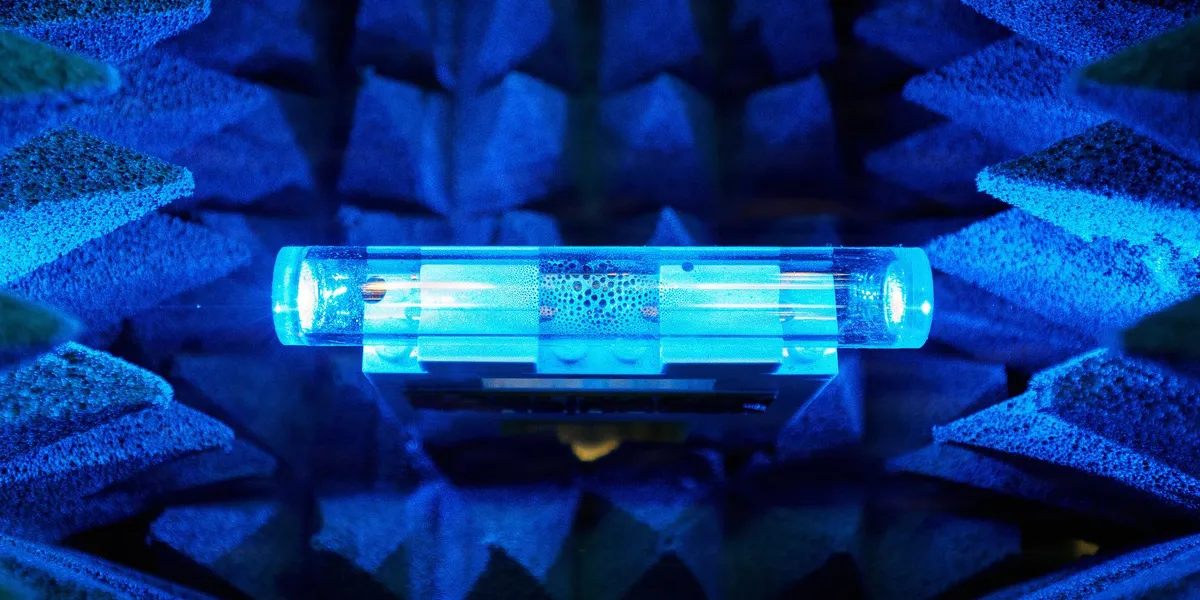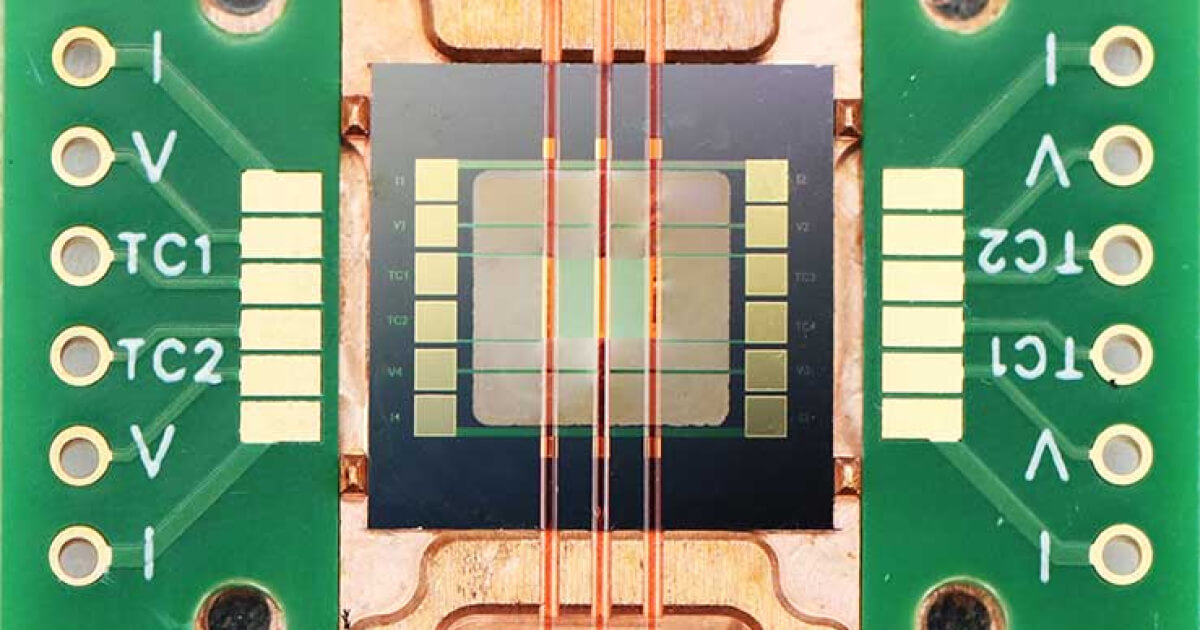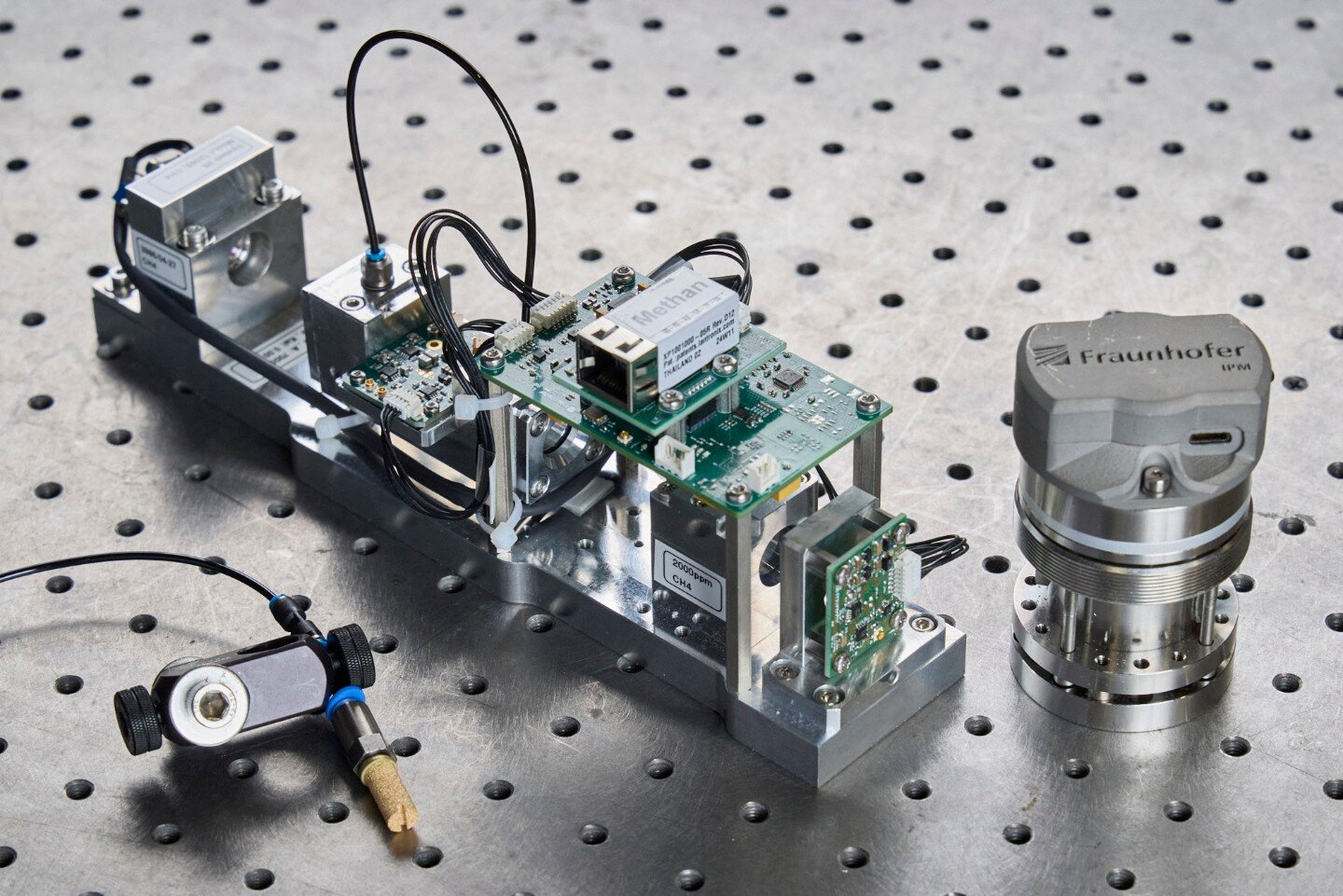
The innovative sensor principle continuously determines its own resonant frequency and automatically adjusts the optical excitation accordingly. Credit: Fraunhofer / Piotr Banczerowski
The photoacoustic effect has been known for more than 150 years: Gases exposed to light heat up. Pulsing the light generates periodic pressure fluctuations, or sound waves, with frequencies that can be uniquely assigned to individual gases. This photoacoustic effect forms the basis for a measurement method that is highly precise even at low gas concentrations. Despite its high sensitivity, the method has previously only occupied a niche, primarily because it relies on a resonator for acoustic amplification. This resonator is highly sensitive to even the slightest changes in air pressure, temperature or mechanical stress. However, ensuring an accurate measurement requires the system to precisely hit the correct resonant frequency.
A light-emitting diode makes all the difference
This is precisely where the team led by Christian Weber, Katrin Schmitt and Johannes Herbst from Fraunhofer IPM has achieved a breakthrough. The researchers have developed a sensor principle that uses a small light-emitting diode to continuously determine its own resonant frequency and automatically adjust the optical excitation accordingly.