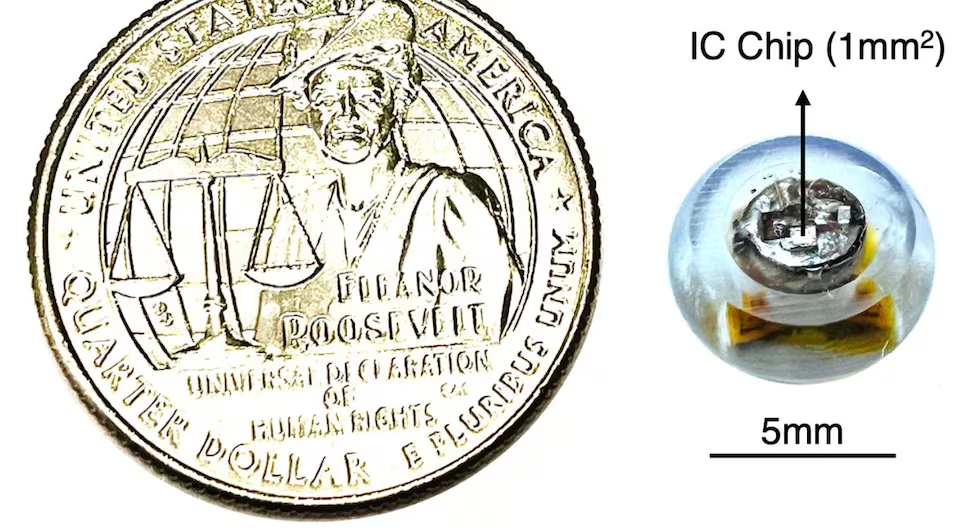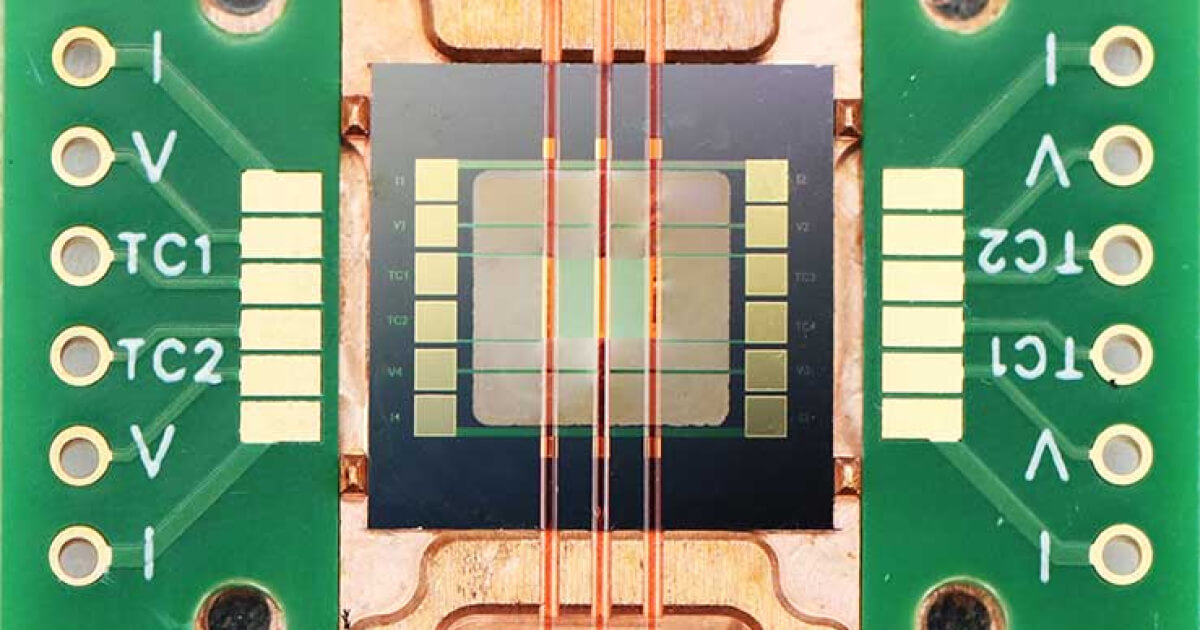
When living cells grow, divide, or respond to drugs, they give off tiny amounts of heat that offer information about what the cells are doing. But since these heat signals are so vanishingly small, they have been traditionally impossible to measure directly. Researchers in the Harvard John A. Paulson School of Engineering and Applied Sciences (SEAS) have developed a calorimeter — a device that measures the heat transfer between a living system and its environment — that can detect metabolic heat signals on the order of 100 picowatts, or trillionths of a watt, in living cells. The device is the most sensitive of any comparable bio-calorimeter to date. The new “pico-calorimeter” can track the metabolism of small populations of bacteria in real time, as well as monitor how bacterial growth changes in response to different antibiotics. The work is from the lab of Joost Vlassak, the Abbott and James Lawrence Professor of Materials Engineering, and was carried out by Harvard associate Juanjuan Zheng, a former postdoctoral researcher in Vlassak’s lab. The research is published in Proceedings of the National Academy of Sciences. Directly measuring heat from cellsBiologists can often only measure cellular metabolism via indirect calorimetry, for example by measuring oxygen consumption or chemical byproducts. By contrast, the SEAS device measures heat itself. “Heat is a direct measure for cellular metabolism,” Vlassak said. “As the cells are going about their business, we see very nice exponential growth, depending on the media.”
A Heat Sensor for Living Cells
Pico-calorimeter could offer new views of cell metabolism, rapid antibiotic testing
TL;DRAI
Harvard's pico-calorimeter measures 100-picowatt metabolic heat in cells, enabling real-time bacterial growth and antibiotic resistance tracking. This accelerates sepsis diagnostics and drug-response assays from days to hours, with commercial applications through a spinoff company.
872 words~4 min read