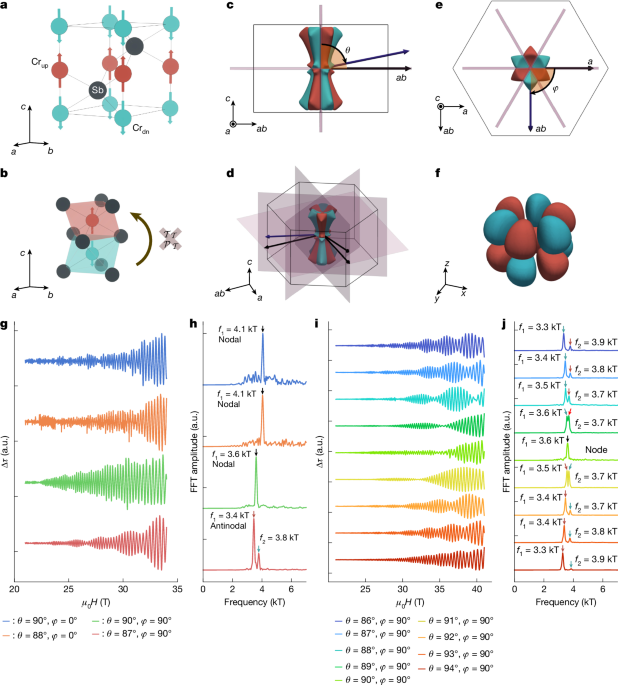
MainThere are two traditional types of collinear magnetic ordering: ferromagnetism1,2, in which all spins point in the same direction, and antiferromagnetism15, in which the spin polarization alternates up and down from site to site. In an antiferromagnet, the magnetic structure can be decomposed into two magnetic sublattices, resulting in a doubling of the magnetic unit cell16 under translation. Recently, a third distinct classification was proposed, dubbed altermagnetism9,10,11,12,13. Like antiferromagnets, altermagnets possess alternating up- and down-spin orientations from site to site. However, the distinction is that in an altermagnet the spin sublattices are connected by rotational symmetries rather than just translation (or inversion). This leads to the lifting of Kramers spin degeneracy17 and a momentum-dependent non-relativistic spin splitting of the electronic band structures18. Therefore, altermagnetism represents a distinct form of ordering, in which the momentum-dependent spin-split property of ferromagnets is combined with the spin-compensated zero net magnetization of antiferromagnets, opening new opportunities for magnetic memory and spintronic device applications19.Numerous altermagnet candidates have been identified from ab initio calculations9,10,19,20,21, with experiments on MnTe giving good empirical correspondence with theoretical expectations22,23,24,25. However, although many semiconducting or insulating materials have been identified, only a handful of metallic altermagnet candidates have so far been proposed. The realization of a metallic altermagnet, with an ordering temperature far above 300 K, would be particularly desirable for efficient electronic transport in technological device settings21.Of metallic candidates, surface-sensitive photoemission spectra of RuO2 (refs. 26,27), KV2Se2O (ref. 28) and CrSb (refs. 29,30,31,32) have been interpreted to show hallmarks of altermagnetic spin splitting. However, for the case of RuO2, a variety of subsequent bulk-sensitive measurements33,34,35 cast considerable doubt on whether this material is an altermagnet. Further photoemission studies36,37 showed that this material seems to possess a topological surface state with Rashba-like spin splitting, which may give the appearance of altermagnetically lifted Kramers spin degeneracy although the bulk is actually nonmagnetic. A similar story has unfolded with KV2Se2O, for which the surface termination layer may be altermagnetic38, yet neutron diffraction clearly resolves conventional antiferromagnetism throughout the bulk39. These cautionary tales motivate bulk-sensitive studies of candidate altermagnets, to firmly establish their intrinsic magnetic properties.Nodal magnetic order parametersWe can frame our thinking of magnetic order parameter symmetries by analogy to unconventional superconductors. In a conventional s-wave BCS superconductor, the order parameter is the gap function \(\Delta ({\bf{k}})\), which is an isotropic energy separation corresponding to a dispersion possessing the same symmetries as the crystal. By contrast, unconventional superconductors4 are those in which the pairing symmetry breaks crystal point group symmetries, or where the gap function exhibits a non-trivial phase structure (like a sign change) not required by the crystalline symmetry.These concepts have recently been applied to magnetic systems5,6. Let us define the order parameter for an unconventional magnet as the exchange splitting (energy difference) between up- and down-spin states at a given wavevector, \(\Delta ({\bf{k}})=E({\bf{k}},{\rm{\uparrow }})-E\,({\bf{k}},{\rm{\downarrow }})\). This produces spin-split Fermi sheets separated by the (perpendicular) wavevector \({k}_{\perp }\simeq \Delta ({\bf{k}})/(\hbar {v}_{{\rm{F}}})\), where vF = ∂E/(ħ∂k) is the Fermi velocity. In this way, a ferromagnet is analogous to a BCS superconductor—its nonzero magnetization splits the Fermi surface into unequal majority and minority spin species, characterized by an isotropic energy gap between them. It follows that for an unconventional magnet of p-, d-, f- and g-wave symmetry, the Fermi surface will possess 1, 2, 3 and 4 highly symmetric nodal planes, respectively, at which up-character swaps to down, and vice versa.CrSb crystallizes in the hexagonal P63/mmc NiAs-type structure, with chromium atoms stacked along the crystallographic c-axis in octahedrally coordinated layers, whereas the antimony atoms fill the interstitial sites in a trigonal prismatic arrangement40 (Fig. 1a,b). Below an ordering temperature of around 740 K (Extended Data Fig. 1), the chromium sites possess alternating magnetic moments oriented along the c-axis41. The trigonal arrangement of antimony necessarily requires a 63 screw rotation to map a spin-up chromium site to its spin-down counterpart. Consequently, although CrSb breaks both pure timereversal and primitive lattice-translation symmetries, it preserves a combined symmetry pairing this non-symmorphic spatial operation with time reversal. These symmetry properties motivate the proposal10,13,21,32,42,43 that CrSb is a metallic altermagnet in which \(\Delta (G{\bf{k}})=-\Delta ({\bf{k}})\), where G is this composite operation.Fig. 1: Nodal planes bisect g-wave-symmetric spin-split Fermi surface sheets in CrSb.a, The crystal structure of CrSb, with alternating magnetic moments on the Cr sites oriented along the c-axis. Red indicates spin-up and blue indictes spin-down. b, The trigonal arrangement of the antimony ions means that mapping a red chromium site to a blue one necessarily requires a screw rotation. c–e, The primary Fermi surface sheet of CrSb is a closed 3D ellipsoidal pocket, shaped like a dogbone. Nodal planes—where spin degeneracy is imposed by symmetry—are given by thin shaded slabs. The azimuthal angle φ is defined as the inclination from a to ab in the hexagonal basal plane; the polar angle θ is from c towards the basal ab plane. f, Visual depiction of the \({{\mathcal{Y}}}_{4}^{-3}=yz\,(3{x}^{2}-{y}^{2})\) real spherical harmonic, which characterizes the g-wave symmetry profile of altermagnetic spin splitting in CrSb. g,h, Quantum oscillations in the background-subtracted magnetic torque Δτ (g), rescaled to the same maximal amplitude and high-pass filtered for ease of presentation (see Methods for details) at magnetic field H orientations as indicated, and their FFT frequency spectra (h). A singular FFT peak is observed in the three nodal orientations, which splits into two peaks in the antinodal plane (coloured red). All measurements were performed at 0.4 K. i,j, Δτ and corresponding FFT spectra for small rotations of θ in the antinodal plane away from the ab direction towards ±c. For H aligned along ab, only one frequency is observed, which elsewhere splits into two distinct peaks, indicating altermagnetically spin-split Fermi sheets. a.u., arbitrary units.Quantum oscillation measurementsIn this work, we map the symmetry of Δ(k) in CrSb by performing magnetic quantum oscillation measurements through the de Haas–van Alphen effect14,44, and show that this material is a g-wave altermagnet. Quantum oscillation experiments are an especially well-suited technique for resolving the nodal planes of an unconventional magnet, and hence the order parameter symmetry. This is because Δ(k) does not just go to zero for k on a nodal plane—it is also mirror-symmetric about the plane. Aligning a magnetic field within a nodal plane therefore produces quantum oscillation orbits for up- and down-spin Fermi sheets that are different, but can be mapped onto each other by a mirror operation about the nodal plane, and which therefore enclose the same area. This leads to a single quantum oscillation frequency per Fermi pocket for fields in nodal planes. By contrast, for fields oriented away from nodal planes, the up- and down-spin Fermi sheets are not related by any symmetry operation, and therefore typically enclose different areas, leading to two distinct quantum oscillation frequencies. This thereby yields an expected smoking-gun signature of altermagnetic spin splitting.Throughout this article, we shall refer to rotations of the orientation of an applied magnetic field H through azimuthal angles φ defined in the crystallographic ab plane, and polar angles θ between c and the ab plane (Fig. 1c,e). Note that for hexagonal CrSb, the a direction is equivalent to b. The c−a plane is a highly symmetric nodal plane in which Kramers degeneracy is enforced by symmetry, whereas c–ab is antinodal, in which spin degeneracy is only symmetry-enforced at c and ab. In CrSb, g-wave splitting should result in nodal planes every δφ = 60° for rotations in the a−ab plane, and every δθ = 90° rotating through the c−ab plane.We present the experimentally deduced central Fermi surface pocket of CrSb, with its high-symmetry nodal planes between up and down sheets, in Fig. 1c–f. This sheet is a closed ellipsoid-like pocket of hole character, shaped like a dogbone. In Fig. 1g, we plot background-subtracted magnetic torque Δτ as a function of H, to focus on the oscillatory component, measured by cantilever beam magnetometry (Methods). The blue waveform was measured for H ∥ a at θ = 90°, φ = 0°, with the orange data collected a small rotation away in the c−a plane to θ = 88°, φ = 0°. The corresponding fast Fourier transform (FFT) spectra in Fig. 1h for both of these orientations exhibit a singular frequency peak at 4.1 kT.Tracking \({\boldsymbol{\Delta }}({\bf{k}})={\boldsymbol{E}}({\bf{k}},{\boldsymbol{\uparrow }})-{\boldsymbol{E}}({\bf{k}},{\boldsymbol{\downarrow }})\)
3D bulk-resolved g-wave altermagnetic order parameter in CrSb - Nature
Quantum oscillation measurements map the g-wave altermagnetic order parameter in CrSb, establishing it as a prototypical unconventional magnet with momentum-dependent spin splitting.
8,529 words~39 min read