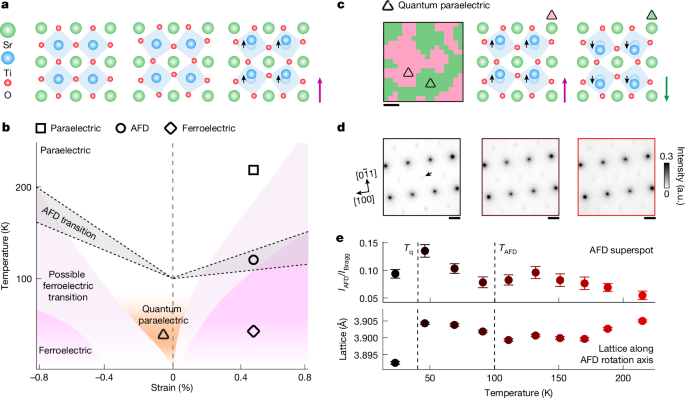
MainBulk SrTiO3 hosts distinct structural phases (Fig. 1a). In the high-temperature cubic phase, the titanium ions sit at the centre of the oxygen octahedron and strontium corner atoms. A so-called antiferrodistortive (AFD) structural transition occurs below TAFD ≈ 105 K and involves rotations of oxygen octahedra in opposite directions21, leading to a tetragonal phase and a doubling of the unit cell along the rotational axis. This AFD transition maintains centrosymmetry of the crystal. Further cooling is accompanied by a large rise in the dielectric function, indicating proximity to a polar, ferroelectric transition4,5,6. However, in pure SrTiO3, quantum paraelectricity manifests as deviation from classical Curie–Weiss behaviour below the temperature Tq ≈ 40 K, and long-range ordering of polar displacements does not set in, purportedly due to quantum fluctuations of opposite polarization states.Fig. 1: Structural transitions in the SrTiO3 lamella.a, Structural phases of bulk SrTiO3. From the cubic paraelectric to the AFD tetragonal phase, TiO6 octahedra undergo out-of-phase rotations, lowering the symmetry to tetragonal. In the ferroelectric phase, titanium atoms shift away from the centre of the TiO6 octahedra, leading to an electric dipole moment. b, Phase diagram of SrTiO3 as a function of temperature and strain. The stabilization of a long-range ferroelectric phase can also be realized using calcium doping or oxygen isotope substitution. The parent SrTiO3 phase transition follows the grey dashed line, entering the AFD phase at around TAFD ≈ 105 K followed by a quantum paraelectric regime at lower temperatures. The phase diagram is based on previously published data53. c, Schematic of polar nanodomains in quantum paraelectric SrTiO3, with spatial fluctuations of polarization orientations at the nanoscale (10 × 10 nm2 field of view). d, Electron diffraction patterns collected at 23 K (left), 91 K (middle) and 172 K (right). Black arrows mark the AFD superspots located at half-integer positions. Scale bars, 0.1 Å–1. a.u., arbitrary units. e, Quantification of AFD superspot intensity, IAFD/IBragg (top), and the lattice parameter along the AFD-rotation axis (bottom). Two anomalies near TAFD and Tq are highlighted by black dashed lines. The SrTiO3 lamella used for STEM imaging thus retains the bulk-like structural transitions.SrTiO3 has further anomalous dynamics that precede and influence this quantum regime. A transverse acoustic phonon mode partially softens at a finite wavevector, q, hinting at a possible new state with spatial correlations at the nanometre scale7,8,9,10,11,12. Pinpointing the precise structure—both below and above Tq—could unveil the nature of quantum paraelectricity in this prototypical system. Here we leverage liquid helium cryogenic scanning transmission electron microscopy (STEM) to directly image local polarity in a SrTiO3 lamella down to very low temperatures (about 20 K), revealing a spatially fluctuating and evolving landscape of nanoscale polar textures (Fig. 1c).Structural transitions in SrTiO3
Imaging of nanoscale polar textures in quantum paraelectric SrTiO3 - Nature
Cryo-STEM reveals that SrTiO3 forms periodic polar nanodomains below 105 K, but these fragment below 40 K, linking quantum paraelectricity to nanoscale polar ordering and disordering.
7,098 words~32 min read