Moon Ki-hoon
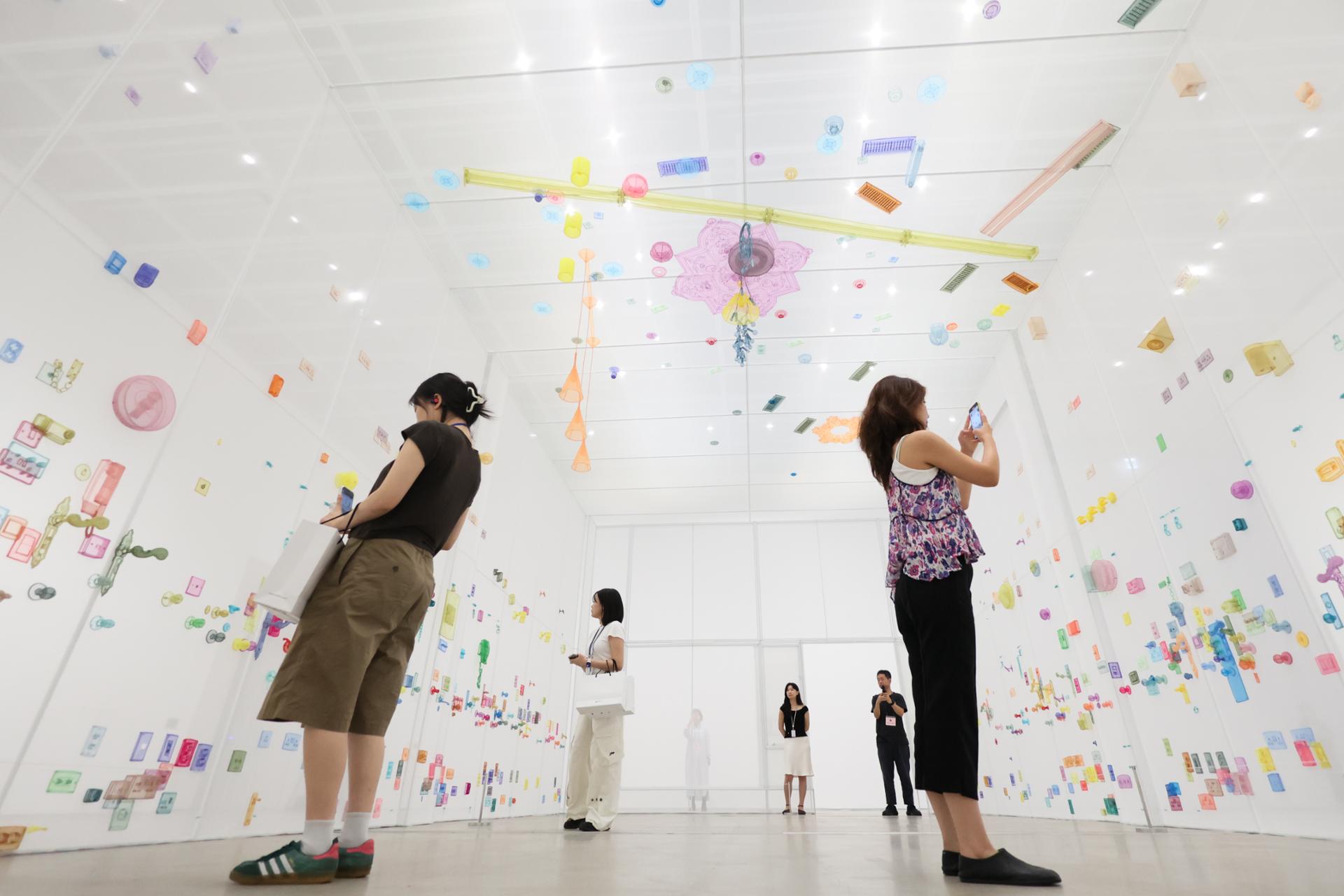
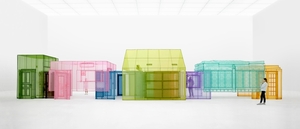
MMCA's 500-work survey opens with the artist's childhood carvings, closes with fatherhood "Nest/s" (2024) by Suh Do-ho (MMCA) Few Korean artists are in higher demand, at home or abroad, than Suh Do-ho. The world knows him as the artist who rebuilds the houses he has lived in at full scale in translucent polyester.Be it a hanok in Seoul or a studio in New York, each detail, down to the doorknobs and light switches, is rendered in bold colors that pull the eye from across the room.The reading that has built up over shows at the Whitney, the Smithsonian and, last year, Tate Modern is a story about nostalgia and the stubbornness of memory, of a nomad who left Korea in his late 20s and never let go of a single home.Less familiar here and even less so abroad is what came before the leaving, and that is where the National Museum of Modern and Contemporary Art in Seoul begins its survey of the artist. Seen from New York or London, the hanok that keeps turning up in Suh's fabric structures looked like an exotic note, a piece of somewhere foreign set against Western rooms. Seen from Seoul, it is simply the house he happened to grow up in. That puts the questions that cut across Suh's oeuvre — how a body moves through a room, what connects a person to a space — ahead of any fact of displacement, and makes leaving one event in his life rather than the whole story."If I had grown up in an apartment in Seoul, I would have made that apartment out of fabric," Suh told reporters at a press preview Wednesday. "It was never about using a Korean image strategically to get ahead." Installation view of "Do Ho Suh" at the National Museum of Modern and Contemporary Art, Seoul (MMCA) The exhibition brings together more than 500 works, the largest of Suh's career, though the artist insisted more than once that it is not meant as a retrospective. If Tate covered roughly the last decade, this one, in his words, "runs from my kindergarten drawings to the very latest."That is, quite literally, what the show is. The corridor leading into the galleries has been turned into a section titled "Seed Bank," a dense cabinet of everything that predates Suh's professional career: wooden sea creatures carved in the yard of his childhood home, a military-style high school uniform, rudimentary sketches and installations from his student years, and his graduation project from Seoul National University."The seeds of everything I've done over the past 30 years are all there," Suh said. "Honestly, it feels like standing here with no clothes on." Installation view of "Do Ho Suh" at the National Museum of Modern and Contemporary Art, Seoul (MMCA) From there the show moves through some 200 drawings, many made with thread pressed into handmade paper and strewn with loose tangles of line that look like stitching come undone. Then come the rubbings: the full-size ghost of his family's old Seongbuk-dong hanok in graphite on mulberry paper ("Rubbing/Loving: Seoul Home," 2013–2022), an exquisite shell with nothing inside, and behind it the grim, darkened walls of a theater troupe's company housing in Gwangju ("Rubbing/Loving: Company Housing of Gwangju Theater," 2012), one of the few works here where an otherwise personal memory carries the weight of history. "Haunting Home" (2019) by Suh Do-ho (MMCA) The biggest pieces arrive last. "Perfect Home" (2024) lets viewers walk through Suh's current London flat, with fixtures from every previous home pinned to its walls like specimens; the 22-meter "Nest/s" (2024) strings rooms from four cities together in candy-colored polyester. "Who Am We?" (2000), a crowd portrait of sorts, covers the walls of a 15-meter-high room with yearbook faces shrunk to the size of grit. "Perfect Home: London, Horsham, New York, Berlin, Providence, Seoul" (2024) by Suh Do-ho (MMCA) The one real addition to previous shows comes at the end in the MMCA Studio, and it happens to be the most intimate: children's jackets and socks folded one after another, drawings made together with his kids. A new coat, "Memory of Love" (2026), is lined with pockets cut from his family's own clothes, each holding a small keepsake.The fabric houses the world knows, Suh pointed out, were nearly all made when he was single. "There was nobody between me and the room," he said. "Then I married and had children, and suddenly there were people in between. All the stories that came out of that got folded into the house." "Memory of Love" (2026) by Suh Do-ho (MMCA) The selection is personal to the point of excess, and the sheer overload of stuff in the early rooms occasionally disorienting. But that, more or less, is how memory works; it refuses to sort itself out and hangs onto the odd thing as it glosses over the important one, like a dream you can barely recount the next morning.The show convinces less because it sends one back to bygone rooms of one's own than because it gets that unruliness and impermanence right. This is where the materials come in: rendering something as large and immovable as a house in fabric or paper is not a bid for accuracy, and Suh said as much when asked about the gap between fading memory and ever more detailed reconstruction. "Apartment A, Corridors and Staircases, 348 West 22nd Street" (2012) by Suh Do-ho (MMCA) "Fabric has its physical limits. However specific I try to make it, it can't hold the detail of something like 3D printing. Some things get lost, and I knew that going in," he said. "And I have no wish to get it as close to reality as possible. Memory summons the past from whatever information it has, and how much is never the same. What stays, in the end, are the things my hands touched the most."For Suh, the show also fills a gap that has bothered him for years. Critics in the US, he said, only ever cared about what he made after art school there, and once he became known back home, nobody here asked about the years before either."People walk through my houses and wonder why they're thinking about their own house, their own life," he said. "I don't know what to call that. But it's something positive, and I wanted to share it with as many people here as I could.""Do Ho Suh" opens Thursday at MMCA Seoul in Jongno-gu and runs through Feb. 9. Parts of the show travel afterward to the Museum of Contemporary Art Tokyo and M+ in Hong Kong.