Kim Hoo-ran
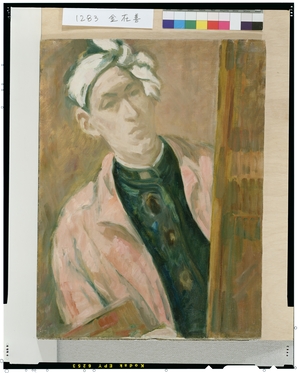
Relative donates two works by Kim Jae-seon, whose work was presumed to have been completely destroyed by his family when he died of TB in 1948 “Self-portrait” (1941) by Kim Jae-seon (Tokyo University of the Arts / DNPartcom) Every family has its own lore. Older family members recall a person or incident related to the family that they have heard about from their elders. Although details are often lacking, these stories are passed down from one generation to the next as a crucial part of the family’s shared history. Retold enough times, they acquire the status of family lore.For years, Diana Kang had dismissed a tall tale repeated at big family gatherings as mere family lore. For as long as she could remember, the retired businessperson and art aficionado had heard about a family member who had studied painting in Japan and who tragically passed away at a young age.“When we were young, every time our families got together, our mothers talked about their uncle, who is our great uncle,” says Kang at her home in Seoul overlooking the Han River on April 4. Seated next to Kang is Sandy Yi, her maternal cousin, visiting from the US.“'Our uncle was a great painter,' they would say,” Kang recalls. “I actually never paid attention until two years ago when we got together for a family reunion in Hawaii,” Kang says. Nine members of the family, including two aunts and an uncle, had gathered in Hawaii in May 2024.Once again, the story of the long-gone painter uncle wound itself into conversation as family members discussed how he was such a great painter and how he was so popular.“So, for the first time, I asked, ‘Oh, what’s his name?’” Kang says.At the airport on her way back to Seoul at the end of May, with a bit of time to kill, Kang looked up the name on Naver. “And the name Kim Jae-seon came up!” Kang says.Surprised and thrilled, Kang shared the link with the family, but by early June when she was back at home, she had forgotten all about it.That is until Kang ran into Kim In-hye, chief curator at the National Museum of Modern and Contemporary Art, Korea, who was also one of the lecturers for an art class she was taking with her friends. Diana Kang speaks during an interview with The Korea Herald at her home in Seoul, April 6. (Yoon Chang-bin/The Korea Herald) “I sent a picture of this (an image of a self-portrait by Kim Jae-seon found on Naver) and sent her a message asking if she knew about the artist,” Kang says, sounding excited as she recalls the moment.Chief curator Kim not only knew about the artist, she also said that his painting “Seated Boy” was in a private collection. Kim said she would let Kang know when there was an exhibition.This bit of news came as a pleasant surprise: Kang’s family thought that none of Kim’s paintings had survived. Kim had died of tuberculosis in 1948, and the family, afraid the highly contagious disease would spread, had burnt everything in his studio, including his photographs.By some miracle, a painting had survived.Two weeks later, Kang was having lunch with another lecturer from her art class, Kim Jung-wha, a former head of the Seoul Museum of Craft Art.After hearing the story about Kang's great uncle, Kim suggested that she call Kim In-hye right away.“Kim Jung-wha said to tell her that I wanted to buy the painting from the private collector and to tell her that I would donate it to the museum,” Kang recalls. “Deep in my mind, I was like, ‘But I don’t even know how expensive it is.’”At the end of June, Kang made that call to Chief Curator Kim at MMCA. Kang told Kim that the family was interested in buying the work and asked if she could inquire as to whether the collector was willing to sell.“Kim called me to say the collector said he was willing to sell because we are the family,” Kang recalls.Now that the painting was available for purchase, she enlisted the help of a friend at a gallery, saying, “It’s very difficult for me to negotiate price. So, why don’t you get involved?”“I asked her to call Chief Curator Kim at MMCA and the private collector and find out how much the collector was willing to sell it for.”Kang’s anxiety compounded after she learned that MMCA had been interested in purchasing “Seated Boy” when it was shown at an exhibition several years ago, but that the work was too expensive for the state-funded institution.“If it is too expensive for a museum, I cannot buy it either," Kang recalls thinking.But she need not have worried. Learning that it would be bought by the family, the collector offered the painting for one-fifth of the price he had asked of the museum, Kang explains. “The collector was very considerate.”Though the collector chose to remain anonymous, Kang thinks he could have been a relative of the artist’s close friend.With her birthday coming up soon, Kang’s husband, Kang Sung-yong, offered to pay for it and ultimately, the money was sent on July 12, the day of her birthday.MMCA Chief Curator Kim then picked the painting up from the collector and brought it to the gallery.“I called my aunt and said, ‘Imo, I got the painting back in the family,’” Kang says.“My mom remembered the family burning everything in her uncle's studio and used to say how she had wanted to keep a couple of the paintings and how she was so sad,” Kang adds.Kang’s maternal aunt, Yi’s mother, 91, died on July 16 from pancreatic cancer, happy with the knowledge that a family treasure had been recovered.Kang’s family and friends remarked that all the years of art classes might have been for this moment: Kang has been taking art classes with friends for some four years and travels to art fairs and museums around the world.“The timing was so wonderful. I was able to find the source, buy it and have it back in our family within five, six weeks,” Kang says, expressing wonder at the serendipity of it all. Diana Kang poses holding "Still Life" in front of "Seated Boy" at her home in Seoul in July 2024, the day Kim Jae-seon's paintings arrived. (Courtesy of Diana Kang) But there was more surprise in store. When the collector sent “Seated Boy,” he also sent along a still life of fruit, which he thought could also be by Kim Jae-seon.“And that connected to the stories we had heard about still life paintings,” Yi says.“They (the family) used to say he was a very good-looking person, tall and good-looking. They would bring, you know, an apple or an orange to the studio and he would paint still life with it,” Kang says. “And my mother, being kind of mischievous, would go in and eat all the fruit.”Kim would scold his elementary school-age niece for doing that, Kang’s mother used to say.“So, we heard all these stories. And when the collector sent the painting of that boy, he also sent along a small still life painting of fruit,” Kang says.While everyone in the family suggested keeping the fruit painting, Kang sent both paintings to MMCA. “The museum wanted both because they needed more pieces to build up the archive,” Kang explains.“Seated Boy” took pride of place over the dining table at Kang’s home until museum staff came to pick up the two paintings in October 2025. Diana Kang (right) and her cousin Sandy Yi pose for photos before an interview with The Korea Herald at Kang's home in Seoul, April 6. (Yoon Chang-bin/The Korea Herald) Decision to donateWhile the museum donation was initially suggested by Kim Jeong-wha at Seoul Museum of Craft and Art, Kang had also felt that it was not something just for the family.According to Kang, whether to donate “Seated Boy" was never a question."I think everybody in the family just thought that was a natural thing to do,” she says.“Actually, the response was that maybe we can find some more of his paintings to make more of a body of work,” Yi adds.“I wanted it to be shared with others and, if possible, I want other people to know more about him. Maybe have some research done about that period and about him in particular,” Kang explains.Kang admits that she did not know that donating artwork to a museum was a complicated process.First, it has to go through authentication. “There is a committee of experts who meet on a quarterly basis, or something, and they review all the art that is being donated and they have to come to a consensus as to whether a piece is worth accepting,” Kang explains.“For us, it took about eight months for them to go through the whole process. Finally, they said they’d take it and then they came and we signed them over,” Kang says. “We keep the copyright to the work.” You also get lifetime membership at the museum, she adds.Earlier in the day, the cousins had gone to the MMCA Gwacheon branch to see the paintings. It was Kang's first time seeing them after the donation and Yi's first time seeing the works in person.“It’s been almost six months since we gave it to them. It has been cleaned and you can see the colors much better and vibrant. Yes, it was so much better,” Kang says with a smile. “I’m glad he went to the museum.”Yi agreed that it was better for the preservation of the oil paintings.“I felt like, okay, it’s in the right place,” says Kang, describing how the limited-access storage facility looked like a safe place. “We had to put on special shoes,” adds Yi.Kim Jae-son, artist lost and foundAt her office at MMCA in Samcheong-dong on June 22, MMCA Chief Curator Kim In-hye suggests that “Seated Boy” may have been a work in progress, not completed.“I remember it as not being signed by the artist,” she says.How can it then be ascertained as Kim Jae-sun’s work?“He died very suddenly at the age of 30 and his wife, Song Gi, also a painter, followed him soon thereafter,” Kim says, adding, “There are newspaper articles about a posthumous exhibition in 1948 of the artists’ work organized by Lee Que-dae.” “Self-portrait in Traditional Coat” (1948-49) by Lee Que-dae (Private collection, courtesy of MMCA, Korea) Lee Que-dae (1913-1965), who studied art at Teikoku Art School in Japan from 1934 to 1938, was a pioneer of modern art in Korea and organized a number of artists’ associations. Despite his significance in Korean art history, research and exhibitions linked to Lee only picked up after 1988, when a ban on the artist — who had gone to North Korea at the end of the Korean War — was lifted.Among the organizations he established was Joseon Art and Culture Association, a group that was neither leftist nor rightist, formed in 1947. “In the rather small art circle at the time, this was sensational,” Kim explains.“Here was a young artist gathering together young artists in a third space when artists were being polarized into extreme left and extreme right,” Kim says. One of the artists joining Lee was Kim Jae-son, about five years Lee’s junior.“It’s only speculation, but I think Kim Jae-son was Lee Que-dae’s dear hubae (junior),” Kim says.“It is reported that when the two artists suddenly died, Lee Que-dae organized a posthumous exhibition for them. A brochure for the exhibition exists,” says Kim. "‘Seated Boy’ is on the cover of the brochure.” “Seated Boy” by Kim Jae-seon (MMCA, Korea) “That is why we see ‘Seated Boy’ as having been painted around 1948. Lee may have been working on it right up to his death, which leads to speculation that it may be an unfinished work,” Kim says.Unsigned, the work was credited to another artist at an exhibition in the 1990s, according to Kim at MMCA. The discovery of the 1948 posthumous exhibition brochure since then confirmed Kim Jae-son as the artist behind “Seated Boy.”“Still Life,” a much smaller work, was far easier to authenticate. Kim had written on the back of the canvas why he had made it — to mark an anniversary of his arrival in Japan — and had stamped his name on it.“Assuming he went to Japan in 1936 or 1937, this appears to be almost a practice piece. Of course, there are circumstances that point to his having studied art in Korea before going to Japan and this still life was made not long after. This means it was painted around the time he turned 20,” says Kim. “This was a painting made before his style had been formed.”While it is a typical still life that does not show any particular traits, it is a significant piece nonetheless because of the dearth of artworks from the late 1930s to 1945, Kim explains. “Still Life” by Kim Jae-seon (MMCA, Korea) The back of “Still Life” by Kim Jae-seon shows stamping of the artist’s name. (MMCA, Korea) “Paintings from 1945 to 1950 are even scarcer. It was a period of even greater chaos,” says Kim. Hence the significance of the discovery of “Seated Boy” possibly created during the tumultuous times of the US Army Military Government in Korea (1948-1950), following the surrender of Japan at the end of World War II.No photographs of Kim Jae-seon are known to exist, but there is a self-portrait that he painted as part of a graduation requirement at Tokyo School of Fine Arts that is kept in the collection of Tokyo University of the Arts today.Upon graduation in 1941, Kim returned to Korea and found a teaching position at a school. He passed away in 1948.Kim at MMCA suspects that there are many more Korean artists whose traces have disappeared, leaving behind only their self-portraits that remain in the Tokyo University of the Arts, than those who returned to Korea and made a name for themselves.Upon completing their studies in Japan, the Korean artists returned to their hometowns — some to hometowns in today’s South Korea and some to those in today’s North Korea. “We cannot trace those who returned home to the North,” Kim says.Kim has seen work that were circulating as Kim Jae-seon’s still life oaintings but says that those works, which rarely come on the market, could not be authenticated as Kim Jae-seon’s. “The evidence was too weak to establish it as his work,” says Kim.“It could be said that Kim is an artist who has vanished and about whom accurate assumptions are difficult to make for various reasons,” Kim says. “However, there are many such artists and we are currently conducting in-depth research on the theme.”Kim says Kang’s donation is a rare case of a surviving family member purchasing a particular work and donating it to MMCA. “Because the couple passed away at such a young age without any children, I didn’t think there would be surviving family,” says Kim.“'Seated Boy' doesn’t seem too remarkable when viewed as an image. But when you look at it in person, the feel of the brush strokes and the speed give off tremendous energy,” says Kim, explaining that this is the case with many unfinished works.The size of the painting is rather large for a work for that period, she adds, speculating that the artist may have been preparing for an exhibition organized by Joseon Art & Culture Association led by Lee Que-dae.It is a miracle that these oil paintings survive.“Even if they had not been burned by the family, they would most likely have been burnt during the Korean War (1950-53) as were so many modern paintings made before 1950. The war bears the biggest responsibility for the rarity of works before 1950,” she says.Relying on goodwillSome 60 percent MMCA's collection are donated works. The museum’s budget for acquisition, which this year stands at 4.1 billion won ($2.7 million), Kim says, makes acquisitions difficult.“With that kind of budget, one acquisition and that’s it,” says Kim.While the government encourages the museum to receive donations, pointing to overseas museums as examples to follow, Kim explains that the conditions here are different from those in other countries, where donors receive large tax benefits.Museums in the West also have powerful board members who donate money and also purchase works recommended by acquisition board members, according to Kim. This is a difficult model to follow in Korea, she adds.James Turrell’s “Imaginings, Wide Rectangular Curved Glass” (2021), acquired at a tune of 1.6 million won through donation by a group of business leaders that supports MMCA acquisitions, is a very special case, explains Kim.The work will be shown to the public as part of MMCA Gwacheon’s 40th anniversary exhibition, “Imaginations in Light,” which opens July 10.Meanwhile, Kang is looking forward to more works by her great-uncle Kim Jae-seon surfacing.“We are hoping that Chief Curator Kim, during her work, may run into some. There might be some other private collectors who have his work that we don’t know of,” Kang says. In the meantime, she has asked Kim to let her know if she finds anything.At MMCA Gwacheon earlier that day, the cousins had noticed that a number of well-known painters, such as Park Soo-keun, had their separate rooms filled with their work.“I think it would be really amazing if we could find enough to make a Kim Jae-seon room or even a little wall section,” Kang says. Diana Kang (right) and her cousin Sandy Yi (left) view “Seated Boy” and “Still Life” at the MMCA Gwacheon branch storage facility on April 6. (Courtesy of Diana Kang)