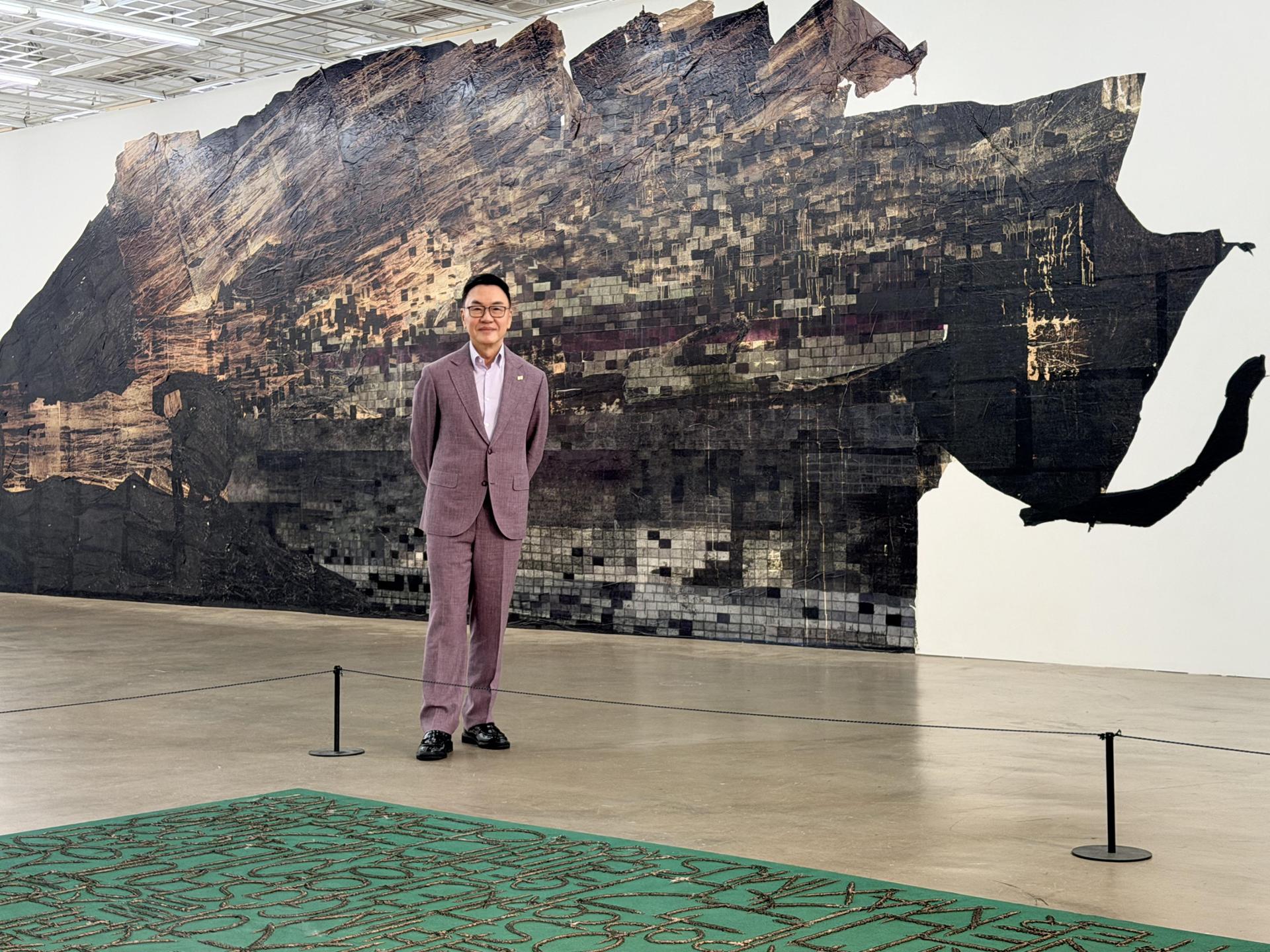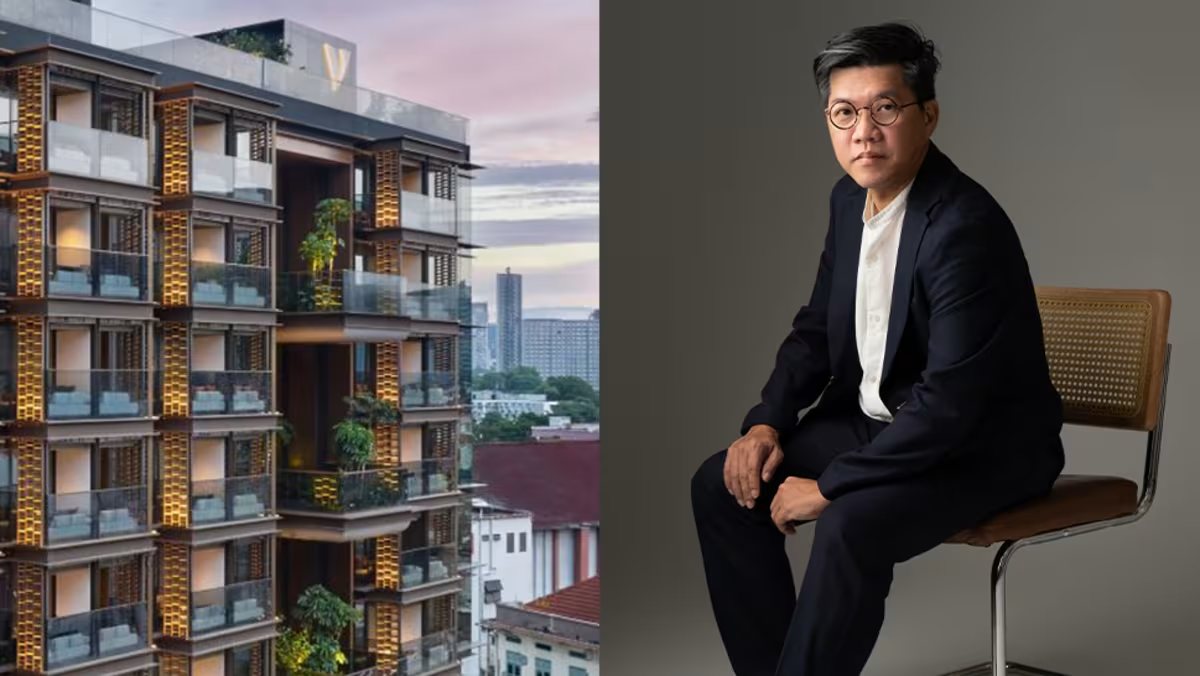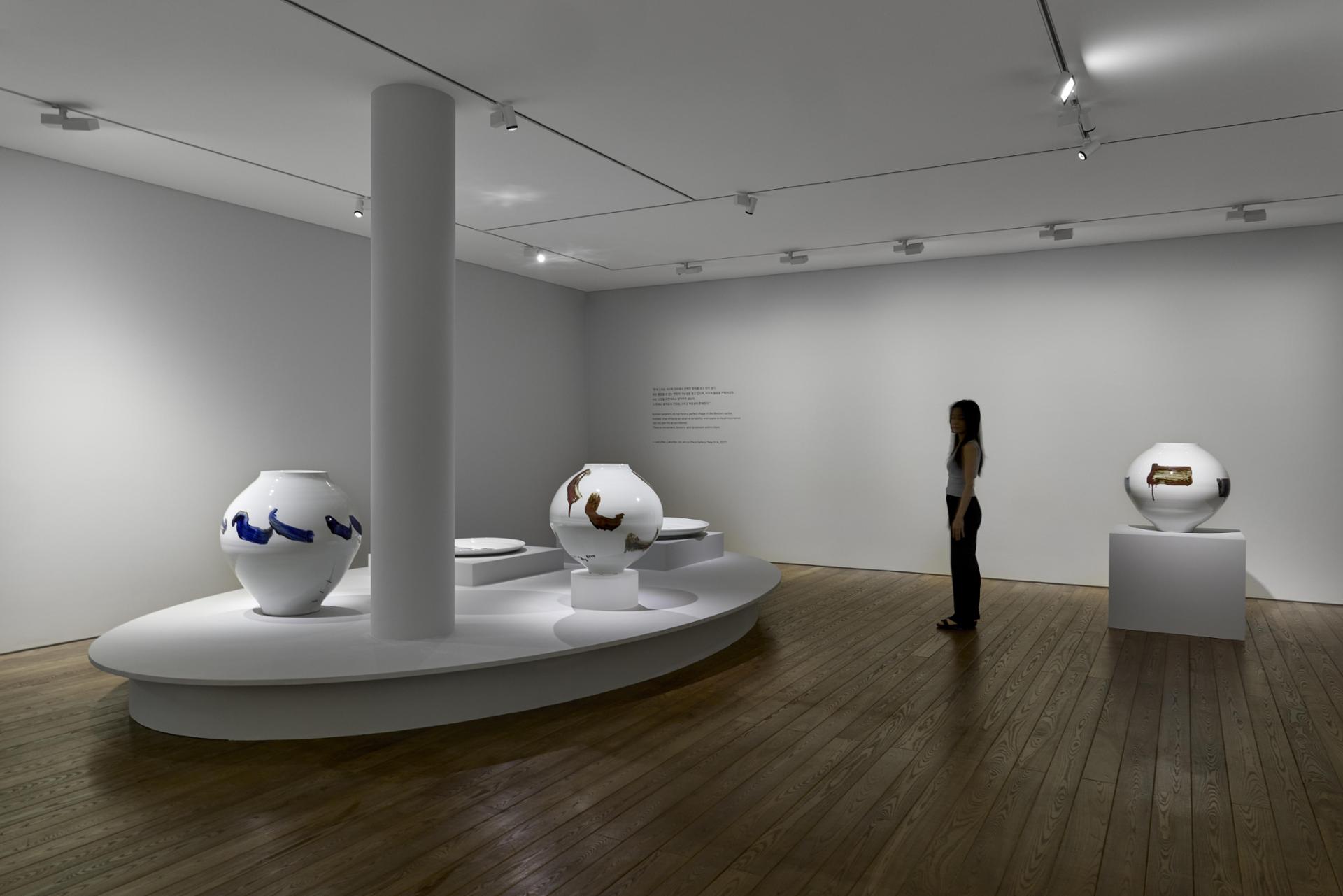
"Byung Cho: When Space Becomes Painting" at BB&M in Seoul (BB&M) After decades of shaping spaces, renowned architect turns to art in search of creative freedomArchitect Byoung Cho, known in Korea as Cho Byoung-soo, has long been celebrated for his earthbound architecture, earning him the nickname “the architect of the earth.”“My parents always told me that I should know where I came from,” Cho said Wednesday during an interview at BB&M Gallery in Seoul. “Every school vacation, they would send me to our family’s rural hometown in Sangju. Although I grew up in Seoul, there was a period when I preferred the countryside.”"I especially loved the smells and the landscapes," he added. “The sensations you experience as a child never really disappear.” "Mahk Red 1" by Byoung Cho (Byoung Cho, BB&M) The acclaimed architect is now presenting his first solo exhibition of paintings in Seoul, offering a rare glimpse into a body of work that predates and underpins much of his architecture. The exhibition reveals the visual and philosophical foundations that have shaped his practice for decades.Cho traces his fascination with earth to memories from childhood. Along with recollections of crouching by streams and gazing across villages from mountain ridges, he vividly remembers seeing exposed soil at a burial site.“My mother’s friend had passed away, and I went to the mountain where she was buried,” he recalled. “I saw the cross-section of the earth that had been dug out, and it looked incredibly beautiful to me.”The memory would become one of the starting points for a lifelong exploration of land, soil and landscape. "Forest (soil)" by Byoung Cho (Byoung Cho, BB&M) Cho’s recent painting series, “Mahk,” embodies many of the aesthetic concerns that have defined his work. The title references “maksabal,” a humble Korean bowl prized for its irregular form, traces of the maker’s hand and accidental imperfections — qualities that Cho regards as central to Korean aesthetics.“While studying in the United States, I often felt a sense of distance from Korean culture,” he said. “Then, when I returned to Korea during my third year of university, I came across a ‘maksabal’ at Hwanghak-dong Market by chance. I was drawn to how natural it felt. That experience deepened my interest in earth and materiality.”He sees a similar sensibility in Korea’s iconic moon jars.“Moon jars are slightly distorted and asymmetrical. But that imperfection is precisely what makes them beautiful," he said. Installation view of "Byung Cho: When Space Becomes Painting" at BB&M in Seoul (Courtesy of the gallery) The paintings feature green and red hues inspired by Jongmyo Shrine, one of Korea’s most revered Confucian sites. Cho uses "noerok," a traditional green pigment, and "seokganju," a reddish earth pigment historically found in Korean decorative painting.Their restrained combination echoes the quiet elegance of Jongmyo’s architecture, according to the architect.“The dancheong at Jongmyo is calm and natural. It is extraordinarily beautiful,” he said.The paintings themselves are created through circular brush movements, a process Cho likens to the making of pottery. Just as a ceramic vessel bears the marks of the potter’s hand and the accidents of the wheel, the paintings embrace spontaneity, chance and traces of the body. Byoung Cho (Byoung Cho, BB&M) A separate room dedicated to archival materials presents sketches, drawings and paintings dating back to his student years, revealing how artistic interests that emerged decades ago eventually evolved into architectural projects."Many of the drawings preceded the architecture and later evolved into built works," he said.Cho is best known for projects such as Earth House and Mium House, but painting offers something architecture often cannot."Architecture involves clients and countless conditions that require compromise," he said. “Art doesn’t. In that sense, it can feel liberating."Sometimes, you simply want to be free."
Architect Byoung Cho debuts as artist
Architect Byoung Cho, known in Korea as Cho Byoung-soo, has long been celebrated for his earthbound architecture, earning him the nickname “the architect of the
620 words~3 min read