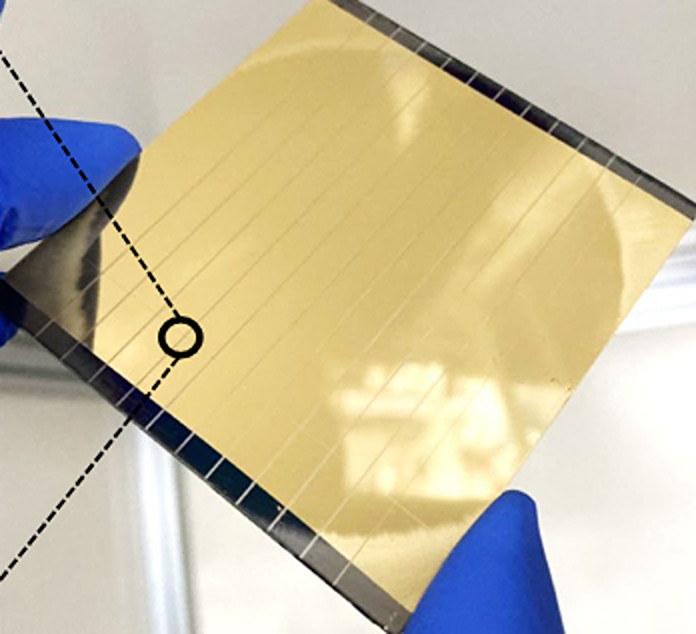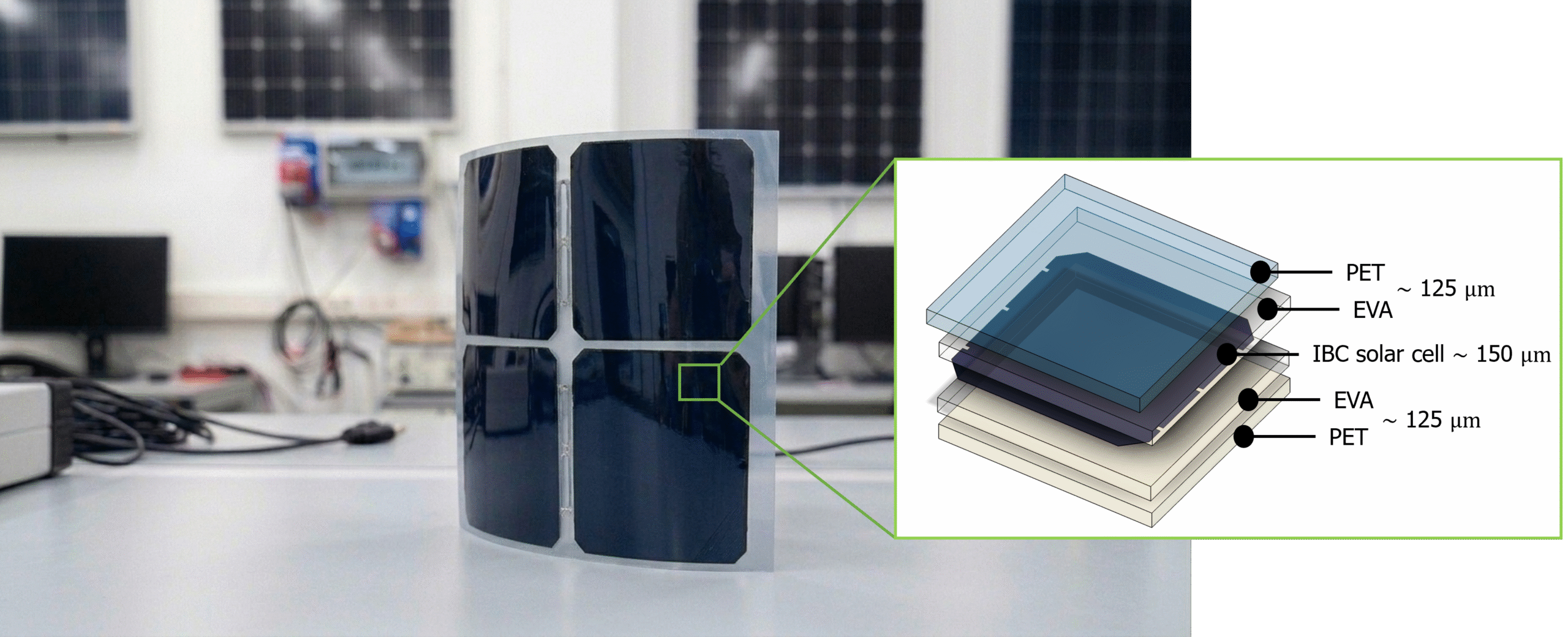
Researchers have developed a glass-free flexible crystalline-silicon module architecture based on commercial IBC cells and a PET/EVA stack manufactured via roll-to-roll hot lamination. The 2 × 2 mini-module retained 96.12% of its initial efficiency after 672 hours of outdoor testing at a fixed bending radius of 150 mm.
A research team in Italy has developed a novel glass-free, flexible crystalline silicon (c-Si) module architecture based on polyethylene terephthalate (PET) and roll-to-roll lamination.
The researchers analyzed the effectiveness of the roll-to-roll process, cell performance before and after lamination, and the impact of cracked cells on series-connected mini-modules under different operating conditions.
“The main architectural novelty lies in combining commercially mature, 150-μm interdigitated-back-contact crystalline-silicon cells with a fully glass-free PET/EVA/c-Si/EVA/PET stack manufactured through a single-pass, atmospheric roll-to-roll hot-lamination process,” corresponding author Paola Jakuza told pv magazine. “While previous studies have separately demonstrated flexible ultrathin cells or PET-based modules, this architecture integrates flexibility, established c-Si technology and scalable, low-CAPEX processing in one module concept.”