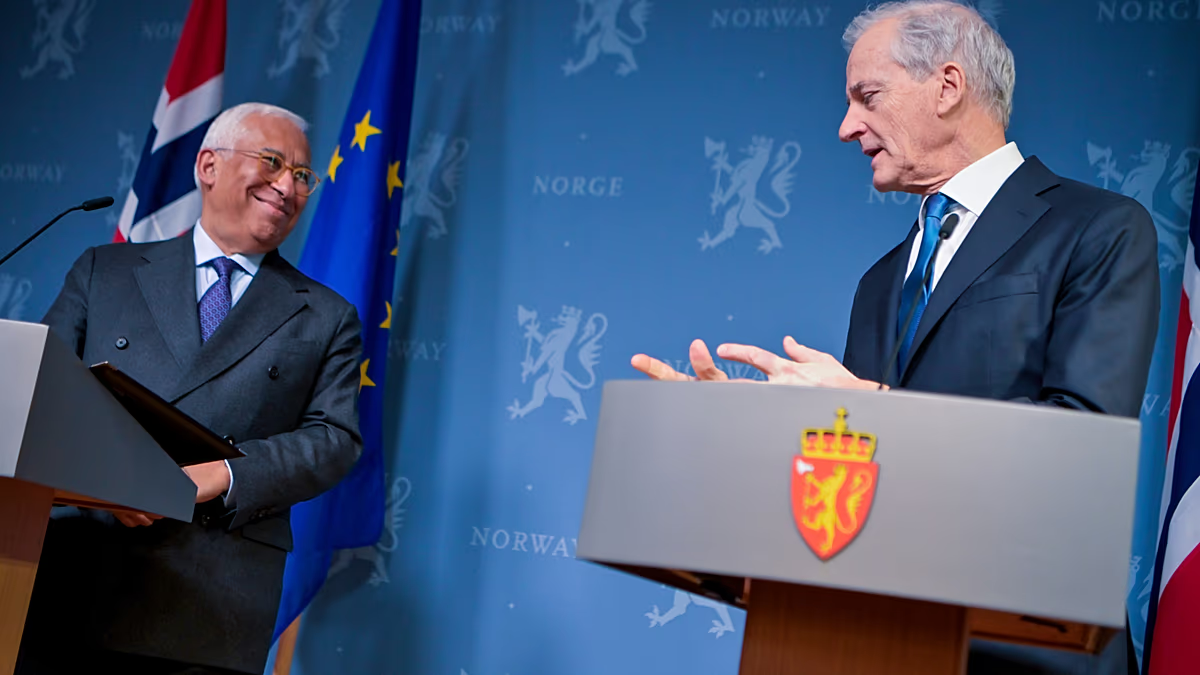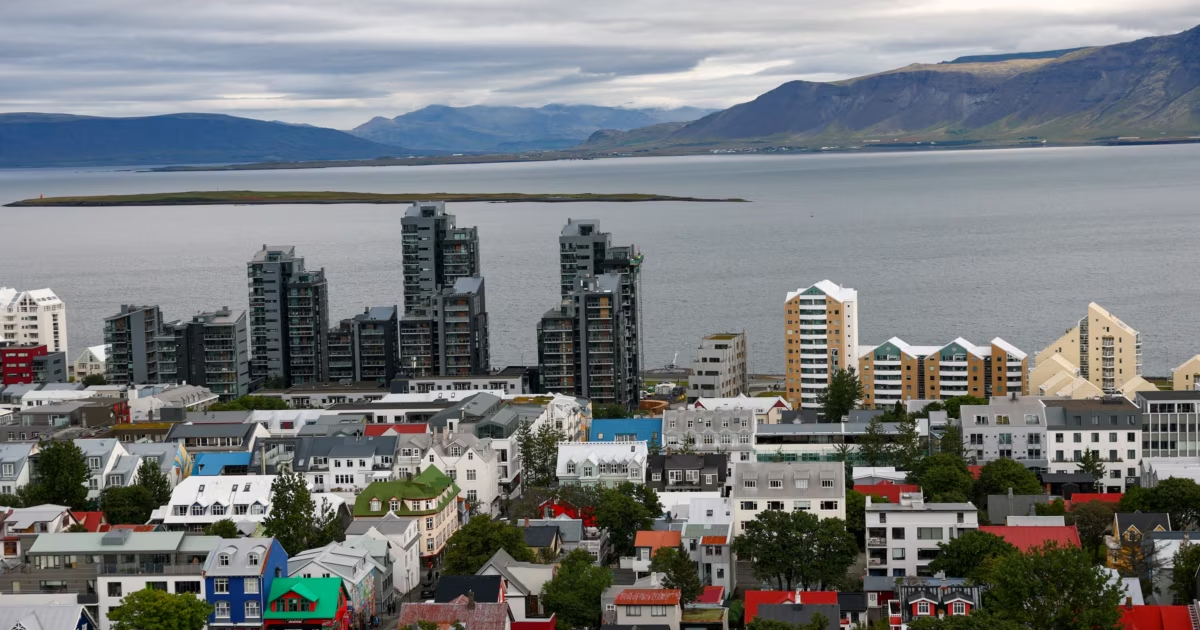
Welcome to Wider Europe, RFE/RL's newsletter focusing on the key issues concerning the European Union, NATO, and other institutions and their relationships with the Western Balkans and Europe's Eastern neighborhoods.I'm RFE/RL Europe Editor Rikard Jozwiak, and this week I am drilling down on one issue: Iceland’s EU referendum.
The Briefing: Iceland's Referendum -- Will It Restart EU Accession Talks?On August 29, Iceland will hold a referendum on restarting European Union accession talks with Brussels.Iceland has been here before. It applied to join the EU in 2009 and began accession negotiations the following year, but a new government put the talks on hold in 2013. Two years later, Reykjavik told Brussels that Iceland should no longer be considered a candidate for membership, although it stopped short of formally withdrawing its application.What happens this time could resonate well beyond Iceland. While a referendum on an island of just under 400,000 inhabitants in the North Atlantic normally wouldn’t grab too many headlines, this vote could have far-reaching consequences for the EU, its current candidate countries, and other European countries that are pondering closer relations with the bloc.A Test Of The EU's AppealFor Hallgrimur Oddsson, director of the think tank Evrópustraumar (European Currents), which charts EU-Icelandic relations, the vote is very much a challenge for the EU’s expansion policy.“The enlargement over the past decade and more has been pointing eastwards,” he told RFE/RL. “In my mind, from the EU perspective, this is a sort of a test. To see if the EU is attractive enough for the wealthier northern countries that are now currently outside of the union to join.”Among European diplomats speaking to RFE/RL, there is a sense that this poll matters as much in Brussels as in Reykjavik -- largely because of the instant feel-good factor it would give the EU, which has endured a turbulent decade marked by Brexit, sluggish economic growth in parts of the union, disputes over migration, and security concerns fueled by Russian hybrid attacks.It would also provide a symbolic boost to a bloc whose recent enlargement debate has largely centered on less wealthy candidate countries in Eastern and Southeastern Europe.If Iceland were to join, it would be the third richest member state on a per capita basis and a net contributor to the European Union’s budget -- something that none of the current EU candidate countries in the Western Balkans or Eastern Europe is expected to be.It would also be easily “absorbable,” as it would not only be the smallest member state population-wise, but is already part of the passport-free Schengen zone and large parts of the EU’s internal market and rulebook by virtue of being a member of the European Economic Area (EEA), together with non-EU Liechtenstein and Norway.The Impact On Norway And Current EU HopefulsThe most obvious and immediate impact if Iceland votes “Yes” on August 29 could be felt in Norway, another affluent, non-EU Nordic country that is already watching the vote closely.EU diplomats have told RFE/RL off the record that Oslo is in regular contact with Brussels about what the potential Icelandic resumption of accession talks would look like and what would be left of the EEA if Iceland were to join.Norway has rejected membership of the EU (or its predecessors) twice, once in 1972 and again in 1994. A majority of Norwegians is still against joining according to recent polls, but an Icelandic “Yes” could fuel calls for Norway to hold a vote on at least opening accession talks.EU officials also believe that Iceland moving closer to the union could trigger renewed discussion in both Greenland and Scotland about their relations with Brussels.Greenland, which is a Danish territory, was part of the EU forerunner, the European Economic Community, until it unilaterally withdrew in 1985, but leading politicians there have recently been keen to explore deeper ties with the EU.And Scotland was, of course, part of the EU when the United Kingdom was a member and voted overwhelmingly in favor of remaining in the bloc in the 2016 Brexit referendum.Any potential future talks with these two countries, however, would have to involve Copenhagen and London, respectively -- something that is likely to be politically sensitive as it could involve questions of greater autonomy or independence. But don’t rule either out if Iceland edges closer to EU membership.There is also great hope in Brussels that renewed Icelandic accession talks will give fresh impetus to the current EU candidate countries -- notably front-runners like Albania and Montenegro in the Western Balkans, but also Moldova and Ukraine.One reason is simply that it would demonstrate that enlargement remains possible, given that no country has joined since Croatia back in 2013. But more importantly, because some of these countries could be “paired” with Iceland in an eventual EU accession -- potentially not only speeding up the process but also making it more attractive to current EU member states, which must approve any new additions and are very keen to get Iceland in.