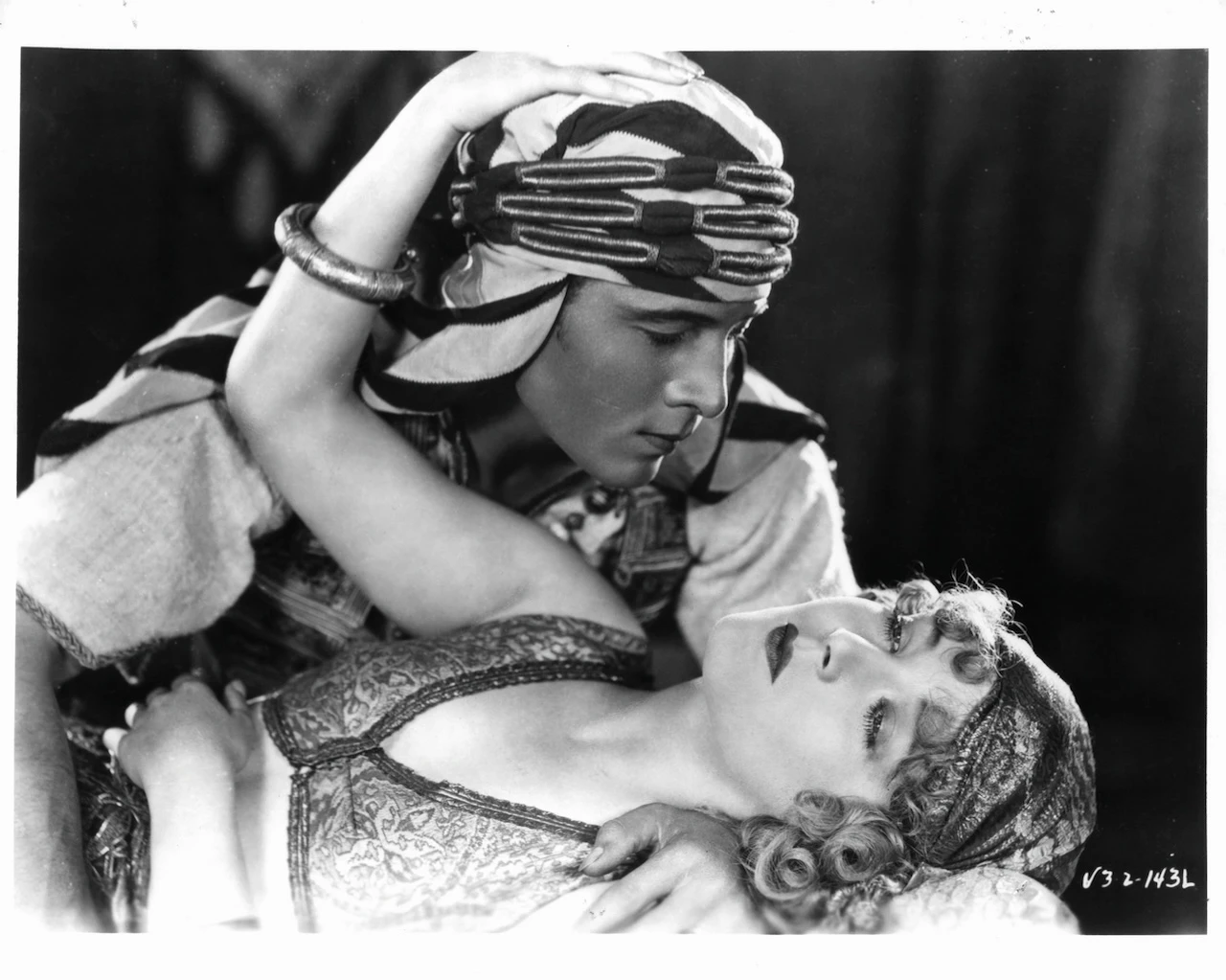
The film star Rudolph Valentino, who died 100 years ago this Sunday, was famously adored by millions of women worldwide. But he was not lucky in love or longevity.Being a specimen of male beauty aside, he had something else in common with another man whose anniversary (the 104th) falls this weekend: Michael Collins.On a more local scale, Collins, too, attracted a cult of romantic followers; his grave is still often decorated with red roses, especially on Valentine’s Day. Like him, Valentino died at 31, his image preserved in youth forever.The actor had married twice by then, neither a success. His first wife, fellow Hollywood star Jean Acker, was a secret lesbian and locked him out of the bedroom on their wedding night. Undeterred, he continued to pursue her for a time, before they divorced three years later.The heartbroken Valentino recovered quickly enough that, after marrying again in 1923, he was charged with bigamy because the divorce wasn’t official yet. His new love went by the exotic name of “Natacha Rambova” and had a heavy Russian accent to match, equally fictitious.Rex Ingram directing Rudolph Valentino in the film The Four Horsemen of the Apocalypse. Photograph: Hulton Archive/Getty She had been born Winifred Kimball Shaughnessy, the daughter of Michael Shaughnessy, a New York Irish Catholic who fought for the Union in the American Civil War and later worked in mines before succumbing to alcoholism and a habit of using his wife’s property to pay off debts.Mrs Shaughnessy soon left him, taking her young daughter from their home in Utah to San Francisco and marrying twice more there, the second time to a perfume millionaire who adopted Winifred and gave her yet another surname, Hudnut.But having studied ballet under Russians, the young woman reinvented herself as one. And it was under the professional name of Rambova that in 1921 she met Valentino, then coming into great fame after his breakthrough in The Four Horsemen of the Apocalypse.It was not love at first sight, she later admitted, but they got on well: sharing among other things a love of dance. He had started his career as a “taxi dancer”, a paid partner at ballroom events. Both were also enthusiasts for the occult, taking part in seances and collaborating in “automatic writing”, a supposedly supernatural technique popular at the time (and practised by Georgie Hyde-Lees, to the fascination of her husband WB Yeats).When on strike against the Hollywood system in 1923, Valentino published a book of poetry entitled Day Dreams, which his wife would later claim was inspired by messages received from “the other side”.By now, Rambova’s professional interests had evolved into costume and set design, in which roles she exerted increasing influence on her husband’s work. This was not, by general consent, a success.Reviewing a biography of Valentino in this newspaper once, the late Hugh Leonard, summed up the relationship uncharitably:“Rambova ... probably did not go to bed with him, either. Instead, she became his Svengali, to ruinous effect, meddling with his career and terrorising his directors.”Her guidance included encouraging him to adopt “an effeminate on-screen persona”, something that played into private speculation about his sexuality (a subject still debated today).For that and other reasons, his film reviews began to suffer and his career went into decline. Meanwhile – Hugh Leonard again – “the worm turned and Rambova boarded a huff and took herself in it to Europe and a divorce lawyer”. The actor was once more romantically bereft. Then in July 1926, a Chicago Tribune editorial added to the pain by describing his cinema persona as a “Pink Powder Puff”.The rest was tragicomic farce. Reacting to the insult à la Ernest Hemingway, Valentino challenged the unknown writer to a boxing match. When the invitation was declined, he instead proved his manhood by fighting a couple of rounds with another journalist. This despite by then suffering from health problems, including painful stomach ulcers. The fisticuffs probably didn’t do much damage. But within days, in a grim coincidence, he needed an operation for acute appendicitis and never recovered, dying on August 23rd, 1926.The extraordinary Rambova went on to reinvent herself again. As late as 1923, when newly married to the Hollywood star and doing a dance promotion in her native Salt Lake City, she had been disgusted to be billed as “The Little Pigtailed Shaughnessy Girl”.But putting that and the Valentino years behind her, she found new careers in writing and fashion design, selling Russian-themed clothes in her own store on New York’s Fifth Avenue until the Great Depression. Shutting up shop then, she moved to the south of France and there met and married a Spanish aristocrat. Together they visited Egypt, and in the process Shaughnessy/Rambova found a whole new vocation. Introduced to the country’s history and archaeology by Howard Carter – discoverer of the tomb of Tutankhamun – she was regularly moved to tears by the things she saw and “felt as if I had at last returned home”. She, too, became an Egyptologist, assembling a large collection of artefacts and publishing several scholarly books.
Valentino’s Irish Valentine: Frank McNally on the extraordinary Winifred Kimball Shaughnessy
She took an exotic name and wed the unlucky-in-love Hollywood heart-throb Rudolph
842 words~4 min read