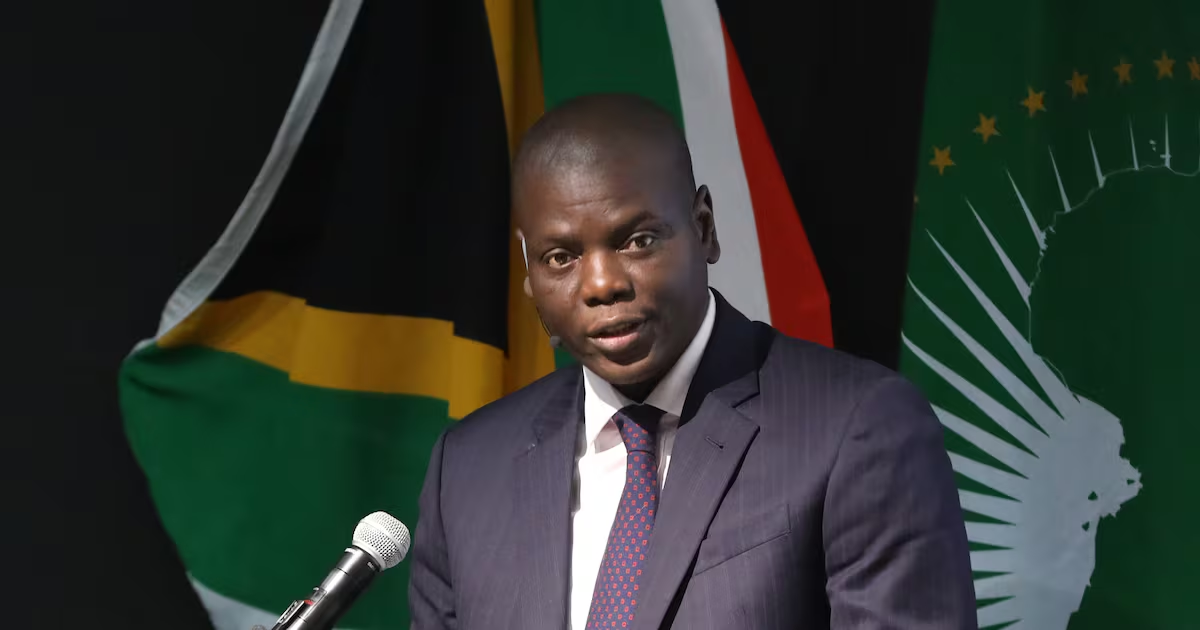
The auditor-general’s finding that the department of international relations & co-operation’s audit outcome deteriorated in 2024/25 surprised no-one. South Africans have come to realise that their government cannot manage public finances. The municipalities are the most visible evidence. The embassies are the latest. The South African high commission to the UK in London, Trafalgar Square, has been closed. The building’s condition became untenable — water supply failures, broken air-conditioning, a persistent smell of urine throughout the premises. Repairs will cost South African taxpayers R70m. The pattern is familiar: neglect a facility, perform no maintenance, then present taxpayers with a bill for a problem that was entirely preventable. The South African embassy at The Hague has been closed for nearly a year, with repair work yet to begin. Given what we know of the South African government it is reasonable to assume similar neglect is occurring at other missions around the world. These are not minor consular outposts. London sits at the centre of one of South Africa’s most consequential bilateral relationships. South Africa is the UK’s largest trading partner on the African continent. Total trade in goods and services reached R294bn in the four quarters to Q1 2026, up 15.3% year on year. An economic partnership agreement, now five years old, gives South African exporters tariff-free access to UK markets in agriculture and automotive goods. The UK holds a 21% share of South Africa’s services imports. More South Africans live in the UK than in any other single country abroad. Allowing the high commission to collapse into uninhabitability is not a facilities-management failure — it is a statement about how seriously this government takes its own diplomatic obligations. Yet while the responsible minister, Ronald Lamola, has tough questions to answer he almost certainly will not face serious scrutiny. South African media has largely served as a government mouthpiece on foreign affairs rather than a checking mechanism. That is a democratic failure — and it matters, because the millions now being spent on repairs in London and The Hague are millions that could have funded schools, clinics, or infrastructure. Incompetence has a price and ordinary South Africans pay it. South Africa can downsize its diplomatic missions where necessary, but it must do so deliberately, strategically and in the right places. The US has cut African visa processing posts from nearly 50 to 20 hubs. Belgium is closing eight missions by 2027 in its first full diplomatic review in a decade. Colombia’s newly inaugurated president, Abelardo de la Espriella, ordered 14 embassies and 15 consulates closed upon taking office this month — including the mission in Pretoria. Bogotá insists bilateral ties with South Africa will continue through regional missions. Whether that holds in practice remains to be seen. That is a democratic failure — and it matters, because the millions now being spent on repairs in London and The Hague are millions that could have funded schools, clinics, or infrastructure. Incompetence has a price and ordinary South Africans pay it. There is a reasonable case for South Africa to rationalise its own diplomatic footprint where missions are underperforming. What must not happen for whatever reason is the neglect of the country’s embassies. A government that chooses to consolidate is exercising judgment. A government that allows its embassies to fall into disrepair is simply failing. South Africa needs to maintain strong ties and build new relationships with economically successful countries. Strengthening or establishing new relations with the world’s successful countries is critical for South Africa’s growth. The government of national unity has no meaningful leverage here. The ANC has ensured that it retains full control of foreign affairs, and the reason for this is worth understanding. Politicsweb editor James Myburgh offered a pointed explanation in an interview on a YouTube podcast: the ANC uses the department to raise funding internationally. That is a serious claim and it reframes the department’s dysfunction in an important way. The department is not merely incompetent — it is institutionally captured for purposes that have nothing to do with South Africa’s diplomatic interests. South Africa’s foreign policy priorities have been misaligned for some time. The embassy collapses are a different but related symptom of the same problem: a department that is not run in the interests of South Africa. • Majozi is senior economist and executive director at African Markets Institute, and author of ‘Lessons from Past Heroes’.
PHUMLANI M MAJOZI | SA’s preventable diplomatic collapse
Neglected embassies signal systemic failure in managing foreign relations
730 words~3 min read