Yields on 30-year Treasury securities have recently pushed to levels not seen in some two decades, a sign that investors might be growing increasingly concerned about the government’s fiscal health. In response, the Treasury announced it would “at least double” the size of its debt buybacks from $2 billion to $4 billion.
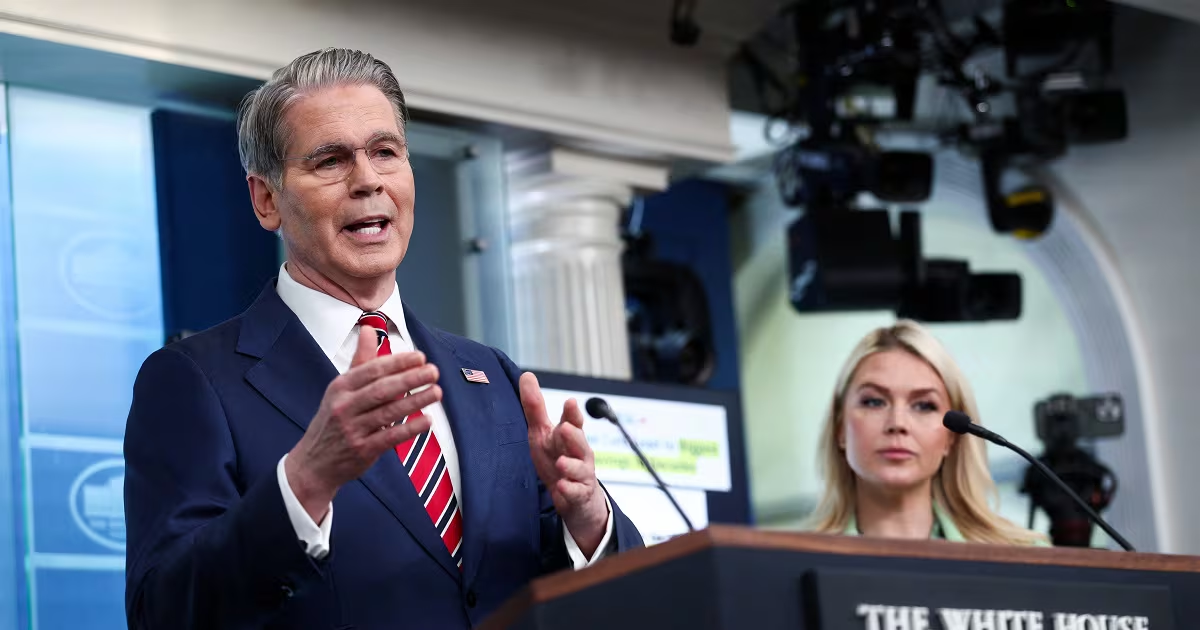
That move, designed to lower longer-term yields, caused those rates to temporarily fall in response, but yields then climbed back on Thursday, erasing much of the decline following the Treasury announcement.Ryan Young, a senior economist at the Competitive Enterprise Institute, told the Washington Examiner that the rising yields are a sign of unease from investors and emphasized that this week the national debt just crossed the milestone of $40 trillion.“If investors are looking at buying a 10-year bond or a 30-year bond, they’re thinking, ‘Am I going to get my money back in 10 years or 30 years?’” Young said. “That’s not as risk-free as it used to be, which is why the government is having to offer higher and higher premiums to entice people to take on that now riskier debt.”The 30-year bond yield was as high as 5.26% on Thursday and was as high as 5.33% earlier in the week. The yield on that long-term bond has generally been rising over the past several years, and was as low as 1.94% just five years ago.The last time the 30-year yield was this high was in the early 2000s, before the financial crisis and the Great Recession.Yields on the benchmark 10-year bond were also up. They are around 4.7% as of Thursday afternoon, after punching as high as 4.75% earlier in the week. That is up from the 4.15% level it was at just at the start of the year.Bessent discussed the move in an interview with CNBC on Thursday.“We’re trying to signal that we think that this is a thinly traded area of the market, that we’re in August, and there’s been a lot of corporate issuance that’s influenced the market,” he said. “And we believe that there are many underlying factors in turn that the market is not looking at, and we are going to make a market in these.”In the Thursday interview, Bessent said the higher yields “don’t reflect the underlying fundamentals” and that the administration will soon be announcing an “increased focus on fiscal consolidation.”And the higher yields could mean the Treasury might become even more involved in trying to tamp down the long-term bond yields. Bessent has suggested the buybacks could increase.“We’re going to increase the size of the buyback,” he said. “I would note that it could be more than the 4 billion per issue.”Jai Kedia, an economist at the Cato Institute, told the Washington Examiner that there are various reasons yields are rising.“What the bond market is telling you is inflation is too high, there’s competition from corporate bonds because our corporate sector is doing very well in some respects, particularly AI and data centers,” he said, “and we have a debt that just hit $40 trillion, and they’re not happy about that and want to be compensated for the risk of holding the instruments that fund that debt.“And those are real structural, in some cases, problems, in some cases, just market forces at work,” Kedia added.And the Treasury intervention of $4 billion might not be enough to provide much of a counterbalance to all those factors at play.Mark Hamrick, chief economic analyst for the Hamrick Brief, told the Washington Examiner that there would need to be a “much more meaningful intervention” in the marketplace in order to have a sustained lowering of yields.Kedia also said that the move by the Treasury is marginal, given the fiscal landscape.“When you have a debt that’s $40 trillion, increasing your price commitment from $2 billion to $4 billion is like trying to dig your way out of a trench with a teaspoon,” he quipped.Young said that a better way to bring down yields would be if the government made a concerted effort toward balancing the budget and enacted significant fiscal reforms, such as lowering spending on entitlement programs. He said that even “credible gestures” toward doing so would help.He also said there are a variety of ways to do entitlement reform across the political spectrum, and depending on the balance of power in Congress.“Whatever mix of those that we do, even if it’s not perfect, would reassure markets that the government is at least taking its finances more seriously than it is now, and that we do a lot to lower interest rates and calm investors,” Young said.The debt hitting $40 trillion rang alarm bells this week, with some longtime advocates of balancing the budget calling on Congress to act.The situation is tricky for lawmakers because if they were to make tough decisions, such as raising taxes or dramatically cutting spending on popular programs to balance the budget, they could be used against them by a political opponent and get voted out of office.‘SLOGGING ALONG’: PROSPECTS FOR THE HOUSING MARKET IN THE YEAR AHEADFormer Rep. Carolyn Bourdeaux heads the Concord Center and told the Washington Examiner that serious work is needed. She also warned that the situation could spiral out of control absent any action by lawmakers.“Anybody who’s serious in Washington knows that this is going to require both expenditure cuts and revenue increases, and you can see the problem there,” Bourdeaux said. “Nobody wants to put any of those kinds of ideas on the table … even though everybody behind the scenes, behind closed doors, understands that this is necessary.”