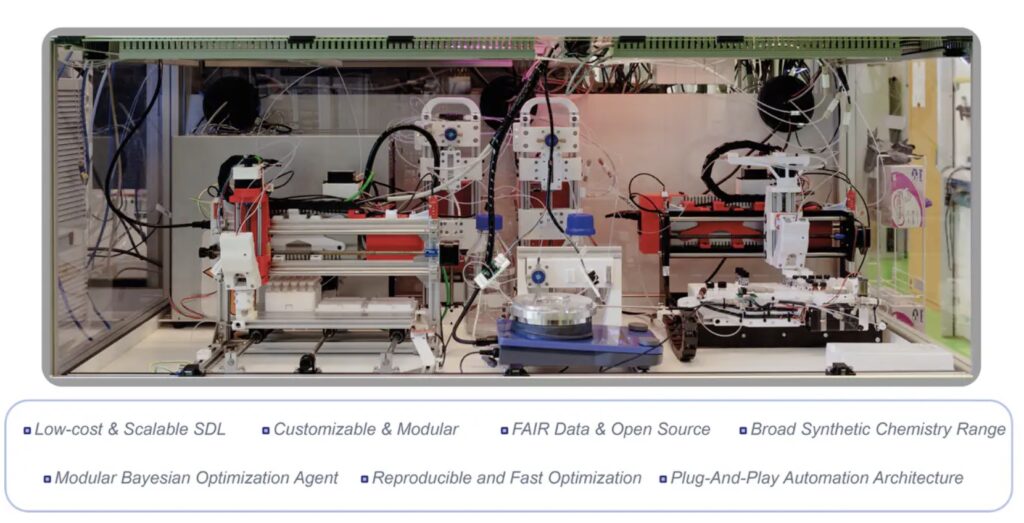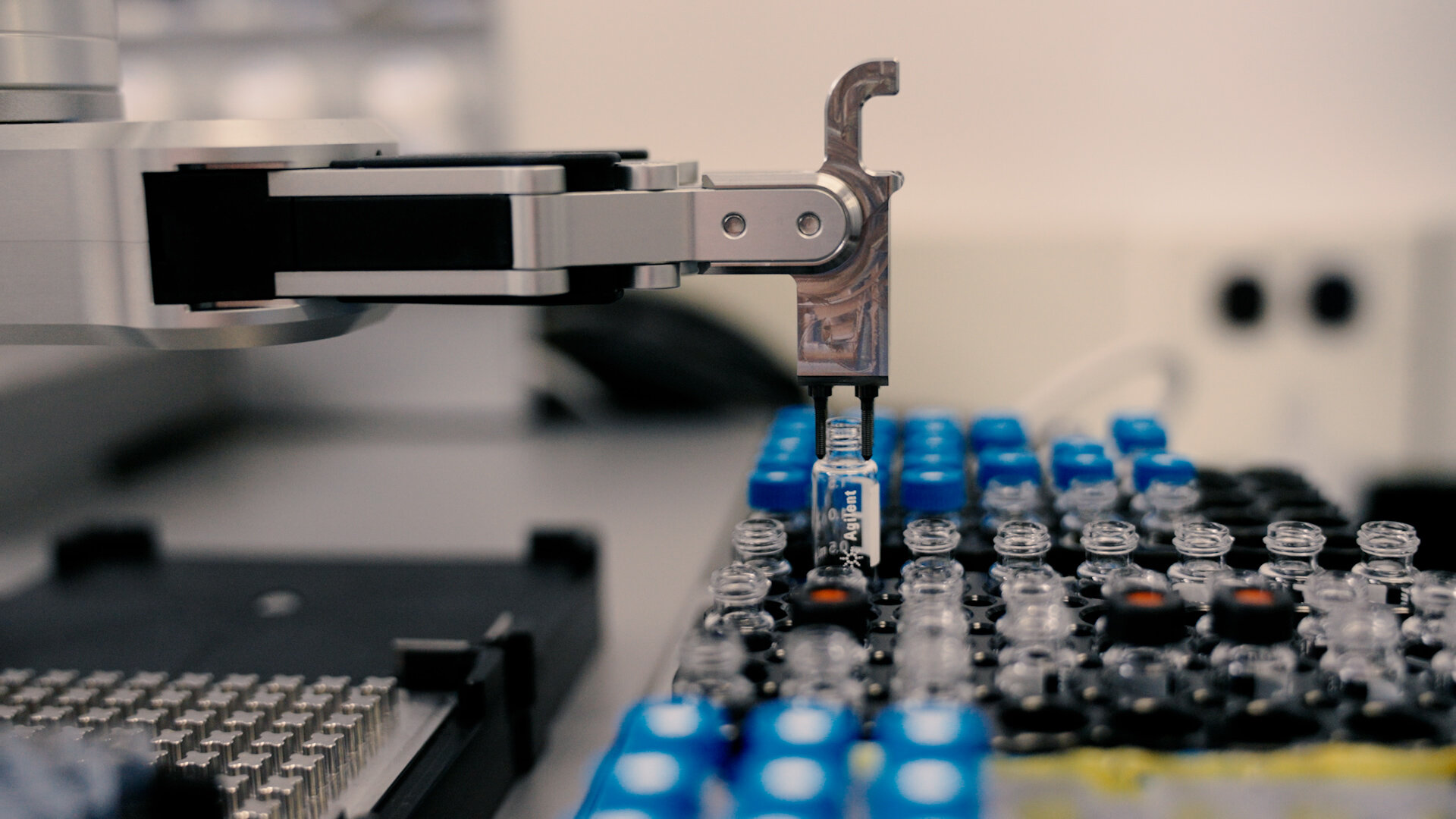
A robot positions "bloccs" for assembly via automated, iterative carbon-carbon bond formation. Credit: Molecule Maker Lab
A paper published in the journal Science lays out a roadmap for broadening access to the process of discovering molecular tools that can benefit society, including medicines, materials and a wide range of everyday consumer products.
In parallel, the Molecule Maker Lab (MML) at the Beckman Institute, University of Illinois Urbana-Champaign, has formed a global Task Force charged with prospectively developing safeguards to minimize the risks and maximize the benefits of democratizing molecular innovation.
In the paper, "Bonding Carbons Iteratively," author Martin D. Burke, the May and Ving Lee Professor for Chemical Innovation at the University of Illinois Urbana-Champaign and founding director of the Molecule Maker Lab (MML) at the Beckman Institute, describes a modular approach for making molecules called "blocc chemistry."
This method builds small molecules via iterative assembly of prefabricated building blocks, or "bloccs." Unlike traditional chemical synthesis—which for nearly two centuries has relied on highly specialized, largely inaccessible human expertise—blocc chemistry allows carbon-carbon bonds, the backbone connections in nearly all organic molecules, to be assembled iteratively and automatically.