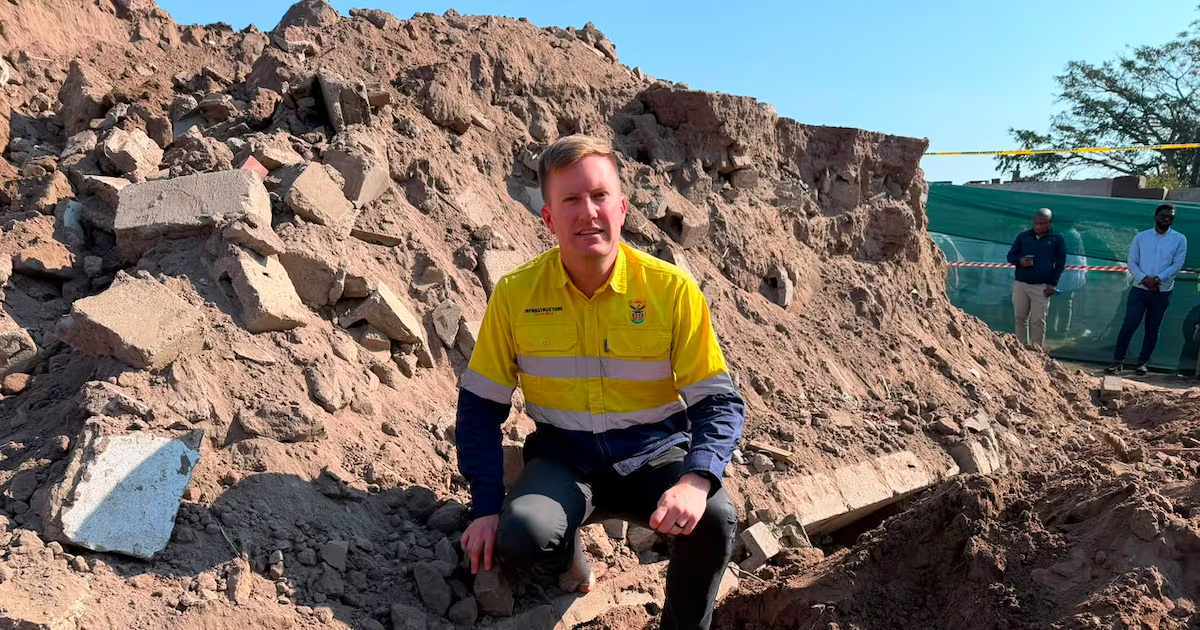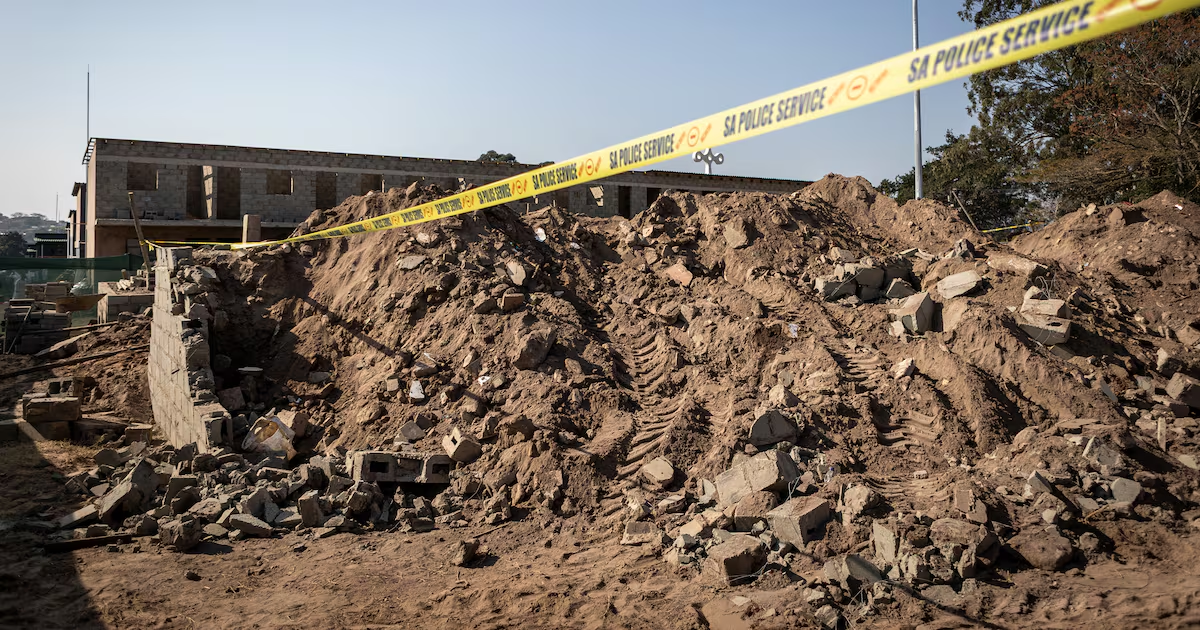
Public works and infrastructure minister Dean Macpherson said investigations into deadly building collapses raise concerns about the wider practice of construction proceeding and approval being sought afterwards.“That is unacceptable. Building approval is not unnecessary red tape. It is a public safety control,” he said.Macpherson said the purpose of obtaining approval before construction is to allow the relevant authority to consider whether what is proposed complies with the law before people are exposed to risk.He said a system in which substantial construction can proceed and only afterwards be regularised fundamentally weakens that protection.Investigations by the Council for the Built Environment (CBE) have exposed weaknesses in South Africa’s construction regulatory system, from unlawful construction and inadequate inspections to lack of professional accountability, poor information sharing and weak penalties.The findings come after serious incidents at Redcliffe in Verulam, eThekwini, Doornkop in Soweto, Ormonde in Johannesburg and the Magnolia Development in Sea Point, Cape Town.Across the four incidents, 17 people lost their lives and 24 people were injured.Macpherson said there are identifiable weaknesses in the system which, in some cases, have allowed dangerous or unlawful construction to proceed, reduced the ability of authorities to intervene, weakened professional accountability and left known risks inadequately managed.He said the reports identify an excessive regulatory focus on the initial building plan approval stage.“Building control cannot stop when a plan receives a stamp. Authorities need visibility over what happens during construction. They need to know when construction has commenced. They need to know whether what is being built corresponds with what was approved. They need to know who has accepted professional responsibility. There must be functioning systems for inspection, certification, and ultimately, occupation,” he said.With municipalities at the front line of building regulation, Macpherson said the investigations raise concerns about shortages of suitably qualified building control personnel, limited inspection capacity and the ability of municipalities to identify construction which has never entered the approval system.He said the investigations raise concerns about inadequate supervision, failures to discharge statutory responsibilities and weaknesses in verifying whether people accepting responsibility for specialised or high-risk work have the required competence.Macpherson said investigations also found regulators do not share enough information with one another.The reports recommend sanctions for violations of planning and construction requirements be strengthened.Macpherson said while the circumstances surrounding the George, Redcliffe, Doornkop, Magnolia and Ormonde building collapses are not identical, recurring issues are evident. These include the need for stronger professional accountability, improved information sharing, greater visibility of construction activity, better systems for reporting structural incidents, improved verification of professional competence, and the modernisation of the regulatory framework.In the Redcliffe incident, where a five-storey building collapsed while concrete was being poured, killing five people and injuring 11, investigations found the building had no approved building plans or construction work permit. The department of employment and labour had not been notified that construction had started.Macpherson said no responsible construction team or built environment professional could be identified, and investigators could not establish one clear technical cause because important information, including complete structural drawings, was unavailable.The investigation identified possible problems with the reinforcement, foundations, concrete, structural design and temporary support.Macpherson described Redcliffe as “a case of ignoring the law”.In Doornkop, where part of a two-storey residential building collapsed after heavy rainfall, killing a 60-year-old woman, her 24-year-old daughter and her one-year-old granddaughter, investigations established the property was on high-risk dolomitic land, a danger the government had identified years before. Residents had previously been relocated from the area, but part of the old structure remained and was later occupied by a family.Investigators said the most likely cause of the collapse was a sinkhole beneath the building, which caused a loss of foundation support.The investigation also found weaknesses in the management of known dolomite risks and the prevention of people occupying high-risk land.Macpherson described Doornkop as “a case of not enforcing the law”.At Magnolia, where about 40 m² of temporary formwork collapsed during construction, injuring four workers, investigators found the temporary structure had been loaded before it was stable, inspected or approved for loading.Unlike Redcliffe and Ormonde, the development had the required planning approvals and professionals had been appointed. Safety audits had also been conducted and the relevant authorities were notified after the incident.In Ormonde, part of an industrial building under construction collapsed while concrete was being placed on suspended floors. Nine workers died and six were injured.Investigators found serious problems with the structural steelwork, including concerns about connections, structural members and the overall design. The investigations concluded the beams and columns supporting the affected slabs could not carry the additional load during construction.The building did not have an approved building plan when it collapsed and an application was only submitted Macpherson said he has directed the CBE to formally share the relevant findings and recommendations arising from the investigations with the respective municipalities and other affected stakeholders, and to engage them directly on the findings and proposed interventions.TimesLIVE
‘Ignoring the law’: Macpherson exposes failures behind building collapses
Investigations reveal unlawful construction and weak oversight at heart of deadly incidents
813 words~4 min read