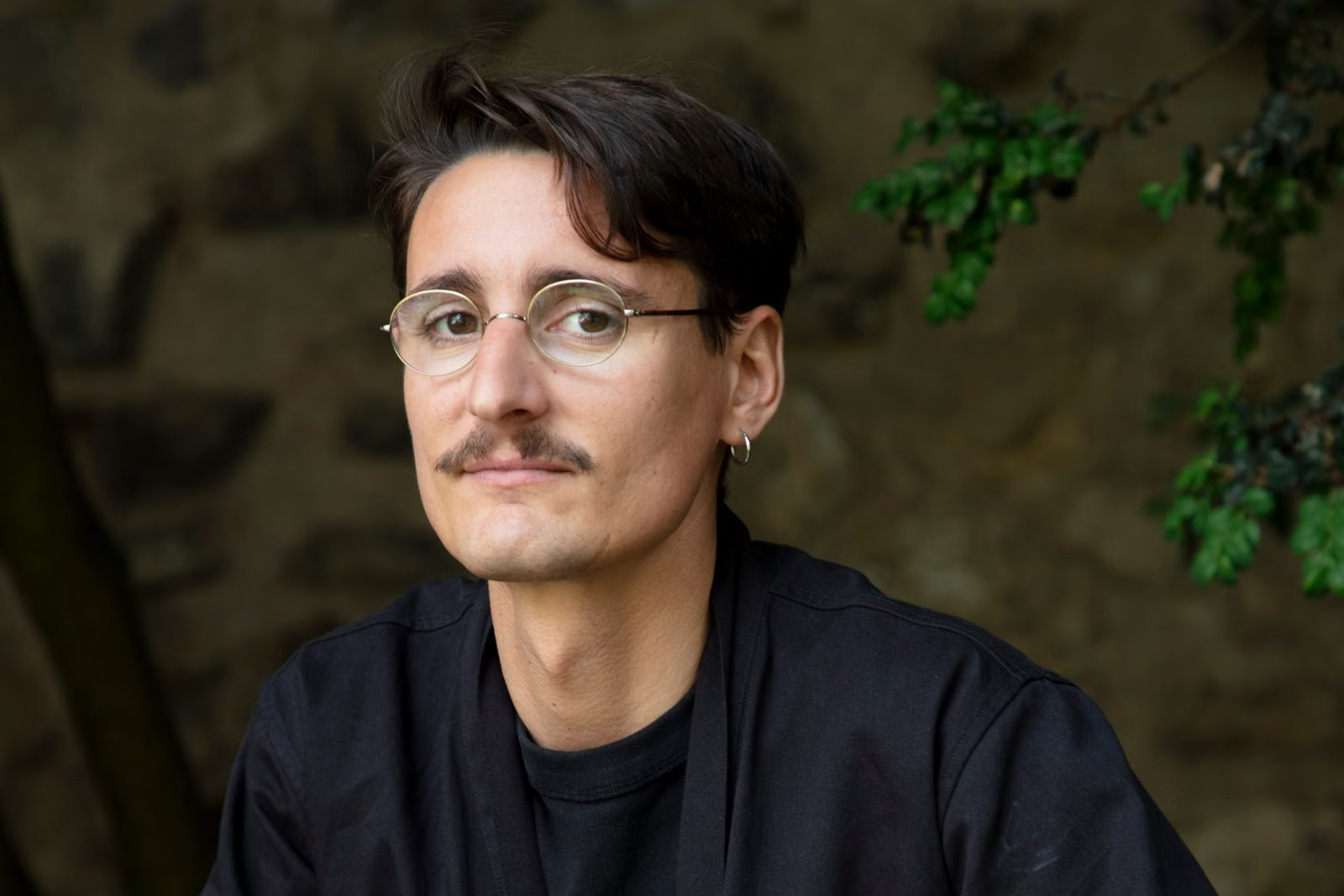
Mathias Énard’s array of European literature awards attests to his originality and ambition, requiring careful, patient reading. His 11th novel, The Deserters, longlisted for this year’s Booker Prize, is no exception.It comprises two distinct narratives, told in alternating chapters and unconnected except through allusion and interpretation. One starts straightforwardly: a soldier in an undated phase and unspecific region of the 1990s Yugoslavia Wars has deserted his command. He is hiding in the mountains near his ancestral home, from where he hopes to escape somewhere further from the theatre of the war. References to the Mediterranean and, later, to his participation in war crimes, indicate he may be Croatian, but — alienated, morals corroded and surviving on instinct — he represents any soldier in war’s brutal vortex.Into his hideout wanders a traumatised woman fleeing her village on a donkey. Reflexively, he thinks of killing her, but both have a spark of recognition as townsfolk, near neighbours in a long-lost time of peace, though on different sides of the ethnic divide. So, at least temporarily, he keeps her captive instead; the scene is set for either a brief but terrible confrontation or interpersonal truce and perhaps even co-operation if they can bridge the fear, loathing and uncertainty gap.Segments involving the soldier and the woman are written as stark but dense interior monologues, in juddering, confused language, often in agentless passive voice reminiscent of JM Coetzee’s Waiting for the Barbarians. Grammatical format is haphazard, symbolising the chaos and confusion of war.The second plotline is narrated by a 70-something German historian of mathematics, Irina Heudeber, writing in 2022 shortly after Russia’s full-scale invasion of Ukraine. She looks back to a small symposium she attended on September 10 and 11 2001, held on a cruise boat docked on the Havel River near Berlin. The attendees are esteemed mathematicians from around the world, gathered to pay homage to her father, the groundbreaking mathematician Paul Heudeber. Irina drifts between the events at the conference and what she knows of her father’s life, providing a fuller story of him as a prisoner and survivor of Buchenwald concentration camp, a committed communist in post-war East Germany, and his relationship with Irina’s mother, who became a high-ranking politician in West Germany.In its more conventional structure and style, these chapters are marginally easier reading. But the Heudeber story, too, is complex and nuanced, and Irina struggles to narrate it, switching between memory and conjecture, presenting letters between her parents, and episodic flashes of scorn at the sycophantic encomiums of some of the mathematicians in remembering her father.She narrates most eloquently when her passion rises, ironically often when questioning the value of her career and whether she has lived up to the Heudeber name. A particularly beautiful sentence muses for an entire page, 30 mesmerising lines weaving together “the secret music of mathematics”, “poetry, which is the algebra of literature”, the horror of the Bosnian War as one conflict in the Yugoslavia Wars, and “the concentration of pain and solitude” endured under torture — by her father and those caught in current wars.Other passages are heavy, opaque, almost spiritual. They point out how little we know as infinitesimal beings in an infinite universe and allude to the mystery of religious faith: “He saw God in the elliptical, he glimpsed God in the clinamen between spheres and the musical play of the planets,” Irina says of the 13th-century Persian theologian and polymath Nasir al-Din al-Tusi. The beauty of the language is inversely proportional to the clarity of the ideas, but her point seems to be that only in mathematics is there order; everything else is random and unpredictable. But perhaps these are literary misdirections: actually, Énard may be demonstrating the narrator’s arrogance in pursuing philosophies while war rages and the global order crumbles.The beauty of the language is inversely proportional to the clarity of the ideas, but her point seems to be that only in mathematics is there order; everything else is random and unpredictable. Énard makes us work hard for these interpretations. Clearer, though, is how, from multiple angles, he probes the act of desertion. The soldier has physically deserted, but is he finding his way back to morality, to a place of redemption? Heudeber is portrayed by his daughter as a moral template, a lodestar of order, diligence and duty, someone who saw beauty in the language of numbers. But in his rigid belief in communism, his refusal to compromise for the sake of his lover and their child, and to use mathematics as a shield to hide from responsibility — from life — we come to see Heudeber as the arch deserter.The woman’s old and injured donkey is the book’s only hero. Despite its suffering, it refuses to desert her; symbolising duty, sacrifice and grace, there’s a small fable in the contrast between its behaviour and the desertions of the cast of human characters.Indeed, there’s little to hint at warmth, a deeper humanity, in the denouement of either of the plotlines. The soldier-protagonist acts bravely to save the woman from rape by other deserters who stumble on them, but it’s left unresolved as to whether, in “his sombre sleep, populated with corpses and carrion feeders of every kind”, he is ready to seek salvation.The Heudeber section rounds out even more hazily. Irina sets out to visit the site of the Buchenwald camp to try to better understand what her father experienced. But, as Holocaust survivors and writers Primo Levi and Elie Wiesel note, no meaning is to be found in catastrophe.How to interpret what we know is a sword of Damocles hanging over the conference, and then the 9/11 event itself on its second day? “All the threads of history seemed gathered in a single hand,” Irina thinks as she watches the live TV feed from New York.We are all deserters, Énard implies, because too much of the history of the world — World War 2 and the Holocaust, America and 9/11, Yugoslavian genocides and now Ukraine — shows how we have abandoned a common humanity.Business Day
Mathias Énard and the weight of desertion
The ambiguities of abandoning armies, ideals and, ultimately, a common humanity
1,007 words~5 min read