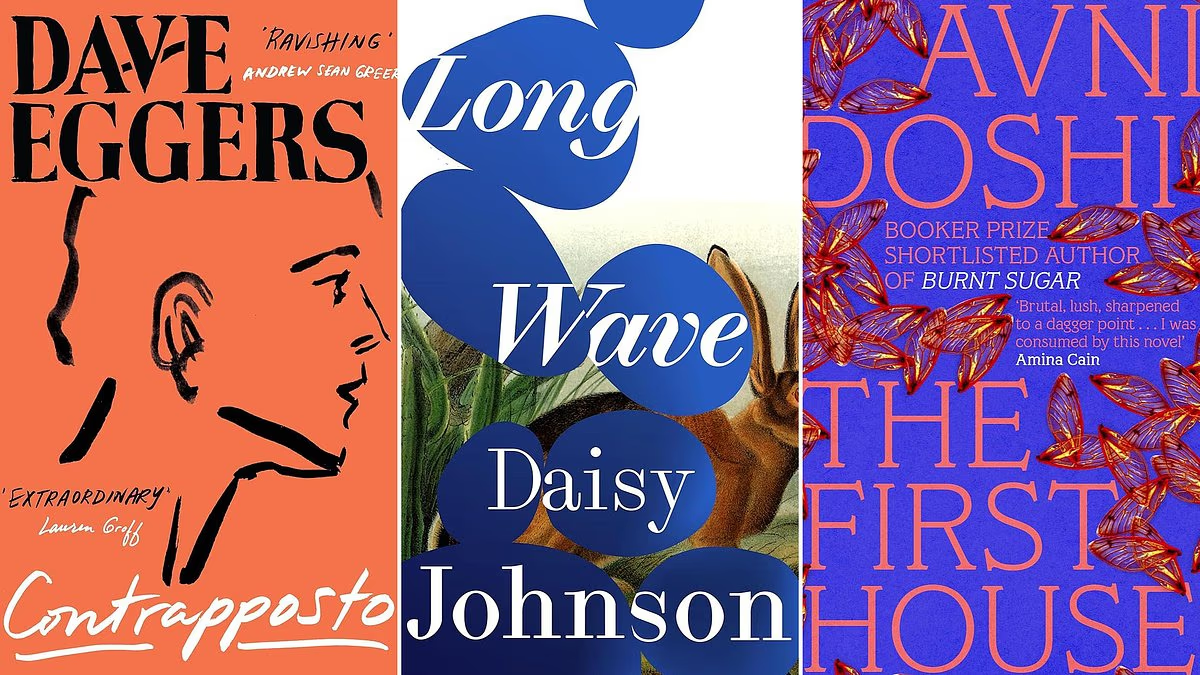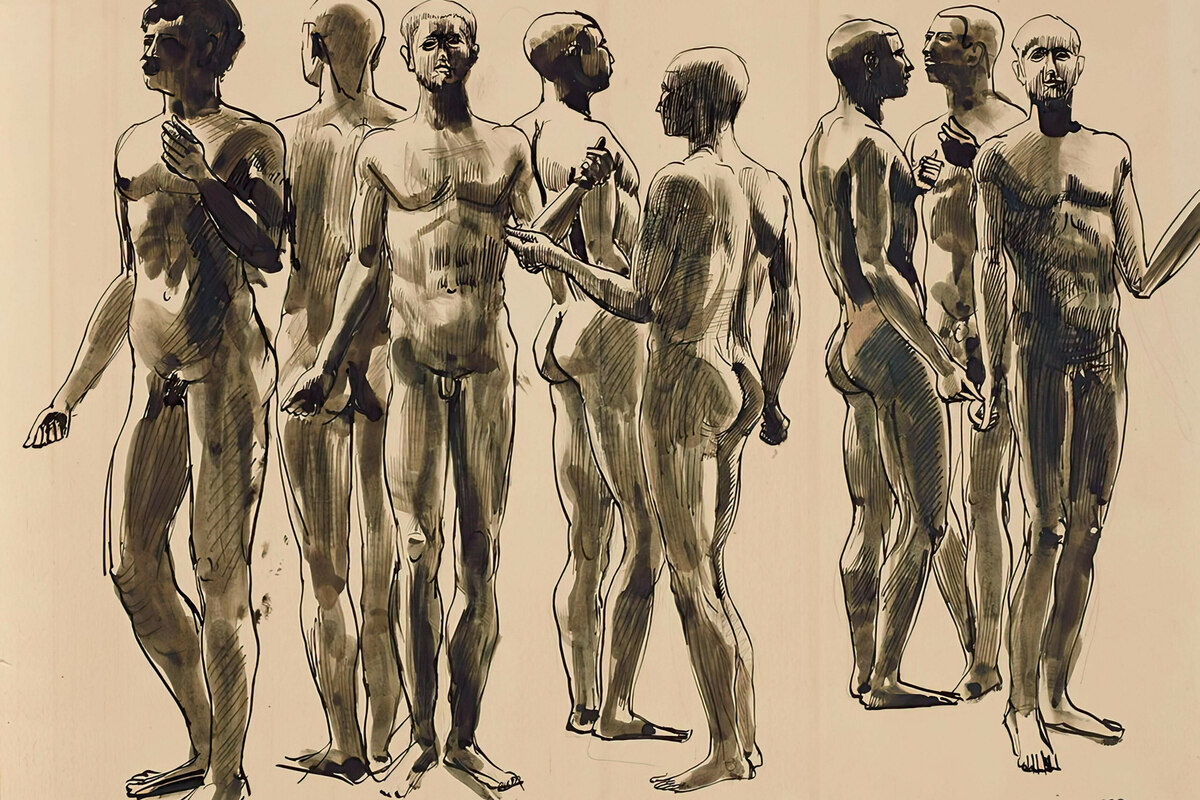
At the beginning of the 21st century, one book mapped, with uncanny accuracy, where American literature was headed. A Heartbreaking Work of Staggering Genius, by an upstart writer named Dave Eggers, was powered by a voice that was at once self-deprecating and self-aggrandizing. It was ostensibly a memoir of the period when Eggers raised his little brother, Toph, after their parents’ deaths, but its characters consistently break the fourth wall, and the book frequently doubles back to explain and contradict itself.Although the work was a critical favorite and a Pulitzer finalist, Eggers’s ironic tone struck some readers as overly precious—few books have inspired such devotion and exasperation in equal measure. Most prescient, Eggers eagerly highlighted the invented and imprecise elements of his story, foreshadowing a culture (literary and otherwise) in which the boundary between reality and fiction would grow ever more porous.Back then, Eggers’s persona was as visible—and as polarizing—as his writing. The same year that Genius was published, 2000, he responded to an interview request from The Harvard Advocate with an email rant. The student who’d reached out asked him about “selling out”; he objected, strenuously, to that framing. Success, he wrote, doesn’t make an artist inauthentic; it simply makes more things possible. Embittered critics who sneer at how a creative person makes money won’t be remembered, he argued; all that matters is the work. Three years later, the publishing company he ran put out a magazine, The Believer, that disavowed snark in its book reviews. And for a while, he managed to balance a devil-may-care imaginative attitude with commercial success, rejecting both the cynicism of the critical elite and the compromises of corporate publishing.In 2004, The New York Times described Eggers “as the magnetic center of a literary counterestablishment” and noted that his recent book of short stories had been released “with a characteristic disdain for the rituals of the publishing industry: no reviewers’ galleys, no back-cover blurbs, no publicity.” The first page of his novel You Shall Know Our Velocity was printed directly on the front cover—launching the story before a reader could open it—and was initially sold only through independent bookstores and his own publishing outfit, McSweeney’s. When Eggers rereleased it a year later, he’d added an entirely new middle section that altered the shape and meaning of the book.But 11 novels, three works of nonfiction, and a number of screenplays and children’s books later, Eggers isn’t the counterestablishment; he’s just the establishment. His work has won him more accolades—and, perhaps more notable, it’s grown more conventional. Books such as A Hologram for the King, published in 2012, and The Circle, from 2013, settled into familiar forms, despite their urgent subjects (America’s reputation abroad, predatory social media), and critics admired their conscience more than their invention. His youthful audacity survived mainly in packaging and sales: He issued a special edition of one book bound in fur, for example, and refused to sell the hardcover edition of another novel through Amazon. And by this point, the cultural tide had also turned against his earnestness. In 2013, Gawker made that Harvard Advocate interview its prime example of “smarm”—a pose of unearned, largely hypocritical positivity even worse than the “snark” it sought to oppose. Tom Scocca, the writer of the Gawker article, declared that Eggers was “full of shit.”Read: “The Comebacker,” a short story by Dave EggersYet Eggers really had built something new. Another magazine venture of his, a literary journal called Timothy McSweeney’s Quarterly Concern, began by publishing only work that had been rejected by other publications. He’d also started other ambitious endeavors, including the national education nonprofit 826 National and a college-scholarship program for first-generation attendees. Eggers may no longer be an upstart, but in the 2020s, he maintains this parallel track of making art and opportunities—he is creating the conditions in which others might flourish.These complex relationships—between art and institutions, between artistic integrity and worldly achievement—animate Eggers’s latest novel, Contrapposto. The book primarily follows two characters, Robert “Cricket” Dibb and Olympia Argyros, from childhood to old age. When the pair meet as children, Cricket is a budding visual artist who spends his days drawing and dreaming; Olympia seeks to cultivate Cricket’s talents while harboring art-world ambitions of her own. Over the course of their lives, they fall into each other’s arms and then separate again and again. Cricket’s heart is always pointed firmly toward Olympia’s, while her attention moves restlessly from him to a succession of other boyfriends and artists. As they grow older, Cricket and Olympia come to embody what I think of as the two sides of Eggers’s career: Cricket continues to pursue his own idiosyncratic creative calling, and Olympia becomes fluent in the art world’s systems of prestige.By naming his novel Contrapposto (an Italian word that describes a human figure putting most of their weight on one foot, like Michelangelo’s David), Eggers seems to be revisiting The Harvard Advocate’s question: What “foot” should artists lean on—artistic purity or market viability? Olympia sees in Cricket a spark of startling originality that deserves wider recognition, if only he would seek it. She encourages him to imagine art as a public practice, shaped by the programs and relationships that sustain it. But Cricket resists this vision, preferring a more solitary idea of artistic devotion, and the story’s sympathies lean in his direction. This uneven pose gives Contrapposto its richest subject but also exposes its defining weakness. Eggers, whose early work was celebrated for formal daring, has written a surprisingly traditional tale about the conflict between passion and the organizations that help give it shape—a book that stages rebellion while rarely risking much rebellion of its own.Cricket first encounters Olympia when he is 10 and far from home, during a long bike ride soon after his grandfather’s death. Olympia is spending time with another boy, but once she recognizes Cricket from school, she recruits him to vandalize a local playground with risqué puns. Cricket takes pride in his graffiti, his first commission; it gives him “a blossoming sense of fulfillment and purpose.” Sometime later, Cricket is at an art lesson, and Olympia happens to be taking a piano lesson in the same house. They walk home together, Cricket carrying his latest painting, and the girl persuades him to enter an art contest.Cricket and Olympia’s relationship follows this pattern for much of the book—she disappears for a time, then appears unexpectedly. She’s full of energy, sophisticated references, and plans for both of them. She expresses and even demonstrates her affection for Cricket, but she never dedicates herself fully to him. There is always someone else—sometimes a would-be rock star with whom she’s infatuated, sometimes a painter or sculptor she has taken up as a cause. Whether Olympia is falling in love or nurturing talent, she leaves Cricket feeling displaced.Read: The death of the artist—and the birth of the creative entrepreneurUnfortunately, Eggers’s depiction of Olympia at this stage occasionally seems trite. Sometimes she resembles a manic pixie dream girl—the sort of figure the film critic Nathan Rabin once described as existing only “to teach broodingly soulful young men to embrace life and its infinite mysteries and adventures.” Eggers seems unaware that he is reproducing this trope; rather than playing with the cliché, he appears captive to it. We never know Olympia’s thoughts or feelings, merely her words. Although this is ostensibly a book about friendship, such a relationship—at least a literary one—requires access to the interior life of both participants. Instead, we have Olympia on a pedestal, where she is never Cricket’s equal.This asymmetry does more than flatten Olympia: It imbalances the novel. Contrapposto stakes its drama on a genuine contest between two visions of the artistic life, yet it grants full humanity to only one of the contestants. And Olympia’s vision deserves more airtime, because the novel clearly understands that talent alone rarely makes an artistic life possible. As she rises in the art world, Olympia encourages Cricket to pursue the opportunities that might give his work a public audience: college, gallery shows, meetings with patrons—ways of accessing the networks through which artists are recognized and sustained. This begins in their youth, when she persuades Cricket, after a few wayward years out of high school, to enroll in college. He does so (with her, of course), and she introduces him to the art scene on campus. But life in the academy only sharpens his suspicion of it. Rather than committing to his classes, Cricket gravitates toward an iconoclastic professor who publicly denounces his colleagues for their fidelity to settled artistic norms, and Cricket abandons the education that Olympia had hoped would foster and advance his talent.He will repeat this pattern all his life: cultivating his gift in private, at a remove from the systems that might have ushered it into the world. Olympia understands what Cricket refuses to learn—that a career is built as much as it is willed, that success usually demands compromise. Hers is, admittedly, conventional wisdom that any mentor would offer. But a truth does not have to be original to deserve an advocate. Eggers made his name by deriding, and then usurping, the literary establishment, in the process defying the tired binary of pure artist versus sellout. But he has written a novel that fails to inhabit the one character who might complicate that same well-known divide.Yet Contrapposto excels as a study of the development of an artist. Eggers writes with passion and precision about each step of Cricket’s progress, from his early tentative efforts to his growing mastery. We witness as he takes his first lesson, and as he begins to find his voice. Years later, we watch as he struggles to perfect a new skill:Cricket came to know the strange tragedy of painting, for most who try to do it: that there is such joy in the brush, such abandon in filling a canvas with paint—the mind disappears; all we are is what we see; we summon orgies of color, making a tiny perfect world—only to back away from our canvas and realize it’s shit.Eggers’s commitment to showing each stage of Cricket’s growth is essential. (In a metafictional twist, we can judge that development for ourselves: The pages are illustrated with Eggers’s own drawings, presented as Cricket’s.) By depicting the frustrating, ecstatic, plodding, and astonishing process of creating art, he argues convincingly for the importance of discipline as a way of building your life. Cricket is far more interested in improvement than recognition because he believes that cultivating ability, instead of fame, yields its own considerable rewards. This is the book’s most resonant idea: that by committing to a daily practice of self-improvement, a person is, beyond their chosen practice, also becoming someone who can perceive what others cannot, who seizes moments and experiences instead of letting them pass by.Read: A strikingly complex portrait of a Founding FatherEggers seems to be both Cricket and Olympia: He wants to carve a lane for himself as a vibrant, essential artist while blazing a pathway for others who wish to do the same. And the author of A Heartbreaking Work of Staggering Genius and You Shall Know Our Velocity might have seemed especially well suited to take on this dilemma with formal risk. Instead, Contrapposto often settles for familiar rhythms: the sensitive male artist, the elusive woman who inspires him, the old drama of purity versus compromise.Perhaps this is inevitable. Cricket is presented as the rebel, yet his rebellion is curiously backward-looking: He has little use for the contemporary or the abstract, instead drawing models and painting traditional scenes. Olympia, meanwhile, represents status and accommodation, but because the novel denies her meaningful interiority, it cannot fully imagine the seductions or burdens of her position. The result is a book that makes a case for artistic freedom while repeatedly reaching for inherited forms: in its structure, in its gendered imagination, even in the drawings it offers as proof of Cricket’s independence. The writing is quite pleasurable in parts, and the conclusion is genuinely moving. But it is not a work of staggering genius.By Eggers, DaveWhen you buy a book using a link on this page, we receive a commission. Thank you for supporting The Atlantic.
A Novel About the Benefits—And Costs—Of Being a Rebel
Dave Eggers’s career has long balanced two major impulses. In his new book, he lets them wrestle on the page.
2,029 words~9 min read