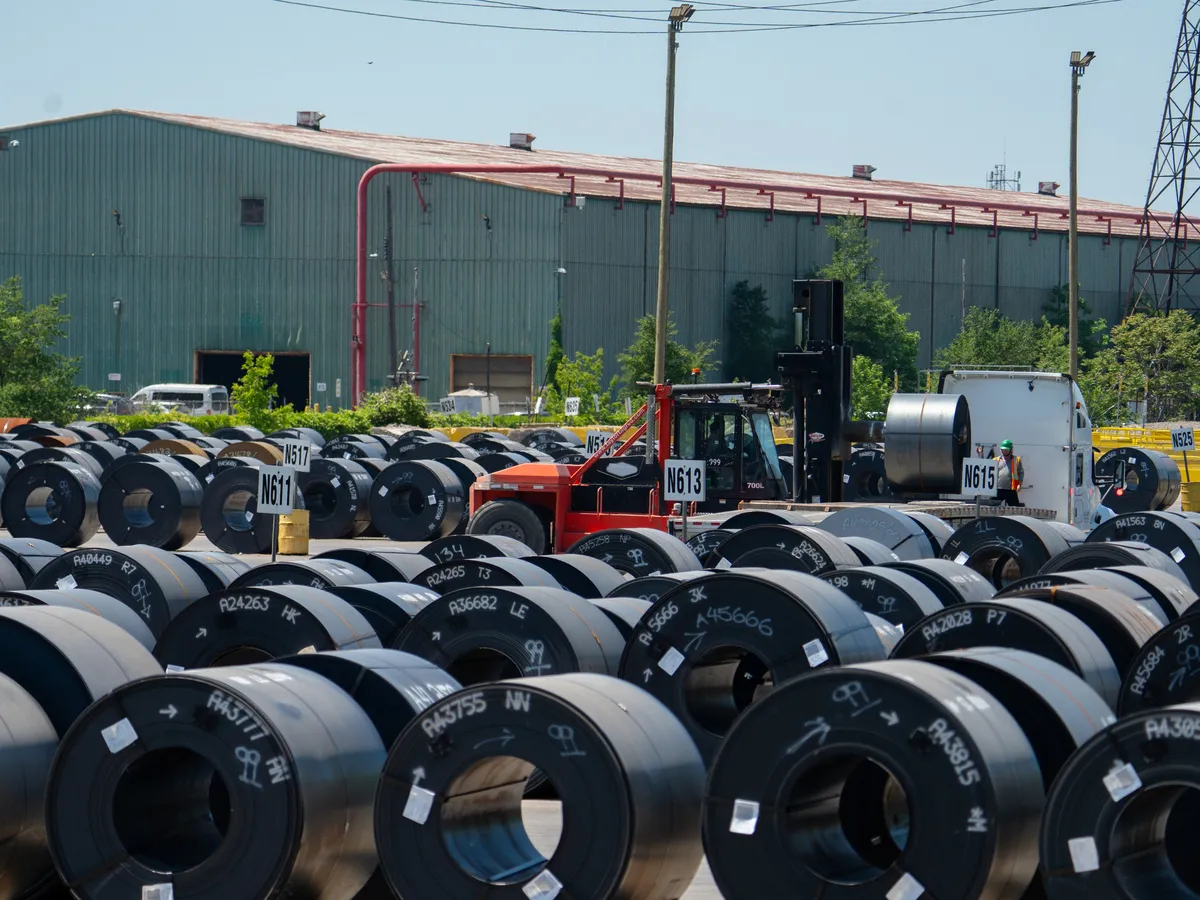
Skip to Content News Archives Economy Energy Oil & Gas Renewables Electric Vehicles Mining Commodities Agriculture Real Estate Mortgages Mortgage Rates Finance Banking Insurance Fintech Cryptocurrency Work Wealth Smart Money Wealth Management Investor Personal Finance Family Finance Retirement Taxes High Net Worth FP Comment Executive Women Puzzmo Newsletters Financial Times Business Essentials More Innovation Information Technology FP500 Podcasts Small Business Lives Told Tails Told Shopping Financial Post Store Obituaries Place a Notice Advertising Advertising With Us Advertising Solutions Postmedia Ad Manager Sponsorship Requests Classifieds Place a Classifieds ad Working Profile Settings My Subscriptions Saved Articles My Offers Newsletters Customer Service FAQ News Economy Energy Mining Real Estate Finance Work Wealth Investor FP Comment Executive Women Puzzmo Newsletters Financial Times Business Essentials HomeFP CommentJack Mintz: Picking today's winners and tomorrow's losersIf we continue the current world trade war, we will find that, as in real war, even the winners suffer severe lossesLast updated 21 minutes ago You can save this article by registering for free here. Or sign-in if you have an account.A heavy forklift operator places a coil of steel onto a flatbed truck at a ArcelorMittal Dofasco site in Hamilton, Ont. Photo by Peter Power/Postmedia filesI buy terrific coffee from the The Roasterie in Calgary even though I have to pay shipping costs to Toronto. Now that the federal government has pledged $100 million (for starters) to pay 50 per cent of the cost of shipping steel within Canada, I wonder if it could do that for roast coffee, as well? Somebody else would be paying my freight but, really, it’s a trivial amount.Subscribe now to read the latest news in your city and across Canada.Exclusive articles from Barbara Shecter, Joe O'Connor, Gabriel Friedman, and others.Daily content from Financial Times, the world's leading global business publication.Unlimited online access to read articles from Financial Post, National Post and 15 news sites across Canada with one account.National Post ePaper, an electronic replica of the print edition to view on any device, share and comment on.Daily puzzles, including the New York Times Crossword.Subscribe now to read the latest news in your city and across Canada.Exclusive articles from Barbara Shecter, Joe O'Connor, Gabriel Friedman and others.Daily content from Financial Times, the world's leading global business publication.Unlimited online access to read articles from Financial Post, National Post and 15 news sites across Canada with one account.National Post ePaper, an electronic replica of the print edition to view on any device, share and comment on.Daily puzzles, including the New York Times Crossword.Create an account or sign in to continue with your reading experience.Access articles from across Canada with one account.Share your thoughts and join the conversation in the comments.Enjoy additional articles per month.Get email updates from your favourite authors.Create an account or sign in to continue with your reading experience.Access articles from across Canada with one accountShare your thoughts and join the conversation in the commentsEnjoy additional articles per monthGet email updates from your favourite authorsSign In or Create an AccountorThe steel industry is obviously much more important than coffee roasting. Steel companies, primarily in Quebec and Ontario, employ 23,000 people and produce over 12 million tonnes of steel a year. But some aren’t competitive, so we foolishly throw subsidies and tax breaks at them. In the case of the almost literally never-ending saga of Algoma, subsidies totalled $800 million from 1992 to 2021, with another $500 million in 2025 in tariff relief.Get the latest headlines, breaking news and columns.By signing up you consent to receive the above newsletter from Postmedia Network Inc.A welcome email is on its way. If you don't see it, please check your junk folder.The next issue of Top Stories will soon be in your inbox.We encountered an issue signing you up. Please try againWhy do we distort the market in favour of some products or firms and not others? One argument is that other countries protect certain industries so we need to do the same. Under CUSMA, 90 per cent of our steel exports were generally going to the U.S. tariff-free. Now, steel companies are being hammered by U.S. tariffs as high as 50 per cent. But autos, lumber, and copper, aluminum, and their derivatives are also being hurt by Trump tariffs. Shouldn’t their transport costs be subsidized, too? And what about agriculture, which was hit hard by Chinese import restrictions?Today, international trade is being grossly distorted by grants, tax concessions and cheap government credit under the guise of industrial policy. Importing countries then counter it all with tariffs and quota restrictions to protect their own industries. Resources are being badly misallocated as governments pick winners today that become losers tomorrow (ask Ontario and Quebec about EV subsidies). It’s costing governments a bundle of taxpayer money and making many rich investors even richer. Is this an economic war countries should be fighting?A June report by the OECD estimates that subsidies across 15 major industries totalled US$108 billion in 2024, accounting for 1.3 per cent of company revenues. That’s up 55 per cent since 2015. Tax concessions were the most bountiful component in 2024, at US$41 billion. The most heavily subsidized industry was solar (3.2 per cent of firm revenues) followed by electronics (2.1 per cent), aluminum (1.7 per cent) and steel (1.3 per cent).China is the worst subsidizer by far, providing 3.1 per cent of company revenues, almost three times the rate in North America and North America is twice more than the EU. Chinese profit margins are only five per cent of company revenues, so it’s clear many companies would not survive without state support.Market socialism has been a brilliant strategy for China to acquire market power over global markets by producing cheap, high-quality products. The large state-owned enterprises set low prices at which small suppliers compete. To earn their slim margins on their sales, the suppliers cut costs such as by hiring cheap “flexible employees” (now three-eighths of today’s 800 million work force) or by innovating to keep competitive. Margins are so thin that many become unprofitable requiring public subsidies (often VAT refunds) that becomes a financial burden for sub-national governments.One result of all the subsidies is that China dominates several strategic sectors, including bio-tech, electronics, advanced materials, aerospace weapons and nuclear technology. But another is that China’s official and hidden public debt is now running at 300 per cent of GDP. With cheap Chinese goods sold in international markets, job losses grew in the European and North American industrial heartlands.An August IMF paper finds China to be largest subsidizer of strategic industries (although the IMF data do not include tax concessions nor credit relief). Averaged over 2015-23, Chinese grants were about three per cent of value-added in strategic industries, compared to one per cent of other industries.By comparison, U.S. and EU subsidies for strategic industries are about 0.5 per cent of value-added. The IMF paper argues that China’s strategic-sector subsidies have allowed it to grab global market share as the EU and the U.S. have focused more on industries without scale economies. Chinese subsidies come at a cost, however: a high public deficit and a growing low-income gig workforce.And Canada? According to the IMF paper, Canada is the fourth-largest cash subsidizer, trailing only China, the U.S. and Russia in both strategic and non-strategic industries. Unlike the U.S., however, Canada focuses its handouts more on strategic industries.The current vogue for industrial policy is causing havoc to the world trading system. Countries that cut business subsidies risk losing key industries, so feel they have no choice but to funnel money into firms. The only way around subsidy competition is multinational collaboration. As the EU has done reasonably effectively since 2007, western countries should adopt rules limiting state aid and jointly punish countries like China that have been using subsidies to grab international market share.Increasingly, however, we do the opposite: excuse subsidies and tariffs in the interest of industrial policy and veer farther away from free-trade principles. If we continue the current world trade war, we will find that, as in real war, even the winners suffer severe losses.Financial Post Join the Conversation This website uses cookies to personalize your content (including ads), and allows us to analyze our traffic. Read more about cookies here. By continuing to use our site, you agree to our Terms of Use and Privacy Policy.
Jack Mintz: Picking today's winners and tomorrow's losers
If we continue the current world trade war, we will find that, as in real war, even the winners suffer severe losses. Read more.
TL;DRAI
Governments subsidized US$108B across 15 industries in 2024 (China 3.1% of firm revenues vs North America 1.5%); US steel tariffs hit 50% while Canada's Algoma gets $500M, creating commodity price distortion. Tech leaders must now embed geopolitical-subsidy risk into supply chain strategy for semiconductors, rare earths, batteries—government-backed "winners" routinely become stranded assets within years.
1,381 words~6 min read