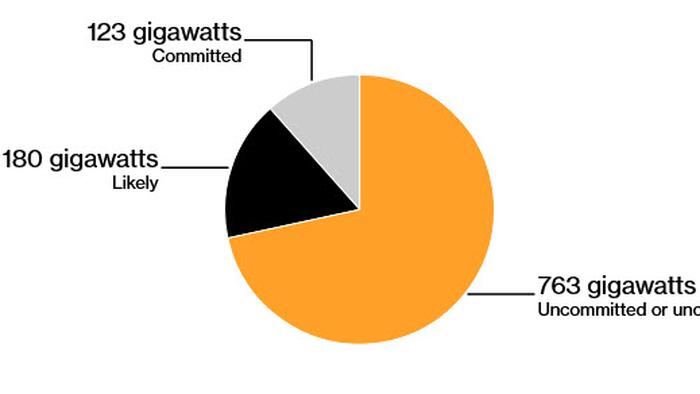
The US artificial intelligence industry is supposed to be hungry for power. Developers have submitted requests for 1,066 gigawatts of new electricity capacity to support data center growth. That number is staggering, roughly equivalent to the entire current generating capacity of the US several times over. The catch: most of it is fiction.
Wood Mackenzie, the energy research firm, estimates that only about 28% of that requested capacity is likely to result in anything actually built. The rest falls into a category that grid operators and utility executives have started calling “phantom” projects, speculative or duplicative applications that clog interconnection queues without any realistic path to construction.
How phantom projects work
The mechanics are straightforward, if a little cynical. A developer with a data center concept submits applications to multiple utilities simultaneously, shopping for the best grid connection terms. Each utility logs the full requested load as a real demand signal. None of them know the others are holding identical applications from the same developer.
The result is a queue stuffed with mirages. Industry estimates put the share of legitimate applications at somewhere between 20% and 30% of all submissions nationwide. On the PJM grid, which serves roughly 65 million people across the mid-Atlantic and Midwest, about half of data center requests may be credible. In Texas, on the ERCOT grid, the legitimacy rate drops to around 14%.