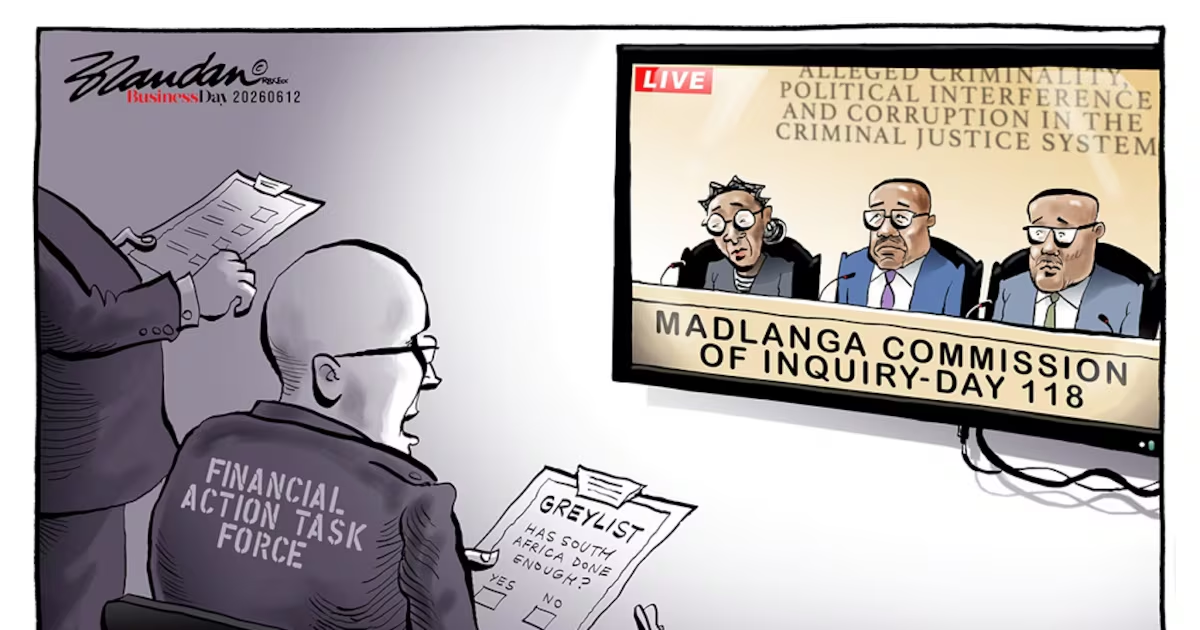
The National Treasury recently filed its opening technical compliance report with the Financial Action Task Force (FATF), beginning an assessment that runs until October next year. Almost nothing about the filing was reported, which is a fair reflection of how the country treats the subject: an administrative burden discharged by officials on our behalf. It deserves more attention than that because the question the assessment asks is not really about money-laundering. It is about whether our institutions can be made to work.South Africa came off the greylist on October 24 2025 after 32 months and 22 action items. The National Treasury, the Financial Intelligence Centre, the South African Revenue Service and the sector supervisors delivered that under sustained pressure and with rather less political cover than they deserved. We are now largely compliant with 38 of the FATF’s 40 recommendations, a stronger technical position than that of several countries inclined to lecture us about it.The difficulty is that the fifth round methodology has changed what is being marked. The fourth round asked whether a country had the right laws, institutions and registers. The fifth asks what those laws have produced. Assessors arrive here in March next year to grade us against 11 immediate outcomes, and the evidence they want is arithmetic: investigations opened, prosecutions brought to court, convictions secured, criminal assets traced and confiscated, sustained across five years rather than assembled in the 18 months before their visit. Chris Axelson of the Treasury put this to parliament in June with more candour than officials usually permit themselves. The risk is no longer the rule book; it is showing the rule book bites.On that measure our record is poor, and it has been deteriorating for two decades. In the 2005/06 financial year the specialised commercial crime courts were producing more than 200 convictions per court per year. By 2023 there were 22 such courts, and between them they managed 15 convictions each. Productivity in the specialised commercial crimes unit fell from six convictions per prosecutor in 2018/19 to one and a half by 2023/24. The research is Jean Redpath’s at the Dullah Omar Institute, and it has attracted a fraction of the attention it merits.Very little of the failure happens in the courtrooms. More than 128,000 commercial crime cases were reported to the police in 2023/24, and about 15,000 arrests followed, which is close to the referral rate the country managed in the late 1990s before any specialisation existed at all. Prosecutors are being handed cases too little, too late and too poorly assembled. Redpath’s judgment on Hawks referrals is that they are few and often inadequate, which is what happens when complex commercial investigation is folded into a unit carrying an enormous general mandate and a permanent backlog.The causes are correctable. The specialised courts sat for an average of four hours and 53 minutes a day in 2005/06; by 2022/23 regional criminal courts were sitting for two hours and 54 minutes. Prosecutors and magistrates are paid identically whether a matter is finalised or postponed, while hourly billing can give defence teams the opposite incentive. None of this requires legislation to correct; it requires someone to own throughput and be measured on it.What is at stake financially is easy to underestimate because it is indirect. IMF research across 89 emerging economies greylisted in 2000-17 found capital inflows falling by an average of 7.6% of GDP over nine months. That is an average rather than a forecast, and our financial system is more integrated than most of those on the list. But additional due diligence drives up costs, resulting in slower settlement for exporters, more expensive remittances for the people who can least absorb them, and a higher cost of capital that reaches the fuel price before it reaches the headlines. A second listing would be materially worse than the first, since the first indicated we had a problem and a second would suggest we are struggling to correct it.The scale of what is being policed is worth holding in mind. Commissioned research reported in Business Day put the tax lost to the illicit economy at R84.6bn a year, about 1% of GDP. Against that, the asset forfeiture unit obtained 481 freezing orders worth R859m last year and recovered R533m, against a target of R160m. That is real overperformance by a well-run and badly resourced unit. It is also a rounding error against the estimate.All of which reads as the state’s problem, and the commentary has largely treated it so. But the mechanics do not support that reading. A money-laundering prosecution is built almost entirely from material generated inside private companies: the suspicious transaction report a bank filed, the file an attorney kept, the record of why a risk committee was satisfied with a client. Where that material cannot be retrieved and defended two years later, the case collapses before it is argued and the failure belongs to us rather than to the prosecutors.The question is already circulating in boardrooms: now that we are delisted, can the anti-money-laundering budget come down? Most spending on this peaked in 2024 and has been easing since October. The evidence that will be graded in 2027 is being produced by those systems now and scaling them back is the most predictable route back onto the greylist.Underneath the budget question is a habit of mind worth examining. Compliance is often framed as a cost of doing business, so we build functions that generate reports rather than evidence. No-one asks whether a file would survive cross-examination.Directors could usefully put a single question to their compliance heads this quarter: if a prosecutor asked in 2028 for the reasoning behind a client decision taken this month, could the firm produce it and stand behind it? The answers will be uneven, and the exercise is more instructive than another gap analysis.There is a public role too, and organised business has been oddly silent in it. We are vocal about electricity and about ports and rail, and it has produced results. We have said almost nothing about a court system sitting less than three hours a day, though commercial crime operates as a levy on every firm competing honestly. The department of justice would respond to concerted pressure on sitting hours and case flow management, much as Transnet eventually responded to public pressure. But no such pressure has been applied, and there is no good reason for that.The state has the following obligations: Fix throughput in the commercial crime courts, with longer sittings, proper case flow management, plea and sentence agreements used deliberately, and ordinary commercial prosecutions moved out into the district and regional courts so specialisation stops functioning as a bottleneck. Prosecute the professional enablers: those who move and disguise the money, not only those at the end of the chain. Convicting a senior lawyer, accountant or banker who knowingly enabled a syndicate would send a powerful signal to assessors and the public.In 2023-25 South Africa showed it can legislate quickly and competently once the cost of inaction becomes plain. The next 20 months test something we have always found harder: whether our institutions can produce results consistently after the crisis has passed. On the evidence of the commercial crime courts, that is the more serious problem. The greylist is simply where it happens to be visible.• Foster-Pedley is associate pro vice-chancellor (global engagement Sub-Saharan Africa) at the University of Reading, and dean and director of Henley Business School Africa.Business Day
JON FOSTER-PEDLEY | Greylisting risks resurface as money-laundering reform efforts stall
SA's ability to demonstrate real-world enforcement through investigations, prosecutions, and convictions has weakened
1,240 words~6 min read