Story audio is generated using AI
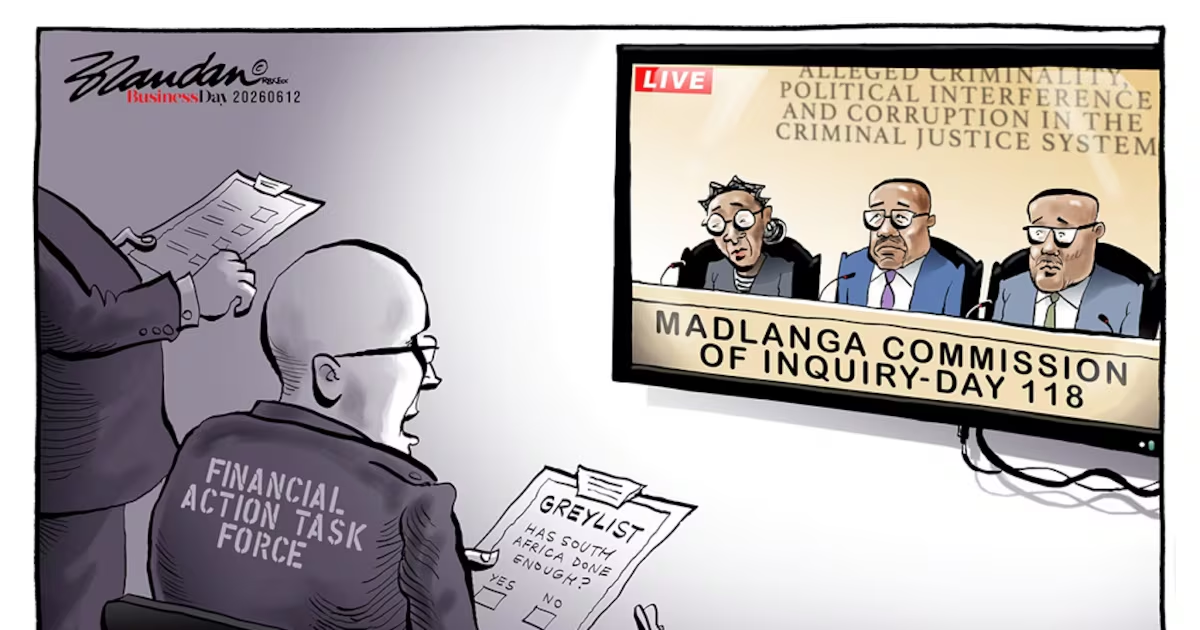
Allegations at the Madlanga commission of inquiry that organised crime has infiltrated the highest levels of law enforcement in South Africa risks undermining the country’s status with the Financial Action Task Force (FATF), which is undertaking an assessment of the country’s fitness to combat serious financial crimes.The Madlanga commission has been inundated by revelations of corruption and fraud among the upper echelons of the police force and alleged connections with organised crime syndicates. Addressing a meeting of parliament’s finance committee to consider legislative amendments to comply with FATF requirements, Ismail Momoniat, who heads South Africa’s delegation to the FATF, said law enforcement is the biggest challenge facing the country in terms of avoiding another greylisting. Ismail Momoniat, head of SA’s delegation to the FATF. Picture: TREASURY Though technical compliance, namely the country’s legislative and regulatory regime, is low risk, Momoniat said the FATF will also assess the effectiveness of the police regarding investigations, prosecutions and convictions with regard to serious money-laundering crimes, terror financing and asset recoveries.“I would say that these are the hardest measures that South Africa will need to deal with,” Momoniat said in reply to a question by ActionSA MP Alan Beesley.Potential impact “Clearly the events at [the] Madlanga [commission] and the ability of the country to deal with organised crime, and particularly if many of our top police are implicated in links with organised crime, do impact on their ability to process cases. If these cases are not completed, that will impact on South Africa,” Momoniat said. “The FATF looks at five years of data. It wants to know the number of cases, how many of them have been fully investigated, whether we are prosecuting such cases, whether there are convictions and so on,” he added.“I think those measures are going to be quite tough for South Africa to deal with. The area of law enforcement is one of our biggest challenges, particularly as it relates to financial crimes.”South Africa was removed from the FATF’s greylist in October last year, just over two years after the intergovernmental organisation highlighted deficiencies in the country’s ability to counter money-laundering, terrorist financing, and financing of proliferation. The greylisting added to the cost of doing business, imposed additional due diligence burdens on South African enterprises and made cross-border correspondent banking relationships more onerous.Assessment under way The FATF has already started another 18-month mutual evaluation process in South Africa that will culminate in a report to the organisation’s plenary in October 2027, said Chris Axelson, deputy director-general of tax and financial sector policy at the National Treasury.South Africa is required to submit reports on July 27 and October 19, and in 2027 the FATF could conduct an on-site visit. Axelson told MPs the FATF’s 2027 methodology is wider and tougher than the 2019 evaluation — which led to South Africa being placed on the greylist — and agreed with Momoniat that weaknesses in law enforcement and prosecutions are the big risks facing South Africa.Effectiveness in law enforcement requires three national risk assessments, five years of data, good case studies and evidence that law enforcement capacity has been strengthened to deal with financial crimes, Axelson noted.If South Africa is to avoid a greylisting, it must avoid being referred to the FATF’s International Co-operation Review Group and post-observation process at the October 2027 plenary.Legal redressTo address deficiencies in South Africa’s legislative regime identified by FATF in its most recent evaluation, the Treasury has urgently tabled the General Laws (Anti-money-laundering and Combating Terrorism Financing) Amendment Bill, which it hopes can be promulgated before November. The legislation seeks to amend a number of laws, such as the Companies Act, Non-Profit Organisations Act, Close Corporation Act, Financial Sector Regulation Act and the Financial Intelligence Centre (FIC) Act. Axelson said the bill is urgently required before the technical compliance process concludes in November/December. The sooner the bill is in force, the more it will also assist with the effectiveness of law enforcement.The amendments in the proposed bill will tighten compliance obligations regarding the reporting of beneficial ownership and empower the FIC to conduct lifestyle audits, including of politically exposed persons, and extend the list of entities with which the FIC can share information to include the Public Procurement Office and the Border Management Authority. It will also allow for the sharing of information between banks. The bill also seeks to increase the maximum administrative sanction that the Companies and Intellectual Property Commission (CIPC) can impose to R10m from R1m.