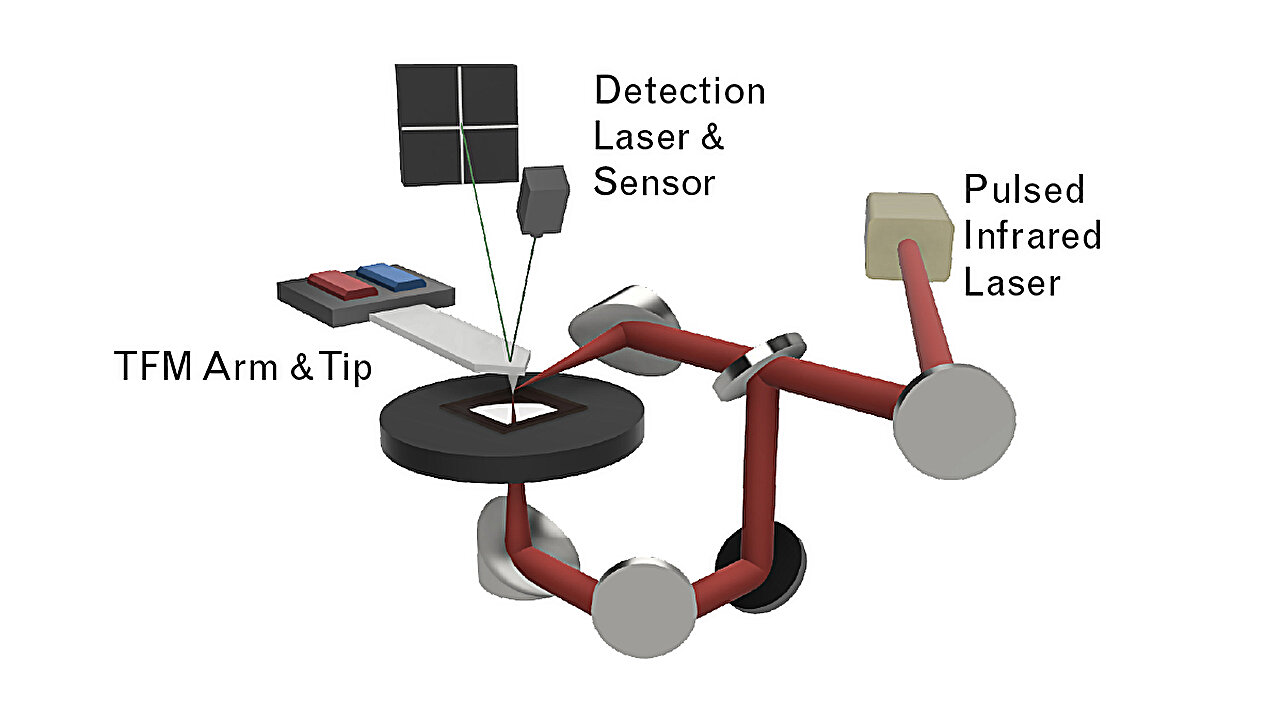
A schematic of a novel infrared torsional force microscopy (TFM-IR) experiment conducted at the University of Maryland. A material sample (located on the dark gray disc) is illuminated with pulses from an infrared laser. A microscopic tip, twisted rapidly back and forth on a long arm, scans the surface of the material to sense its response to the light. A second laser is bounced off the arm to measure small changes to its twisting motion, allowing researchers to capture a detailed image of the sample's surface. Credit: Nature Communications (2026). DOI: 10.1038/s41467-026-74654-0
By rapidly twisting a microscopically small tip back and forth, researchers at the University of Maryland (UMD) have unlocked a new way to detect subtle changes on the surface of a material flexing in response to infrared light.
In a paper published in the journal Nature Communications, the researchers describe a new way to take high-resolution images that they call infrared torsional force microscopy, or TFM-IR for short.
It allows them to measure the surface of a material with near-nanometer precision as it stretches and warps in response to infrared light—invisible light readily absorbed by many kinds of chemical bonds that causes them to vibrate. It's the first technique that can measure both the vertical and horizontal vibrations induced by light with such high precision.