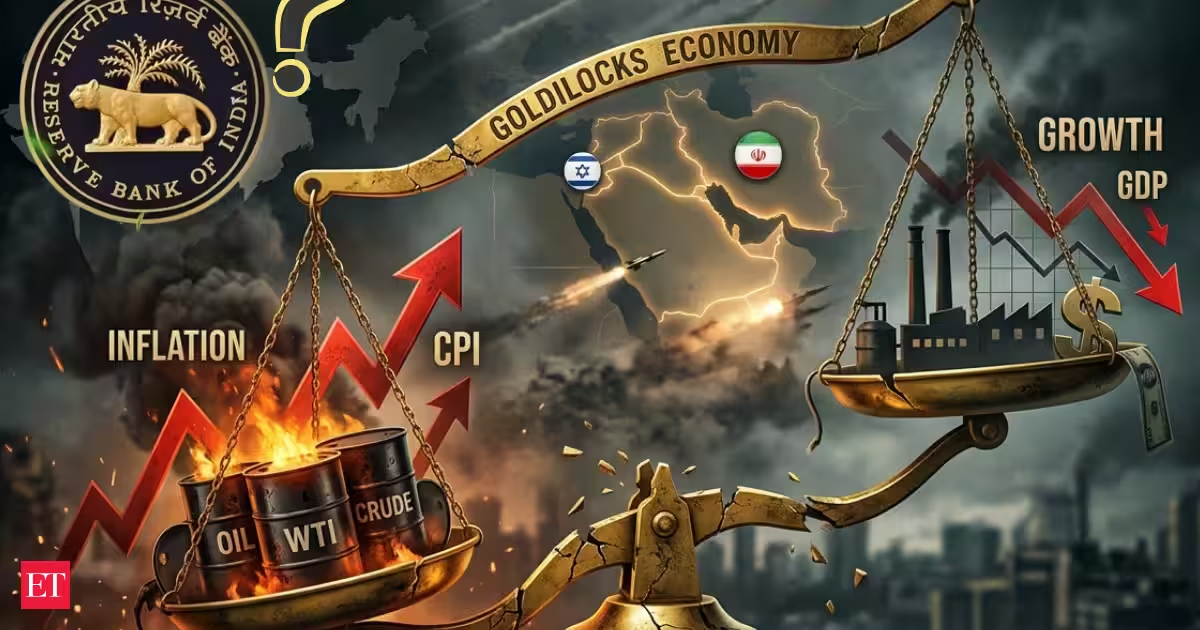
The Monetary Policy Committee (MPC) kept the policy repo rate unchanged at 5.25 per cent in its August 5 bi-monthly resolution — the fourth consecutive time it has held rates steady. The decision was shaped by evolving growth-inflation dynamics driven by both domestic and external factors. Chief among the external shocks are geopolitical tensions emanating from conflicts in the Middle East, the imposition of US tariffs, and prolonged disruptions to global supply chains.Uncertainty around the monsoon and climate-change pressures linked to El Niño add a further layer of risk. Put together, the picture is of a gathering storm whose disruptive impact remains difficult to quantify. With such uncertainty dominating the geopolitical landscape for an extended period, what should a monetary policy authority do?The mandate of the monetary policy, formalised in the amended RBI Act, 1934, in 2016, defines the objective as maintaining price stability while keeping growth in mind. A decade into implementing the flexible inflation targeting (FIT) framework, it is worth noting that India’s growth has historically been, and continues to be, consumption-led — private consumption contributes around 56 per cent of the GDP — while inflation is largely driven by food prices. In the current environment, inflationary pressure stems from global commodity price shocks, monsoon uncertainty, and, notably, fuel price pressure arising from the Middle East conflict.Inflation pathThe MPC’s August 5 resolution trimmed the inflation forecast marginally, by 0.1 percentage point, to 5 per cent, while revising the growth forecast upward by 0.1 percentage point to 6.7 per cent for FY2026-27, compared with the forecast set out on June 5, 2026. This divergence from the June forecast largely reflects a rebalancing of risks to growth and inflation stemming from external shocks, weighed against the resilience of domestic factors. Under the FIT framework, the headline Consumer Price Index-Combined (CPI-C) — comprising food, fuel, and services inflation — remains the official measure of inflation.One issue worth flagging is the change in weights following the shift to the 2024-25 base year, from the earlier 2012 base year. The weight assigned to food and beverages has fallen to 40.10 per cent, from 45.86 per cent earlier. Services represented by miscellaneous, correspondingly, now carry a higher weight of 33.15 per cent than before (28.32 per cent). This is significant because a higher services weight points, broadly, to core inflation (headline inflation minus food and fuel). Although core inflation is not the official FIT metric, the increased weight assigned to services warrants closer scrutiny, since it now carries greater influence over the headline number. The Governor’s statement pegged core inflation at 4.3 per cent.Beyond the core inflation estimate and the higher weight now given to services, the volatility in fuel prices — driven by geopolitical developments — remains a concern, given its potential to adversely affect the medium-term outlook for headline CPI inflation. As the Governor’s statement noted, higher food, fuel, and other input costs could trigger second-round effects, broadening the base of inflation across the economy. A related concern is the growing divergence between the Wholesale Price Index (WPI) and CPI, both in direction and in magnitude. For example, while the inflation rate measured in terms of CPI Combined (base 2024=100), which is the official measure for FIT, stood at 4.38 per cent in June 2026, the WPI (base 2022-23=100) was estimated at 9.87 per cent mainly due to a higher fuel inflation rate 27.41 per cent. This needs to be examined as fuel inflation is guided primarily by developments in the import of crude oil.Growth prospectsTurning to medium-term growth, given that consumption already drives a large share of the economy, growth prospects now hinge on investment — both domestic and foreign. It is expected that robust growth in non-food credit, at 17.7 per cent in July 15, 2026 which is broad-based across sectors, could translate intohigher private investment. For growth to be higher and more sustainable, private investment needs to lead rather than follow. This is where productivity, rather than mere production, becomes critical. Strengthening total factor productivity, along with capital and labour productivity, will help foster durable growth. However, this is easier said than done given ecosystem challenges and the friction surrounding structural reforms. The new labour codes are a case in point: while welcomed by business, they face resistance from labour, which feels largely excluded from the policy framing process.Rate transmissionTransmission of monetary policy through the interest rate channel also deserves careful attention. The weighted average call rate (WACR) at 5.31 per cent during June 6 to July 31 2026 — the operating target of monetary policy — only 6 points higher than policy repo rate has moved broadly in sync with the repo within the Liquidity Adjustment Facility (LAF) corridor. It may be noted that in response to the 125-basis points (bps) cut in the policy repo rate cumulatively, the weighted average lending rate (WALR) of Scheduled Commercial Banks declined by 80 bps for fresh rupee loans, and 91 bps for outstanding rupee loans during February 2025 to June 2026.On the deposit side, the weighted average domestic term deposit rate (WADTDR) on fresh deposits has declined by 63 bps while that on outstanding deposits has softened by 51 bps during the same period. This shows that the monetary policy transmission has been incomplete. For the transmission to be effective, both short- and long-term rates need to respond positively to the WACR, translating into appropriate adjustments in bank lending and deposit rates.On the external front, a sustainable current account deficit in the medium term would be in the range of 2.5 to 3 per cent of GDP, alongside a growth rate of around 7 per cent — and this gap should ideally be financed more through FDI than through debt. Measures to encourage inflows into FCNR(B) deposits, which have drawn around US$36.7 billion, have helped curb rupee volatility to some extent initially, though they may eventually add to the external debt burden. The prospect is of a weaker currency and higher external debt.It is true that managing monetary policy has grown more difficult, as balancing growth and inflation dynamics is compounded by unprecedented geopolitical tensions and uncertainty over monsoon and climate conditions — a daunting task. What is needed going forward is a shift from consumption-led growth toward investment-led growth, with private investment playing the lead role.The writer is Professor at the Gokhale Institute of Politics & Economics, Pune, and a former Central banker. Views are personal) (Through The Billion Press)Published on August 8, 2026
The MPC’s August tightrope and the road ahead
Given that consumption drives a large share of the economy, growth prospects now hinge on investment and productivity
1,075 words~5 min read