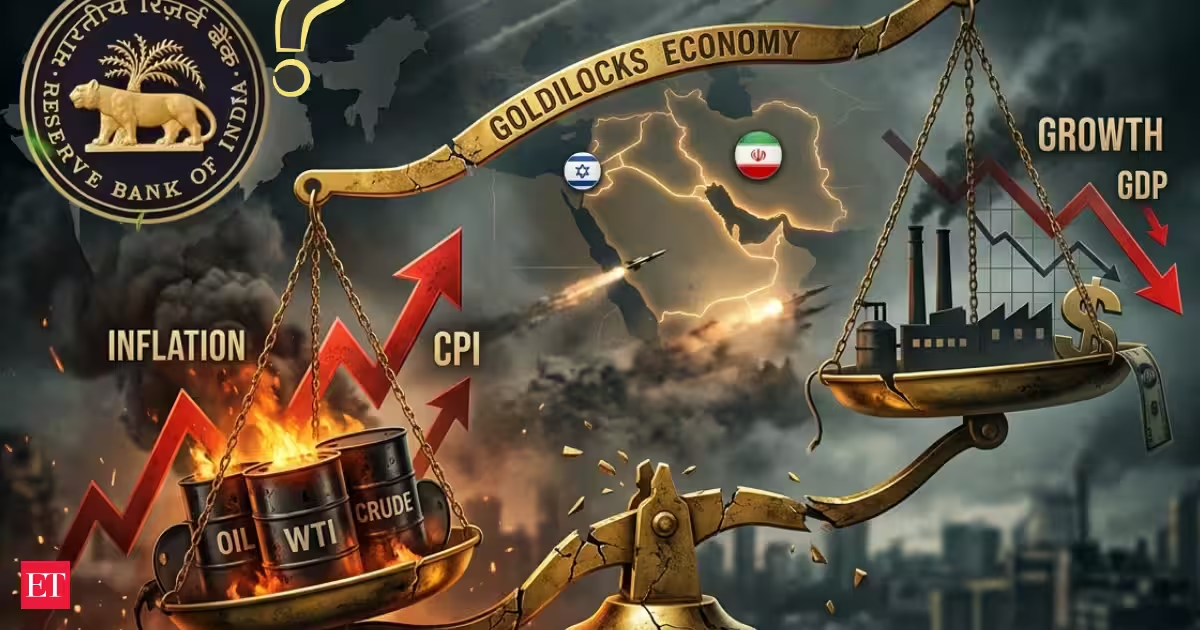
Pity RBI's monetary policy committee. For three days, starting this Wednesday, it will have to grapple with the usual host of unknowns endemic to macroeconomics. And then some more. As an MPC member put it so eloquently a few months ago when things were much less uncertain, its position is like that of a man sitting on a chair in the middle of an oil spill, not knowing where to put his foot down for fear of falling.Things have only got worse. Apart from chaos on the tariff front, and uncertainty of not knowing when the war in West Asia will end - and, by extension, when oil supplies through the Strait of Hormuz will resume - MPC has to contend with two new unknowns:Assuming NSO doesn't share inside information on GDP numbers with MPC before its official release, MPC will have to frame policy without having updated, official information on India's economic growth. Because, in a first, NSO has shifted release date for Provisional Estimates of Annual GDP for 2025-26 and Quarterly Estimates of GDP for the Fourth Quarter (January-March 2026) from the last working day of May to June 5.Consequently, MPC will not have the benefit of official growth numbers while framing policy. True, GDP numbers are about the past, while monetary policy is forward-looking. But Q4 FY26 was when the economy had to deal with higher tariffs and oil supply shock. So, NSO's numbers could have provided a baseline for MPC's growth estimates. But that's not possible now. In a delicious irony, RBI governor Sanjay Malhotra's monetary policy statement comes in the early hours of the very day the NSO announces its GDP numbers.Then there's the matter of a new man at the helm of the US Fed, the de facto central bank for the global economy. The reality, however much RBI governors might like to deny it, is that India can't afford to keep the Fed off its radar. If the Fed, for instance, were to raise interest rates, in all probability, RBI will follow suit - although after a respectable gap and some tall talk, in a show of independence.The problem is that new Fed chair Kevin Warsh is a bit of a mystery man. An acknowledged Trump protege, who owes his job to his apparent willingness to do his master's bidding, it remains to be seen whether he will cut interest rates, as Trump wants him to. Or, given the unpleasant reality of US inflation rates being above target (2%) for more than 5 yrs now, follow the diktat of Economics 101 and raise rates.Unfortunately, it will be a while before we know which way Warsh turns. The first meeting of the rate-setting Federal Open Markets Committee, with Warsh at the helm, is slated for June 16-17, 10 days after MPC meets. US inflation in April was 3.8%, highest since May 2023 (higher than India's 3.48%), and likely to go higher as the stalemate over Hormuz continues, while growth is holding up better than expected (1.6% in Q1 2026, up from 0.5% the previous quarter).In India's case, too, inflation is trending up, though it's within the target range of 2-6%, while growth, even though still the highest among major developing countries, is trending down. How the growth-inflation trade-off will eventually pan out depends on how long the conflict lasts (read: when the Hormuz Strait opens and damaged oil facilities get back on track).What is beyond doubt is that growth in 2026-27 will fall short of the 6.9% projected by MPC at its April meeting. Inflation, on the other hand, will end up well above the 4.6% then projected.In such a scenario, what should policy authorities do? GoI has already launched its own rescue act - correcting policy distortions by raising fuel prices, hiking import duties on import of gold and silver, imposing export curbs on sugar, urging citizens to tighten their belts....What should monetary policy do? Wholesale price inflation is already at a 42-mth high, and retail inflation will soon catch up. Central banks of Sri Lanka and Indonesia have raised rates by 100 and 50 bps, respectively. But there are others, like Bank of England, US Fed and ECB that have preferred to bide their time.If, as Malhotra asserted recently, the 'country's macro fundamentals are very strong', there's no need to worry. Sure, his assessment might take some convincing, given a rapidly weakening currency, rising inflation and strong capital outflows. But remember, the root of the problem is not so much CAD per se as lack of capital flows needed to fund even this relatively moderate deficit.Ideally, a defence must be mounted on both fronts - reduce CAD and incentivise capital flows. A repo rate hike will address both, even if only partially. It will compress demand and incentivise debt flows. Will MPC bite the bullet?(Disclaimer: The opinions expressed in this column are that of the writer. The facts and opinions expressed here do not reflect the views of www.economictimes.com.)
Raise it, regulators: A repo rate hike - 50 bps increase to 5.75 perhaps - will reduce CAD, incentivise capital flows - The Economic Times
India's monetary policy committee faces a complex decision. Delayed economic growth data and an unknown US Federal Reserve policy create significant challenges. Inflation is rising while growth slows. The committee must navigate these uncertainties to set interest rates. The government is already taking steps to manage the economy. The committee's decision will impact the country's financial future.
827 words~4 min read