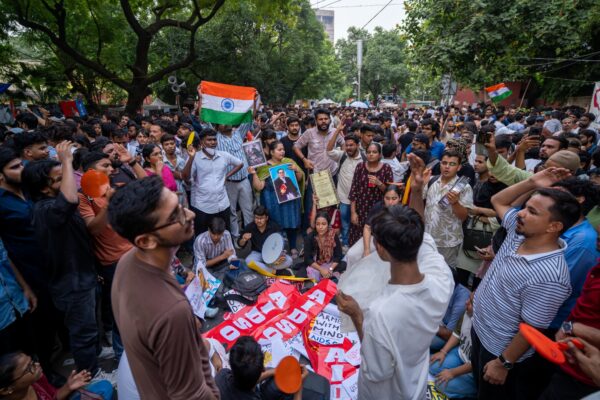
The Cockroach Janata Party’s protests reveal digitally driven mobilisation increasingly influencing governance while established parties retain enduring electoral dominance.
The CJP movement highlights key shifts in how public grievances are organised and expressed in modern India. Wikimedia Commons, CC-BY-SA-3.0,2.5,2.0,1.0.
The Cockroach Janata Party’s protests reveal digitally driven mobilisation increasingly influencing governance while established parties retain enduring electoral dominance.
The structural mechanics of Indian political contestation are undergoing a subtle evolution. While political analysis has historically centered on institutional party machinery and electoral vote-bank consolidation, recent civil agitations in India point to the growing leverage of single-issue pressure movements supported by digital communication networks.
The rapid mobilisation led by the Cockroach Janta Party (CJP) in mid-2026, culminating in the resignation of Union Education Minister Dharmendra Pradhan on July 25, serves as a compelling case study of this shifting dynamic.