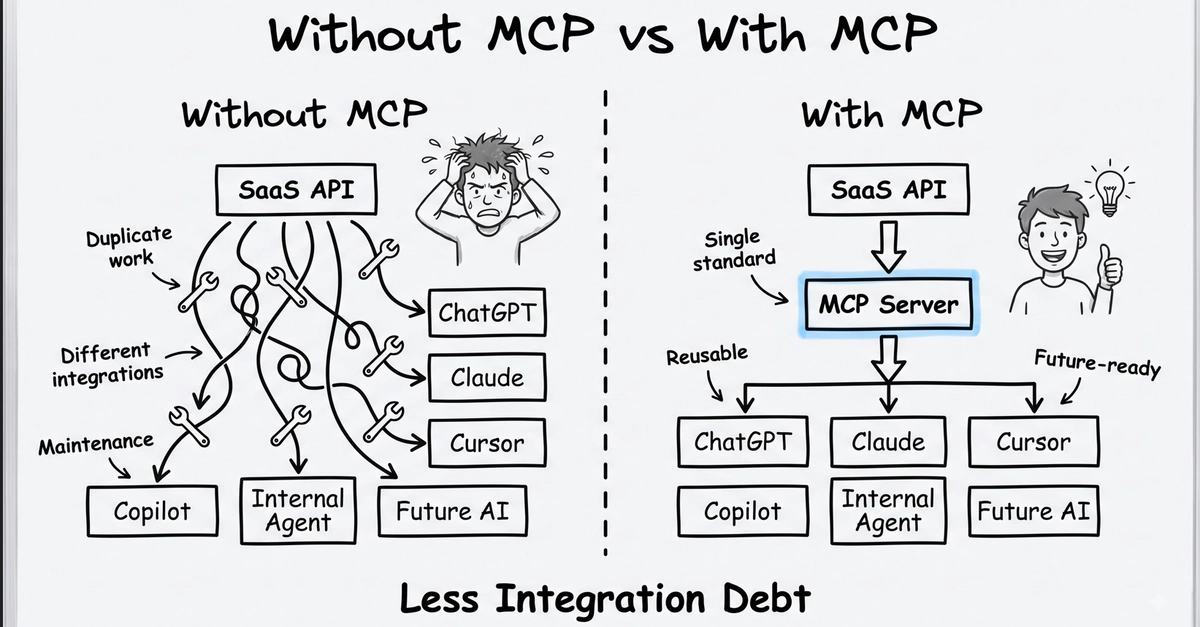
Max Votek, co-founder and managing partner at Customertimes.gettyMarc Benioff did not bury the announcement. "Our API is the UI," he posted in April, introducing Salesforce Headless 360 at TDX 2026. The entire Salesforce platform—Customer 360, Agentforce, Slack—is now accessible via API, MCP tools and CLI. No browser. No dashboard. No human in the loop required.That line sounds like a product release. It isn't. It's a CEO telling the market that the interface his company spent 25 years perfecting is no longer the point.We've been implementing Salesforce for years. We know what that platform was built on: Humans navigating screens. Per-seat subscriptions. Training programs. Salesforce's genius was always making complex CRM feel manageable to the person sitting in front of it.The person is now optional.The Business Model Was The MoatIn the previous piece, I argued that competitive advantage has shifted from applications to context—that what companies own (data, decision logic, workflows) matters more than what they subscribe to. Salesforce Headless 360 is that argument playing out in real time, inside a $300 billion company.The uncomfortable question Benioff just forced into every Salesforce renewal conversation: If an agent does the work, why are you paying per user?This isn't theoretical. The per-seat model made sense when value was delivered through human interaction with an interface. Every salesperson needed a license. But agents don't need licenses the way humans do. They need API calls. And API calls are priced entirely differently—or not at all, depending on the platform.The SI ecosystem feels this first. Entire practices were built around Salesforce implementation: configuring screens, training teams, building custom flows. When agents absorb those workflows, the implementation engagement shrinks. Not because the technology is simpler. But because the human surface area is smaller.Self-Disruption Is The Only Viable StrategyHere's what makes Salesforce's move defensible, even if it's dangerous: The alternative is worse.API-first platforms, built without a legacy UI model, were already routing around Salesforce's perimeter. If Benioff had not opened Headless 360, the market would have eventually moved to platforms that were natively agent-compatible. Salesforce would have found itself a database pretending to be a workflow engine, while lighter and more composable systems took the real work.So, the strategic logic is sound: Cannibalize your own licensing model before someone else does it for you.What Salesforce is betting on is that governance wins. "The Einstein Trust Layer applies to every Agentforce session" and "enforces data masking of PII fields before they reach external LLMs, zero-data-retention agreements with LLM providers, dynamic grounding against your org’s actual data with permission checks, and field-level security compliance." It is "not configurable to 'off.'" That's the value proposition for the enterprise: not the interface but the trust infrastructure underneath it. Agents operating inside a governed, auditable, permission-aware environment are worth paying for. Agents running loose on raw API endpoints are not.We see this at the implementation level. The companies extracting real value from agentic systems are not the ones that deployed the most agents. They're the ones that invested in data quality, permission architecture and workflow governance that make agents reliable rather than just active.The Trojan Horse RiskThere's another consequence of Headless 360 that deserves more attention.By exposing the platform through MCP, APIs and CLI, Salesforce isn't only making Agentforce more useful—it's also making Salesforce accessible to orchestration layers it doesn't control.Tools like Claude Code and OpenAI Codex are becoming operational interfaces for technical teams. Developers already spend hours in these environments—planning, generating code, executing commands—without ever opening traditional enterprise software.Once Salesforce is fully accessible through APIs and CLI, these tools can become the primary interface for Salesforce itself.That’s a subtle but important shift in power. Historically, Salesforce owned both the system of record and the user experience. A sales rep logged into Salesforce. An administrator configured Salesforce. A consultant delivered projects inside Salesforce.In a headless world, Salesforce risks becoming infrastructure while the orchestration layer sits elsewhere.A revenue operations manager may eventually ask Claude Code to analyze pipeline health, update forecasts, create opportunities, trigger workflows and coordinate actions across Salesforce, Slack, Databricks and internal systems. From the user's perspective, Claude Code becomes the operating system. Salesforce becomes one of many connected services.The trend is already visible in software development, where developers increasingly interact with codebases through AI agents rather than traditional IDEs.The strategic question: Can Agentforce become the dominant orchestration layer before external ones become dominant over Salesforce? Headless 360 is both an offensive and defensive move. It expands Salesforce's reach into the agentic world. But it also lowers the barriers for powerful AI-native interfaces to sit between Salesforce and its users.The irony: Opening the platform may be necessary for Salesforce to remain relevant while creating conditions for a new generation of competitors to emerge.The New Pricing ProblemWhat Salesforce has not yet solved, perhaps the hardest part, is what comes after per-seat.Consumption-based pricing works cleanly for compute. An API call is an API call. But agent actions inside enterprise workflows are not fungible. An Agentforce agent that autonomously closes a renewal is not the same as one that updates a field in a contact record. Pricing them identically is absurd; pricing them individually requires a classification framework that doesn't exist yet.This is the real architecture problem facing every incumbent SaaS vendor making the agentic turn: The business model transition is harder than the technical one.What This Means For Everyone ElseSalesforce isn't a cautionary tale. It's a pressure test for the entire category—one that will clarify what the industry has been avoiding: which parts of enterprise software are genuinely infrastructure and which were just expensive habit.The platforms that survive the agentic transition will be the ones that own something agents cannot replicate: governance layers, system-of-record trust, proprietary data schemas that make outputs meaningful. Everything else is negotiating away its own future.Benioff said "no browser required." What he meant was: the competitive advantage was never the screen. We just forgot to mention it sooner.Forbes Technology Council is an invitation-only community for world-class CIOs, CTOs and technology executives. Do I qualify?
What Salesforce's ‘No Browser Required’ Moment Means For Enterprise Software
This is the real architecture problem facing every incumbent SaaS vendor making the agentic turn: The business model transition is harder than the technical one.
994 words~5 min read