Pharmaceutical drugs often rely on chemical compounds found in the body. Take phosphate, a common compound cells use as a chemical switch. In a process called phosphorylation, cells can add a phosphate to a molecule and turn its function on. When the function is no longer needed, cells can remove the phosphate through dephosphorylation, turning the molecule back off.
"While this phosphate switch is necessary for cells, it presents a significant issue for drug design," said Hans Renata, a professor of chemistry at Rice University. "Many drugs, especially ones that are based on biological compounds, have phosphate in their chemical structures. Cells can dephosphorylate those drugs as the body processes them, significantly reducing their efficacy."
The cost barrier of thiophosphate
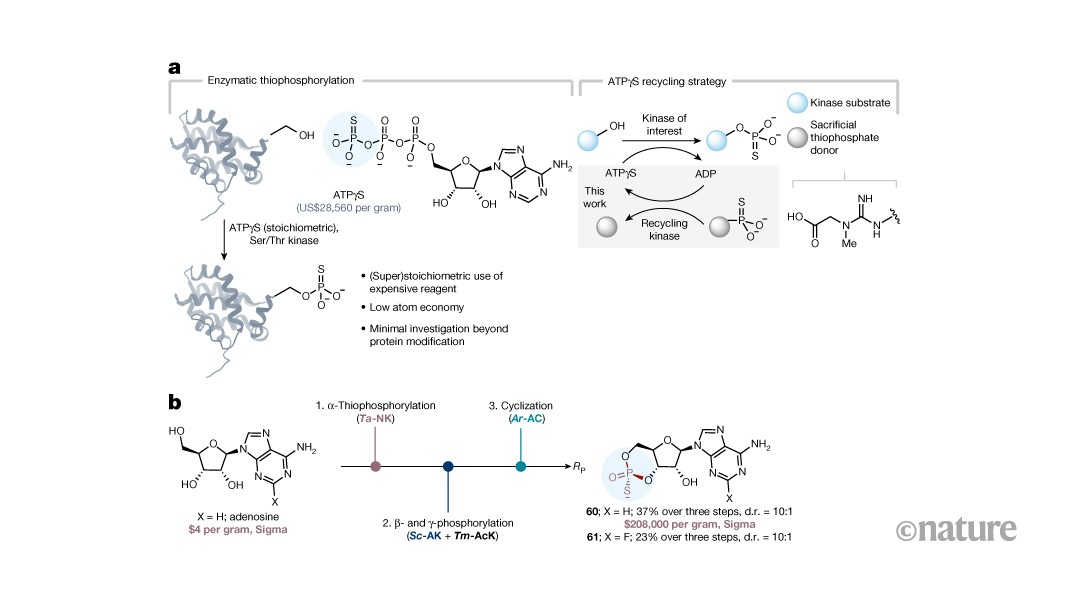
The well-studied solution is prohibitively expensive: thiophosphate, a phosphate analog that acts similarly to phosphate but is much more difficult to remove. Renata's team recently developed a method, published in Nature, that significantly reduces the cost of adding thiophosphate to chemical structures, opening new pathways for drug design.
"To add thiophosphate to a chemical structure like a drug, you need to use a compound called ATPγS, which is a very expensive molecule," said Xiangyu Wu, co-first author and a postdoctoral fellow in the Renata lab. "Every time we wanted to add a thiophosphate, we had to use a new ATPγS, and each ATPγS was extremely expensive—too expensive to use in anything but the smallest amounts."