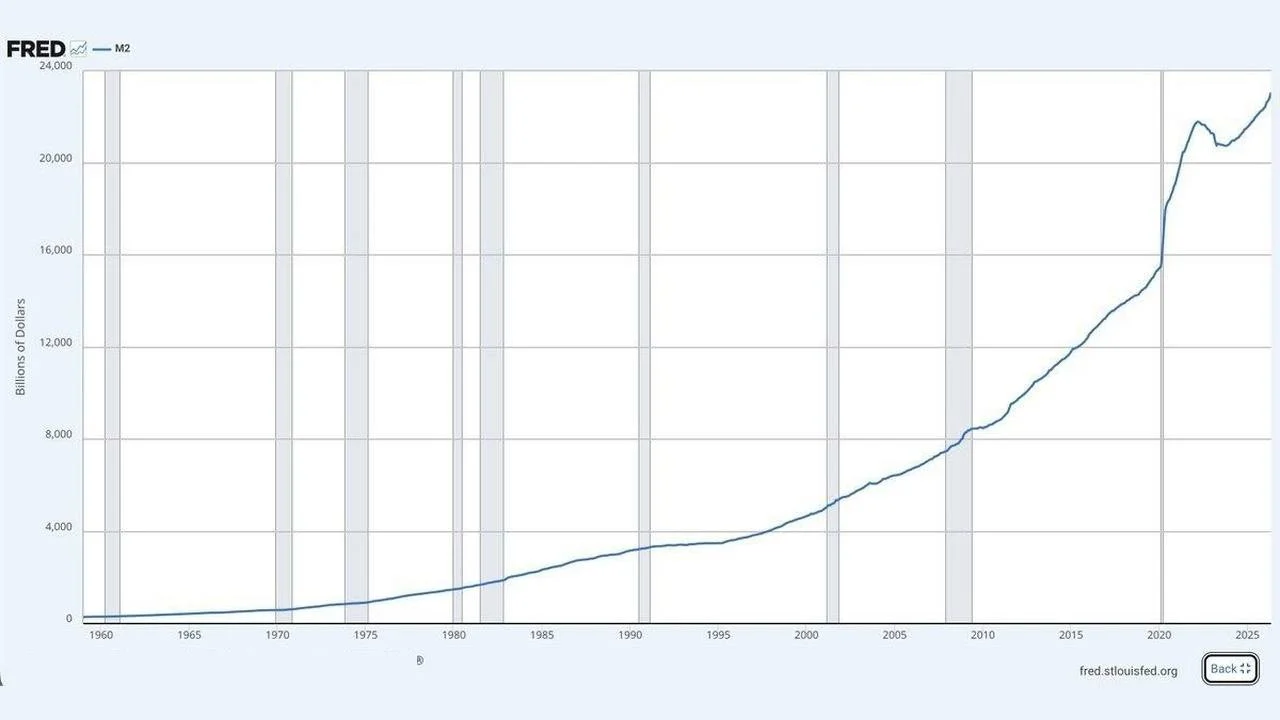
The Federal Reserve is placing renewed emphasis on the M2 money supply as a key lens for evaluating inflation, marking a shift in how the central bank reads economic conditions.
The shift surfaced in the Fed’s July 2026 Monetary Policy Report, which explicitly discussed M2 trends in relation to inflation and liquidity metrics. US M2 money supply has reached approximately $23.16 trillion, with year-over-year growth running in the 4-5% range. The report noted that this moderate growth rate is similar to patterns observed during the 2010s, a period generally characterized by subdued inflation.
Why money supply matters again
For most of the last four decades, the Fed treated interest rates as its primary steering wheel. Money supply metrics like M2, which captures cash, checking deposits, savings accounts, and other near-money instruments, were treated more like a rearview mirror than a dashboard gauge. Historically, the Federal Reserve paid close attention to money supply aggregates like M2, especially during the 1970s and early 1980s, but this focus diminished as the relationship between money supply growth and inflation weakened.
The COVID-19 pandemic saw an unprecedented surge in M2 as the federal response flooded the economy with liquidity, ultimately contributing to inflationary pressures. During the pandemic stimulus era, M2 growth surged well into double digits before contracting as the Fed tightened. The current 4-5% annual M2 growth rate has since settled into a range the Fed considers moderate and broadly consistent with its inflation objectives.