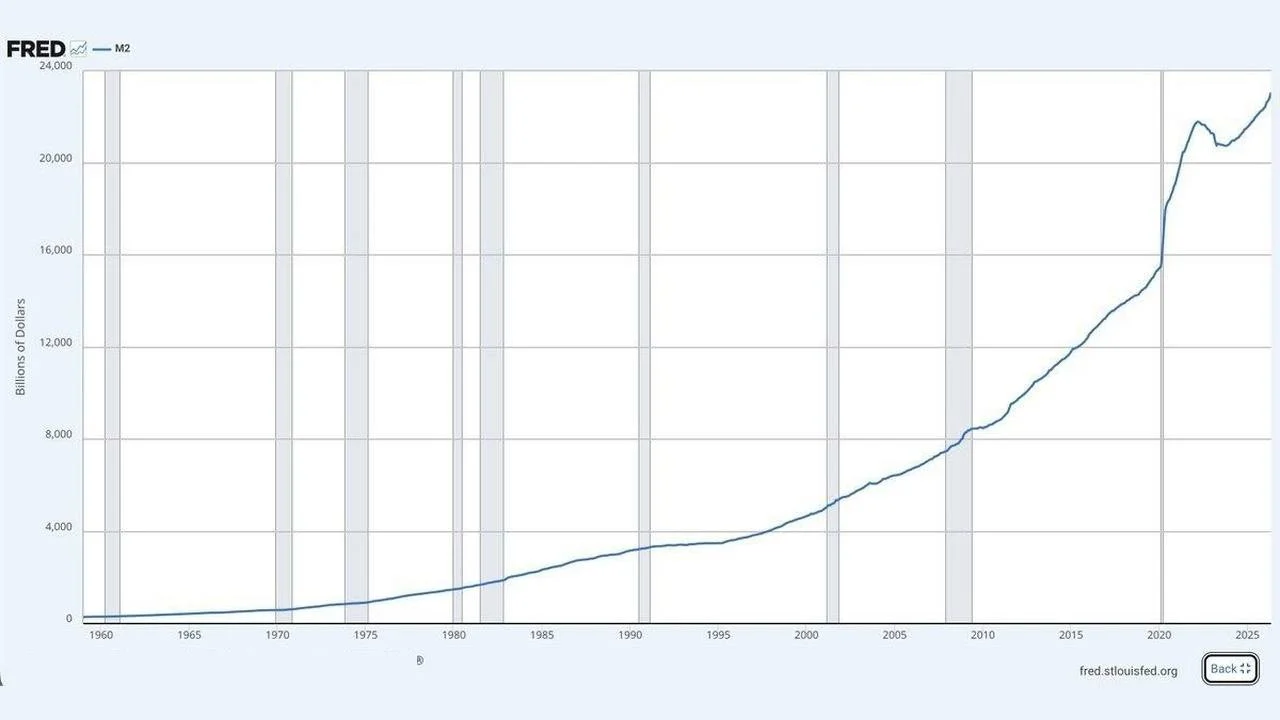
The U.S. money supply has increased at the fastest rate in five years, marking a significant shift from previous monetary contraction trends. As reported by @Kalshi, the M2 money supply reached a record $23.05 trillion in May 2026, expanding by 5.58% year-over-year. This growth indicates a renewed phase of liquidity expansion, driven largely by a substantial rise in demand deposits and money market funds. While the growth rate remains below the long-term average observed from 2000–2026, it points to potential inflationary pressures that could influence the Federal Reserve’s monetary policy decisions.
The acceleration in money supply growth is consistent with market concerns about future inflation, which may prompt the Federal Reserve to consider rate cuts. Currently, prediction markets show a 78% probability that no Fed rate cuts will occur in 2026. Despite this, the increased money supply could shift market expectations if inflation begins to rise, potentially altering the outlook for interest rate adjustments.
Market participants are closely monitoring these developments, as the rapid increase in money supply may influence the Federal Reserve’s approach to managing economic growth and inflation. The implications of this growth on interest rates will be a key focus for financial markets in the coming months.