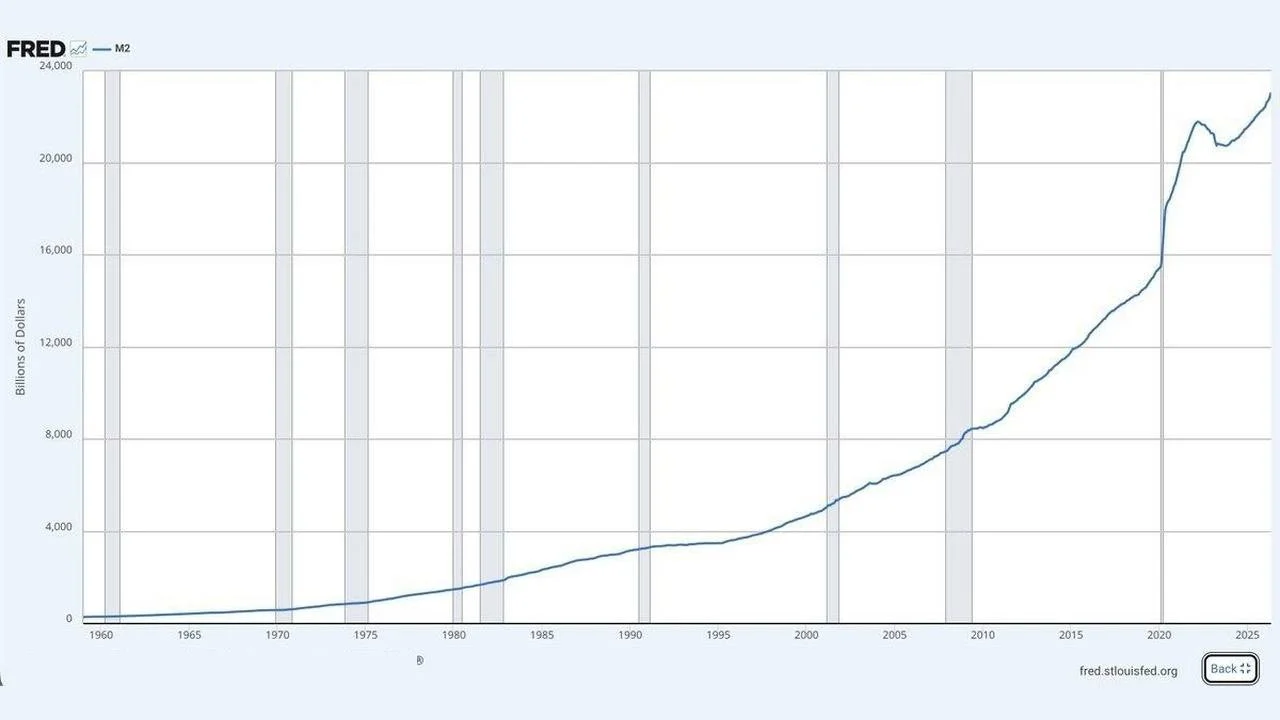
The US money supply has grown by roughly $6.4 to $7.1 trillion since March 2020, and the Federal Reserve’s balance sheet peaked at nearly $9 trillion in May 2022.
Under Jerome Powell’s leadership, which began in February 2018, the Fed deployed aggressive liquidity measures during COVID-19. The side effect was an inflationary wave that reshaped how investors, policymakers, and crypto advocates think about money itself.
The numbers behind the expansion
M2, the broadest commonly cited measure of money circulating in the US economy, hit a record above $22.6 trillion by February 2026. By April 2026, that figure climbed further to $22.8 trillion.
The Fed’s balance sheet has come down from that $9 trillion peak. Quantitative tightening brought the balance sheet to approximately $6.7 trillion by mid-2026.