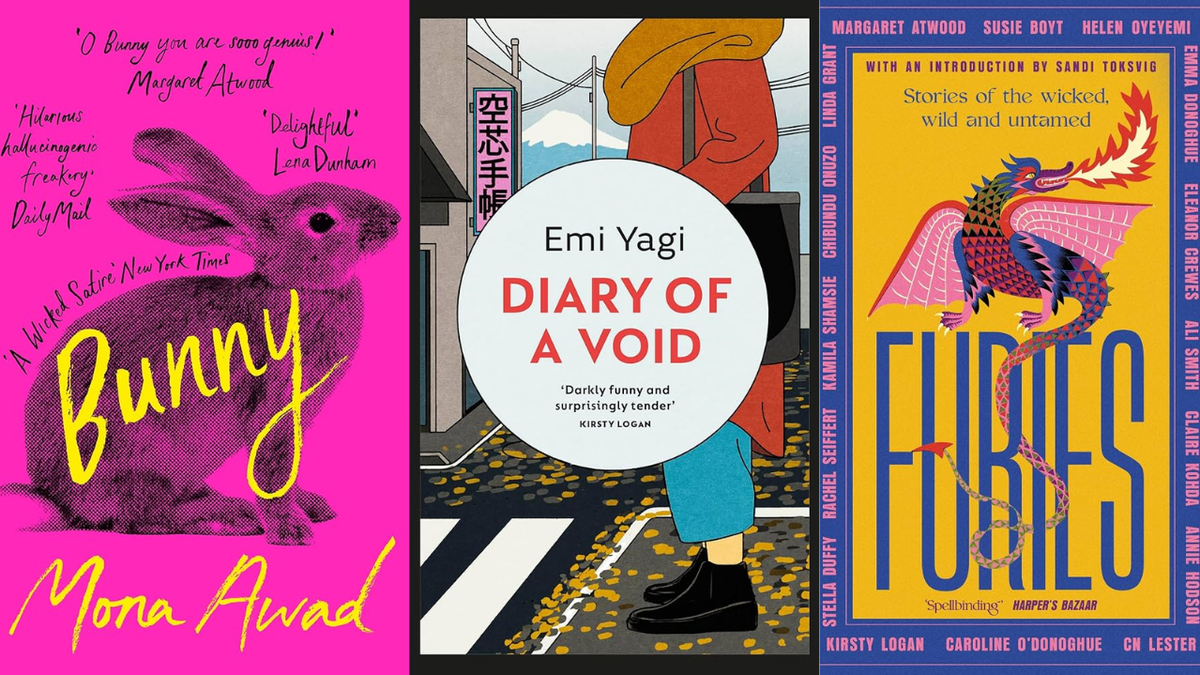
(This story is part of The Hindu on Books newsletter that comes to you with book reviews, reading recommendations, interviews with authors and more. Subscribe here.)A few years ago, I walked into the bookshop Foyles in London and ended up spending half a day there. We don’t really have a thriving bookshop culture in India, except in pockets, so being surrounded by several floors of books felt like stepping into Disneyland for a bibliophile.I browsed for new writers and titles — which, for me, was nearly the entire shop — but to be honest, it was the covers that made me crouch painfully on the floor for hours. I photographed them obsessively: the hot-pink jacket of Mona Awad’s Bunny, the graphic illustration on Emi Yagi’s Diary of a Void, the vibrant yellow and purple of Furies, the white elegance of Francine Toon’s gothic thriller Pine, the passionate embrace of black figures against a light pink background on Elfriede Jelinek’s The Piano Teacher. I kept admiring them. But books in the U.K. are frightfully expensive, so I finally bought only two. The photos of the rest remain on my phone.Our fascination with book covers, as we know them today, is relatively recent. For centuries, people valued books only for the knowledge they contained; appearances did not matter. Only rare, sacred, or valuable books were carefully presented: they were bound by hand in leather or silk, with luxury editions embellished with gold and silver thread, engraved metalwork, and even precious stones.Even after Gutenberg’s printing press made books far more widely available, they were sold as stitched pages wrapped in temporary paper. If you bought a book and wanted it to be more firm and stiff, you could go to a binder and choose a cover that suited your taste.It was only in the 19th century, with advances in colour printing, that publishers realised the importance of the book cover. It was no longer just a protective jacket that kept the book from crumbling, but a clever tool to promote and sell books. In the 20th and 21st centuries, leaps in technology pushed book cover art into new and exciting territory.Today, when we look at a cover, we can guess whether the book is a crime novel (moody landscapes) or academic (minimalist cover) or literary fiction (abstract art). Many of us may own more than one edition of our favourite books simply because a different cover caught our eye. We may have bought books for their aesthetic value and never got around to reading them. And for millennials and Gen Z readers who spend much of their lives documenting everything on their phones, the most beautiful books often find a place of pride on social media. In India, the independent publishing house, Seagull Books, is known for their erudite collection and exquisite covers. Founded by Naveen Kishore in 1982, Seagull Books began with the modest ambition of bringing Indian playwrights to English-language readers through translation. Over the decades, it has evolved into one of the world’s most distinctive literary publishers, with a catalogue spanning award-winning fiction, philosophy, theatre, and criticism. Its list includes Peter Handke, Judith Butler, Ngũgĩ wa Thiong’o, Maryse Condé, László Krasznahorkai, Mo Yan, Alexander Kluge, Thomas Bernhard, and Imre Kertész.An exhibition in Chennai’s Dakshina Chitra, Art of the Book, traces Seagull’s journey through its iconic covers for books by writers including Mahasweta Devi, Romila Thapar, Satish Alekar, Nabarun Bhattacharya, and Dominique Noguez. In this piece by Priyamedha Dutta, Sunandini Banerjee talks about the art of designing book covers, and the increasing pressure to create something unforgettable in a world that thinks in images and consumes them endlessly. Do visit the exhibition if you’re in Chennai or visit the Seagull Books Store if you’re in Kolkata.Books of the weekIn an interview with Devina Dutt, Gulzar speaks about his new book, Aamchi Mumbai (My Mumbai), translated by Rakshanda Jalil and published by HarperCollins. “This city is like an elder brother. It keeps you close, handles things for you with the occasional box on the ears, but it doesn’t let you go,” he tells Dutt. The book comprising 25 short stories and 36 poems is a tribute to Mumbai from one of its most well-known residents.In non-fiction, we feature an excerpt from my colleague Sobhana Nair’s book, Housing the Republic: A Biography of the Indian Parliament (Bloomsbury Publishing). The book traces the lived history of India’s Parliament House — from the approval of its designs in 1919 to the construction of the new Parliament House in 2023. The excerpt explores Mohammed Ali Jinnah’s proposal to convene Pakistan’s Constituent Assembly in Delhi and the opposition it faced from Jawaharlal Nehru, Vallabhbhai Patel, and Rajendra Prasad.We also have Mehul Devkala’s review of Homes without Windows, a collection of 11 autobiographical essays by Dalit activist Chandu Maheria, translated by Hemang Ashwinkumar. Maheria recounts his growing years spent eating leftovers, using filthy toilets, and repeatedly encountering questions about his caste. Devkala says the book offers an intimate account of caste, poverty, and survival in urban Gujarat but is undermined by an embellished translation. Veteran Kathak dancer Shovana Narayan’s new book, Speaking Sculptures: Karanas in Kathak (Shubhi Publications), views temple sculptures as repositories of movement rather than merely decorative art. She explains that karanas are not static poses but moments from continuous movements, with sculptures capturing only a single frame that dancers revive through performance. Narayan explores whether the karanas described in Bharata’s Natyashastra continue to survive in contemporary Kathak. “The book is technical and not a casual coffee-table read for a layman” writes Shailaja Tripathi. “It emphasises that dance is not preserved only through gurus and performers but also through stone, bronze and terracotta.”Maayan is a Kerala-based fantasy comic series that combines regional folklore, history, martial arts, and magic. Set in 15th Century Calicut, it follows Raman, a royal poet’s apprentice, and Maari, a Kalari warrior from a mystical group of wizards called Maayans, as they uncover hidden truths about their world. Created by Kochi studio Carmond Infinity, the series was launched at Kochi Comic Con and has sold over 2,000 copies. The creators aim to bring Kerala’s folklore to a wider audience. Read Nainu Oomen’s piece here.Taste is an experimental, limited-edition publication by Juggernaut Books. In a video on Instagram, publisher Chiki Sarkar said the “exquisitely produced” book costs Rs.15,000. Juggernaut published only 500 copies of which 200 were given to influencers and 300 went on sale across four-five bookshops across the country. Edited by journalist Lakshmi Chaudhry and designed by graphic designer Kriti Monga, this “part art object, part literary magazine” explores the idea of taste through written and visual essays that span music, food, travel, literature, culture, spaces, history, fashion and identity. In this piece, Smitha Menon calls the book a “beauty,” appealing to both the cerebral and the sensory.SpotlightAs you may know by now, our Bibliography section features essays that spotlight at least three books around a common thread. They may explore a current issue (Gaza, Iran, AI), a literary trend (climate fiction), or a theme that runs across multiple works (new-age relationships, digital alienation). In her piece, Lopa Ghosh writes about drowning as a recurring literary obsession and an overlooked human catastrophe.NightstandI just finished reading Mieko Kawakami’s latest novel, Sisters in Yellow. The author of Heaven — brilliant! — and of the widely acclaimed Breasts and Eggs is back with a heart-wrenching story about poverty, survival, friendship, and betrayal in Tokyo. While it didn’t quite reach the heights of Heaven for me, Sisters in Yellow is engaging enough, and its ending devastating. A review will be out soon.Reading mattersHyphen, an initiative of Bahuvachana Trust, is a new biannual literary journal dedicated exclusively to translations from Indian languages into English. It was launched last week, with Deepa Ganesh as editor-in-chief. Nalme Nachiyar speaks to Kannada writer and founder of Hyphen, Vivek Shanbhag, about the inspiration behind the name and the challenges of making translation the journal’s sole focus.The 10th edition of the Bengaluru Poetry Festival featuring Devdutt Pattanaik, Ramya, Tishani Doshi, Mahesh Garg, Prakash Raj and others will be held on August 1 and 2 at Indiranagar Sangeetha Sabha. In this piece by Preeti Zachariah, co-founder of the festival, Subodh Sankar, says this year’s edition will rely “heavily on the beauty of Indian languages.”And that’s all from me. Do write to me with suggestions, comments, and feedback to radhika.s@thehindu.co.in. Have a happy reading week!
The Hindu on Books newsletter: Appearance matters
The Hindu on Books newsletter: Appearance matters
1,401 words~6 min read